
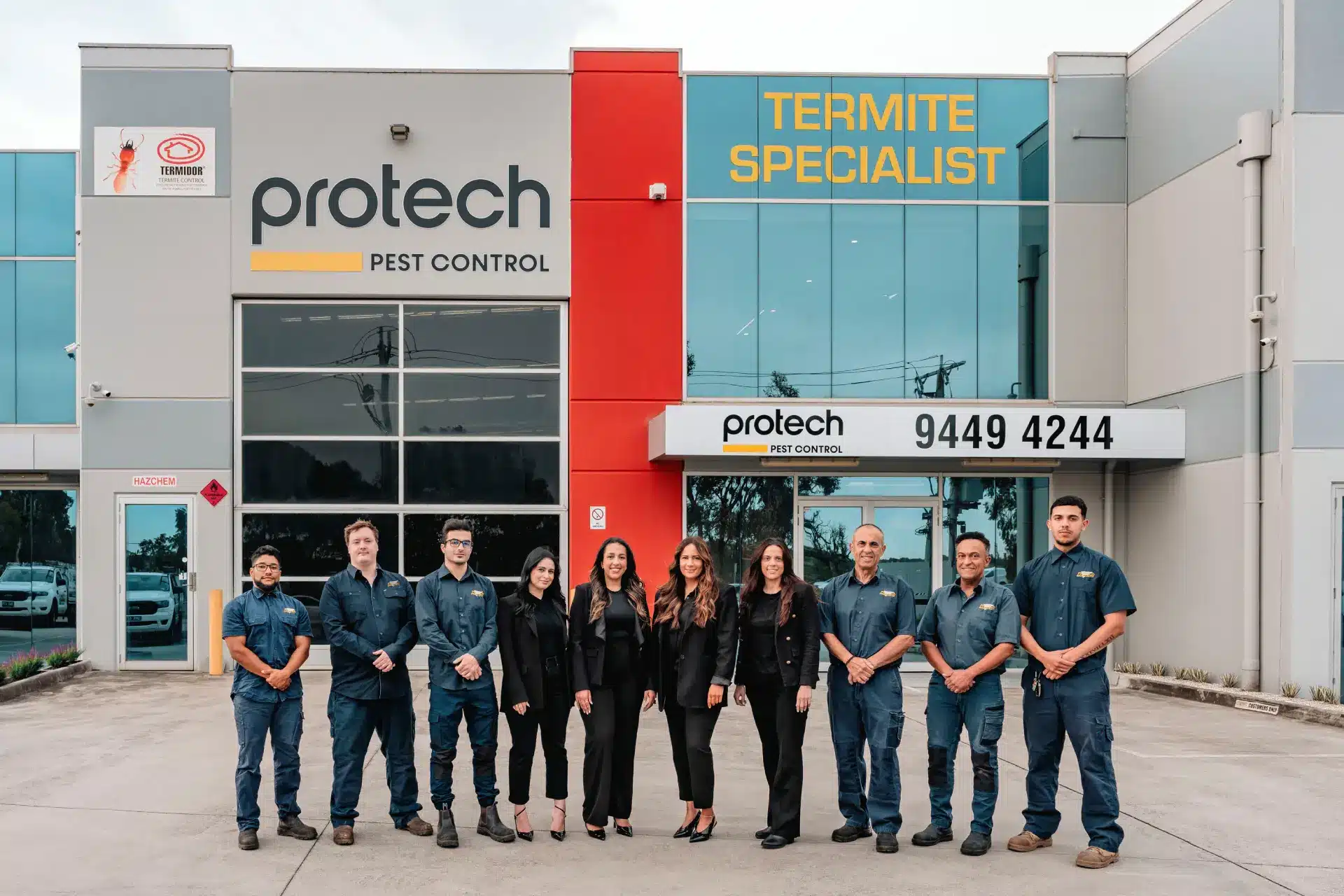
Commercial Pest Control Melbourne
HACCP-aligned, fully documented commercial pest management for Melbourne businesses — discreet, scheduled and audit-ready, from a local team trusted since 2001.
HACCP-Aligned Commercial Pest Control Across Melbourne
For a commercial operator, a single pest sighting carries consequences a household never faces — a failed audit, a council notice, damaged reputation and, in food and healthcare settings, a genuine safety risk. Protech delivers HACCP-aligned, fully documented commercial pest management that keeps your premises protected and inspection-ready year-round.
We’ve protected Melbourne businesses since 2001, backed by more than 40 years of combined industry experience and accreditation with HACCP, AEPMA and NPMA. Our programs are built around your compliance obligations: every visit produces audit-ready paperwork, every treatment is recorded, and pest-activity trends are tracked over time so problems are caught before they become breaches.
Discretion is part of the job in commercial settings, so we work after hours, before opening or during planned shutdowns, use low-odour targeted treatments around food-handling areas, and keep our work out of public view. Rated 4.8 stars from 411 Google reviews and operating from our Campbellfield HQ, Protech is the pest-management partner Melbourne businesses rely on to stay compliant and trading.
What Commercial Pest Control in Melbourne Actually Involves
Commercial pest control is a different discipline from a residential treatment, and the difference is worth understanding before you engage anyone. A home treatment solves a problem that has already appeared. A commercial program is designed to stop the problem appearing at all, and to prove continuously that it has not.
That proof obligation shapes everything. A food business is answerable to an auditor, a supermarket supplier program or a council environmental health officer. A healthcare facility answers to accreditation standards. A school answers to parents and a department. In each case the question is the same at inspection time: show me your pest management records for the last twelve months. A program that treated pests competently but documented nothing has failed the test that actually gets applied.
So a commercial program has four working parts. There is monitoring — bait stations, insect light traps and inspection points placed where pest pressure enters the site, checked on a schedule. There is treatment, applied to the specific risks the site carries. There is documentation, produced at every visit and structured so an auditor can follow it. And there is trend analysis over time, which is what turns a series of visits into an argument that the site is under control.
The fourth part is the one most often missing from a cheap contract, and it is the one that saves a business at audit. A single clean report proves one day. A twelve-month trend log showing declining activity at every monitoring point proves a system.
Industries We Service
Different sectors carry very different pest risks and compliance frameworks. We tailor each program to the standards your industry is held to, so the servicing schedule and the paperwork both match what you will be asked for:
- Hospitality & food venues — restaurants, cafes, pubs, hotels, retail and commercial kitchens, where a clean pest-control record is essential for food-safety compliance and reputation.
- Restaurants & cafés — kitchens, cafés and food businesses needing food-safe, HACCP-aligned, audit-ready pest management scheduled around service.
- Healthcare facilities — hospitals, clinics and medical centres, where hygiene standards are strict and treatments must be planned around vulnerable patients and clinical areas.
- Aged care & retirement living — facilities where treatments are planned around residents, documented for accreditation and delivered discreetly.
- Schools & childcare centres — education and early-learning settings where child safety and discreet, out-of-hours servicing are non-negotiable.
- Offices & workplaces — corporate floors, tenancies and workplaces needing discreet, out-of-hours pest management that keeps business running.
- Factories, warehouses & industrial sites — manufacturing plants, warehousing and distribution centres needing perimeter protection and stored-goods integrity.
- Dairy & food processing — processing facilities operating under rigorous food-safety and traceability standards.
- Farming & agriculture — farms, grain stores and rural operations managing rodent and stored-product pest pressure across large sites.
- Strata & body corporate — owners corporations and strata managers needing building-wide programs across common property, with reporting a committee can table.
- Real estate & property managers — agencies and property managers needing prompt between-tenancy and end-of-lease treatments with clear owner and tenant reporting.
- Facilities & asset management — FM companies and asset managers running multi-site portfolios against service levels and reporting obligations.
- Government buildings — council offices, public facilities and civic sites with formal procurement and reporting requirements.
Operate in a sector we haven’t listed? We almost certainly cover it — get in touch and we’ll build a program around your specific compliance needs. For formal procurement, our tenders and contracts page sets out what we supply with a submission.
Common Commercial Pests We Manage
Commercial premises attract pests that thrive on food, warmth, waste and shelter. Left unmanaged, they contaminate stock, trigger audit failures and spread disease. Our programs target the pests that put Melbourne businesses at risk:
- Cockroaches — the number-one threat to commercial kitchens and food businesses; German cockroaches breed fast and are a leading cause of failed food-safety inspections.
- Rodents (rats & mice) — they gnaw wiring and packaging, contaminate stock and leave droppings that fail any audit; a sighting in a food premises can force an immediate shutdown.
- Flies — a contamination and nuisance risk in kitchens, food processing and waste areas; we combine treatment with fly-control units and breeding-source management.
- Birds — pigeons and other birds foul rooftops, loading docks and signage, creating slip hazards and health risks; we provide humane proofing, netting and deterrents.
- Stored-product pests — beetles, weevils and moths that infest flour, grain and dry goods in warehouses, mills and food manufacturing, threatening entire batches.
- Ants — a persistent problem in staff kitchens, break rooms and any area where food residue accumulates, and a contamination risk in food handling.
- Spiders — a webbing and presentation problem in stairwells, car parks, loading areas and external walkways, with redbacks a genuine safety concern in sheltered outdoor spots.
We also manage wasps, fleas and seasonal pests as part of an integrated program, so your site is covered against every threat under one agreement.
Integrated Pest Management in a Commercial Setting
Almost every pest company will tell you it practises integrated pest management. It is worth setting out what that means in practice, because on a commercial site the difference between the phrase and the discipline is measurable.
IPM works as a hierarchy, and chemical treatment sits near the bottom of it. The first question on any site is exclusion: where are pests physically getting in, and can that be closed? A dock seal, a door sweep, a sealed service penetration or a repaired vent removes a pest route permanently, and it keeps working with no reapplication. The second is sanitation and site conditions: what on the premises is feeding or sheltering pests? Waste handling, drainage, spillage in equipment voids, stock rotation and vegetation against the building all belong here.
Third comes monitoring, which is what converts a program from guesswork into evidence. Bait stations, insect light traps and inspection points are placed where pressure enters, numbered, mapped and checked on the schedule. They tell you where activity is building before anyone sees a pest in a food-handling area.
Only then does targeted treatment apply, aimed at the specific pest and the specific harbourage the monitoring identified. For a food or healthcare site that ordering is a compliance requirement in itself, because it minimises what is applied and where. It is also why an IPM program looks less dramatic than a blanket spray and produces a better result: fewer pests get in, less product is used, and the record shows why.
Commercial Pest Pressure Through the Melbourne Year
Pest pressure on a Melbourne commercial site follows a reasonably predictable annual pattern, and a scheduled program is built to anticipate it.
- Spring (September to November) — activity climbs sharply as temperatures rise. Ant and spider numbers build around external walls and entry points, wasp nests establish, and cockroach breeding accelerates in warm equipment voids. This is when a program earns its keep, because treating the build-up is far easier than treating the peak.
- Summer (December to February) — the peak. Fly pressure around waste, prep and loading areas is at its highest, cockroach populations are at their largest, and stored-product pests move fastest in warm dry goods. Food premises carry the most risk in these months, and it coincides with the busiest trading period for hospitality.
- Autumn (March to May) — rodent pressure rises as rats and mice move indoors ahead of the cold, entering through docks, roof lines and service penetrations. Proofing work done earlier pays off here. Wandering spiders also turn up indoors as males search for mates.
- Winter (June to August) — visible activity drops, which is the season that misleads people. Rodents are established inside buildings and simply out of sight, cockroaches persist in heated plant and kitchen voids, and populations that are left alone over winter emerge into spring with a head start.
A year-round program handles all four, and the trend data across seasons is what tells you whether the site is genuinely improving. A site that shows the same spring spike every year has a structural problem the treatments are covering up; a site whose spring spike gets smaller each year is being fixed.
The Documentation an Auditor Actually Asks For
Compliance is where most commercial pest contracts are judged, so it is worth being specific about what arrives after every visit. A Protech commercial program produces:
- Service reports for every attendance, recording what was inspected, what was found and what was done.
- Treatment records naming the products applied, where, at what rate, and by which licensed technician.
- Safety data sheets for every product used on your site, kept current so the pack is complete when someone asks.
- Site plans showing the location of every bait station, monitoring point and fly-control unit, so an auditor can walk the site against the map.
- Pest-activity trend logs that show what has been recorded at each monitoring point over time, which is the evidence that the program is working.
- Chemical registers covering what is held and applied on site.
That pack is structured for the frameworks Melbourne businesses are actually audited against — HACCP, BRC, SQF, Woolworths and Coles supplier programs, and local-council environmental health inspections. Our reporting page shows what a client receives between visits, and the HACCP pest control page covers the food-safety requirements in detail.
Where activity is found, the corrective action is documented alongside it: what was found, what was done about it, and what changed at the site to stop it recurring. An auditor reading a record of a pest problem that was identified, treated and closed out sees a system working. A record with no entries at all invites the question of whether anyone was looking.
How Often Should a Commercial Site Be Serviced?
Service frequency is the single most argued-about line in a commercial pest agreement, and it should be set by the risk the site carries. As a general guide across the Melbourne sites we service:
- Weekly to fortnightly — high-risk food processing, commercial kitchens under heavy load, and sites with an active issue being brought under control.
- Monthly — most restaurants, cafes, food manufacturers, aged care and healthcare facilities, where audit requirements and contamination risk are both high.
- Quarterly — offices, retail tenancies, schools, strata common property and lower-risk commercial premises with no food handling.
- Annually, with monitoring between — some warehousing and industrial sites where monitoring equipment carries the load and attendance is scheduled around it.
Those bands are a starting point. The frequency that ends up in your agreement comes from the inspection: what the building is made of and how it is sealed, what is stored and handled, what the surrounding area contributes in pest pressure, what your auditor expects to see, and what the trend data shows once the program is running.
Frequency is reviewed as the site changes. A site that has been clean through four consecutive quarters is a different risk from the same site the month a neighbouring building is demolished, and the schedule should move with that.
Annual Programs and Service Agreements
Most Melbourne commercial sites are best served by an ongoing agreement built around a scheduled program, and it is worth understanding what that agreement should contain before you sign one with anybody.
A Protech commercial agreement sets out the scope — which pests are covered and which areas of the site are included. It sets the frequency of scheduled attendance and what each visit involves. It states the response time for reactive callouts between scheduled services, and confirms that those callouts are part of the agreement. It lists the reporting you receive and where it is kept. And it records the guarantee terms that apply, matched to the servicing frequency.
That last point is worth being plain about. Commercial pest management carries the guarantee terms set out in your service agreement, matched to the servicing frequency we agree, because a site attended on a schedule sits in a different position from a one-off household treatment. The full schedule of guarantee periods across all our treatments is published on our guarantee page so you can see exactly what applies to each service.
For multi-site operators the agreement covers the whole portfolio: one point of contact, one consolidated reporting stream and consistent servicing standards across every location, so audit paperwork is uniform wherever the auditor turns up. Our facilities and asset management page covers how that works for FM companies and property portfolios.
Why Melbourne Businesses Choose Protech
Audit-ready compliance documentation — every visit produces HACCP-aligned service reports, treatment records, safety data sheets and pest-trend logs that drop straight into your audit folder. When the inspector arrives, your paperwork is already in order.
Scheduled servicing you can rely on — we set a service frequency matched to your risk and compliance requirements, then attend on schedule, every time. No chasing, no gaps, no surprises at audit.
24/7 emergency response — if pests appear between visits or you’re facing an imminent inspection, our reactive callouts and round-the-clock emergency attendance get the problem treated and documented fast.
One provider for multi-site operators — franchise groups, retail chains, school networks and aged-care providers get a single point of contact, consolidated reporting and consistent servicing across every Melbourne location.
Accredited, licensed and insured — HACCP, NPMA and AEPMA accreditation, licensed technicians applying APVMA-registered products, and full insurance. For a tender submission or an insurer’s question, that documentation is ready to go.
Local and proven — a genuinely Melbourne-based team operating from Campbellfield since 2001, named Pest Manager of the Year in 2011, and rated 4.8 stars from 411 Google reviews.
How a Commercial Program Works
Every commercial engagement starts with a thorough site assessment. We walk your premises, identify entry points, harbourage and high-risk zones, and review your compliance obligations — whether that’s HACCP, a supermarket supplier program or a council EHO requirement.
From there we build a tailored program: the right treatments and monitoring stations in the right places, a service frequency matched to your risk, and a documentation pack structured for your auditors. Each visit is logged, trends are tracked, and recommendations are made when the site or season changes the risk picture.
Once the program is running, the working pattern is steady. Scheduled attendance happens at the agreed frequency, usually outside trading hours. Monitoring points are checked and recorded every visit. Anything found is treated and documented, with the corrective action recorded against it. Trend data accumulates, and where it shows a recurring pressure point we come back to you with what the site needs structurally, whether that is a door seal, a waste-handling change or a proofing job.
The result is a protected, inspection-ready premises and a single accountable partner, so you can concentrate on running your business while the pest management runs to schedule.
What Commercial Pest Control Costs in Melbourne
Commercial work is quoted per site. There is no useful list price for it, because the scope varies more than any other service we offer: a single-tenancy office and a multi-building food-processing plant share almost nothing in terms of area, risk, frequency or equipment.
The figure is built from the size and layout of the premises, the industry and the compliance framework it operates under, the service frequency your risk profile calls for, the monitoring equipment the site needs, and whether attendance is required outside trading hours. We inspect the site, set the scope with you, and give you a fixed quoted price before any work begins.
The one-off and residential services a commercial client also buys — a termite inspection, a pre-purchase building and pest inspection, an end-of-lease treatment — carry published starting prices, and the full list is on our pest control prices page. Requesting a quote is free and carries no obligation.
Changing Pest Control Providers
A good deal of our commercial work comes from businesses moving off an agreement that stopped working, and the changeover is more straightforward than most operators expect.
We inspect the site and review what is already installed, because serviceable monitoring equipment does not need replacing simply because the provider changed. We look at the existing documentation to see what the previous program covered and, more usefully, what it did not — gaps in the record are the thing an auditor finds. We then set the new schedule so there is no interruption in servicing or in the audit trail, which is what protects you if an inspection falls during the transition.
If you are weighing up a change, the useful questions to ask any pest contractor are these: what documentation will I receive after each visit, can you produce twelve months of trend data for my site, what is your response time for a callout between services, are your technicians licensed for the products they apply, and what exactly does the guarantee cover? We are happy to answer all five in writing.
Commercial Pest Control FAQs
Can Protech provide the documentation we need for HACCP and food-safety audits?
Yes. Every commercial service is fully documented — service reports, treatment records, chemical safety data sheets, site plans showing bait-station locations, and a pest-activity trend log. The paperwork is HACCP-aligned and structured so it sits straight into your audit folder for HACCP, BRC, SQF, Woolworths/Coles supplier programs or your local-council EHO inspection. We’ve supported Melbourne food businesses through these audits for over 20 years, and our HACCP pest control page sets out exactly what an auditor receives.
How often should our premises be serviced?
It depends on your industry, risk profile and audit requirements. Low-risk offices and retail are often quarterly; cafes, restaurants and food manufacturers are typically monthly or fortnightly; high-risk food-processing and healthcare sites may need weekly attendance. We assess your site, recommend a frequency that satisfies your compliance obligations, and lock it into a scheduled servicing plan so nothing is missed.
What does commercial pest control cost in Melbourne?
Commercial work is quoted per site, because a single-tenancy office and a multi-building food-processing plant have almost nothing in common in terms of scope. The figure depends on the size and layout of the premises, the industry and its compliance requirements, the service frequency your risk profile calls for, and the monitoring equipment the site needs. We give you a fixed quoted price before any work begins. Our published pest control prices cover the residential and one-off services a commercial client also buys, such as a termite inspection.
Will treatments disrupt our trading or production?
No — minimising disruption is built into how we work. We attend after hours, before opening or during planned shutdowns, use low-odour and targeted products around food-handling areas, and work discreetly so customers and staff aren’t affected. Our vehicles carry Protech signage. Where a venue needs the visit to go unseen, we schedule attendance for a time when no customers are present and park in an area agreed with you, keeping the work out of public view.
Can you handle multiple sites across Melbourne under one contract?
Yes. Multi-site operators — franchise groups, aged-care providers, school networks, retail chains and manufacturers — get a single point of contact, one consolidated reporting portal and consistent servicing across every location. That means uniform paperwork at audit time and one provider accountable for the whole footprint, with no need to juggle separate contractors per site.
What happens if pests appear between scheduled visits?
Call us — reactive callouts between scheduled services are part of a commercial agreement, and we run 24/7 emergency attendance for situations that can’t wait, such as a rodent sighting in a kitchen before service or a cockroach issue flagged during a health inspection. We respond quickly, treat the problem, document the callout and adjust the program if a recurring risk is identified.
What guarantee applies to commercial work?
Commercial pest management carries the guarantee terms set out in your service agreement, matched to the service frequency we agree. That structure suits ongoing programs better than a fixed re-treatment window, because a scheduled site is being attended continuously. The underlying treatments carry their own periods, which are published in full on our guarantee page — bird proofing and netting, for instance, carries workmanship cover for six years and product cover for up to ten, subject to annual inspections.
Are you accredited, licensed and insured?
Yes to all three. Protech holds HACCP, NPMA and AEPMA accreditation, our technicians are licensed to apply the products they use, and the business is fully insured. For a commercial client that combination is the difference between a guarantee that is a marketing line and one you can rely on at audit, in a tender submission or in front of an insurer.
Do you work outside business hours?
Routinely. Most of our commercial servicing happens before opening, after close or during planned shutdowns, because that is when a site can be worked properly without disrupting trade or production. Out-of-hours attendance is built into the service agreement, so it is scheduled in advance and costed into the agreement.
Can you take over an existing pest control contract?
Yes, and it is a common way commercial clients come to us. We inspect the site, review the existing monitoring equipment and documentation, identify anything the previous program left uncovered, and set up the new schedule so there is no gap in servicing or in the audit record. Where equipment is serviceable we work with what is already installed.
What pests are covered by a commercial agreement?
A commercial program is written around the pests your site is genuinely at risk from, which is why it starts with an inspection. Most agreements cover cockroaches, rodents, flies, ants and spiders as standard, with birds, stored-product pests, wasps and fleas added where the site warrants it. The scope is set out in the agreement so there is no ambiguity about what a scheduled visit includes.
Do you service commercial sites outside metropolitan Melbourne?
We cover the whole Melbourne metropolitan area from our Campbellfield base, including the northern growth corridor, the western and south-eastern suburbs and the bayside. For sites beyond that, or for a multi-site portfolio with regional locations, call us and we will tell you honestly what we can service properly and what we cannot.
Protect Your Business — Talk to Protech Today
Keep your premises compliant, audit-ready and pest-free with a documented commercial program built for your industry. Call 03 9449 4244 or request a free quote — scheduled servicing, 24/7 emergency response and a single provider for every Melbourne site.
Learn More About Pest Solutions
Same-day service, eco-friendly treatments and a pest-free guarantee. Domestic & commercial — all Melbourne suburbs.