
Subterranean Termite Control Melbourne
How to recognise them, why a hidden colony does so much damage, and how our licensed team protects your home.
Written by Muzi Tsolakis, Founder and Competency Assessor, Pest Management Victoria. Last reviewed 14 June 2026.
Subterranean termites are the single most destructive pest we deal with across Melbourne, and they are the reason a routine termite inspection is worth booking long before anyone notices a problem. They live underground in colonies that can run to half a million workers or more, they feed on the timber in your home from the inside out, and they do all of it silently behind paint and plaster. Known around Melbourne as white ants, they cause damage to Australian homes that most owners never imagine, almost always without a single warning sign at the surface. This guide is part of our Melbourne Pest Library, and it covers how to recognise them, why a hidden colony does so much harm, and how our licensed team treats them.
How to identify a subterranean termite
Subterranean termites are pale, soft-bodied insects, and the part of the colony you are most likely to disturb in your timber is the worker caste: small, creamy-white, eyeless, and around four to five millimetres long. Soldiers are a similar size but carry a hardened, pear-shaped, yellowish-brown head with strong pincer-like jaws they use to defend the colony, and they are the caste a technician identifies the species from first. The winged reproductives, called alates, are larger again, darker brown, with eyes and four wings of equal length that they shed soon after flying.
According to Museums Victoria, Coptotermes acinaciformis is in fact more closely related to cockroaches than to any ant, belonging to a separate insect order altogether. The Victorian Department of Health advises that the common name should not be used, since termites are not a kind of ant (Victorian Department of Health, "Pest control - termites"). The name persists because it predates the science, so it helps to know that a white-ant problem and a subterranean termite problem are the same thing. Museums Victoria records this species across mainland Australia and describes it as a destructive major pest of buildings and trees, and the Victorian Department of Health attributes more than 80 per cent of termite damage to buildings in Victoria to Coptotermes species, which makes it the one a Melbourne owner most needs to know about.
While Coptotermes acinaciformis is the dominant structural pest, Coptotermes frenchi, the gum-tree subterranean termite, is also active in Melbourne's outer and more heavily treed suburbs, where it nests in living gums and stumps. Identifying the species from the soldiers is how we determine which colony type we are dealing with and how it is likely to be reaching your timber.
Why a colony grows into a serious problem
A mature subterranean colony works as a single organism made of three castes. The queen at its centre lays many thousands of eggs each year and can live for 15 to 25 years, the workers run into the hundreds of thousands and do all the foraging and feeding, and the soldiers guard the galleries. A mature Coptotermes colony commonly holds around half a million termites and can exceed a million (Victorian Department of Health). The colony nests in soil, in a tree stump, or inside the base of a living gum, then sends workers out underground to find timber. The Victorian Department of Health notes that Coptotermes will travel at least fifty metres from the nest through a network of underground tunnels to reach a food source, so the nest itself is often well off the property the termites are eating.
Because the foraging is hidden and the colony keeps growing season after season, the damage compounds quietly for months or years before anyone notices. The Australian termite-management standard AS 3660 designates much of southern Australia as a moderate-to-high termite-hazard zone, and Melbourne's older timber-framed housing stock sits squarely inside that risk (Standards Australia, AS 3660). In Melbourne the clay-based soils common across the northern and south-eastern suburbs hold moisture near the slab year-round, giving foraging workers the damp soil-to-timber pathways they depend on even through a dry summer, and keeping colonies active in the cooler months when owners least expect it.
The damage they cause to your home
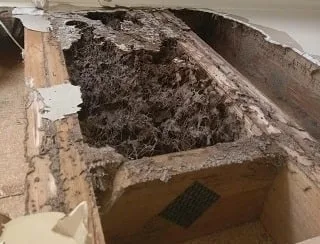
Termites eat cellulose, the structural fibre in timber, and they work from the inside of a stud, bearer or floor joist outward, leaving a thin painted shell that hides the hollow behind it. The result for most owners is a skirting board that crumbles under a thumb or a door frame that gives way, by which point the damage has usually reached structural framing, flooring and architraves and can already have compromised the soundness of the building.
Two things make the urgency real for Melbourne homeowners. The Victorian Department of Health attributes more than 80 per cent of termite damage to buildings in Victoria to Coptotermes species, the genus this guide describes, and the repair bill falls entirely on the owner. Standard home and contents policies almost universally exclude termite damage, treating it as a preventable maintenance problem, so there is no insurer to call. Repair of structural timber is carried out by a licensed builder; we treat the infestation, advise on the extent of the damage, and can refer you to tradespeople we have worked with on Melbourne jobs. Early detection and an ongoing management plan are the dependable defence, which is the reasoning behind the regular timber-pest inspection regime set out in the Australian termite-management standard (Standards Australia, AS 3660).
Signs of a termite infestation
The first warning most owners notice is a mud lead, a pencil-thick tunnel of soil and saliva that the termites build across brick, concrete and foundations so they can travel between the ground and your timber without exposing themselves to the open air. Tapping timber that sounds hollow or papery is another, as is paint that blisters, bubbles or ripples over skirting and architraves where the termites have eaten the wood out behind it. Many infestations build no visible mud lead at all, because the colony enters through concealed sub-slab gaps, pipe penetrations or construction joints, which is why a professional inspection with detection equipment finds activity even when no surface signs are present.
In spring and early summer, typically October through December in Melbourne and particularly on warm evenings after rain, look for a swarm of winged alates around external lights at dusk, or a scatter of discarded wings of equal length on windowsills and along skirting after a flight, both of which point to a mature colony close by. If any of these signs are present, call our Melbourne team on 03 9449 4244 and we will arrange an inspection, most often the same day. It is also the moment to leave the area completely undisturbed, because breaking open a mud lead or spraying the termites you can see only drives the foraging deeper and harder to locate, and makes the colony far more difficult to treat.
Why retail termite treatments cannot reach the colony
A can of insecticide kills the handful of termites it touches and does nothing to the colony, which keeps several hundred thousand insects working out of sight in the soil and the wall cavities. Disturbing a live infestation, prising open a mud lead, or spraying a visible gallery tells the colony something is wrong, and it simply abandons that lead and re-routes its foraging into another part of the building, spreading the active galleries into structural timber you cannot see.
Reliable control depends on reaching the colony itself, and that takes a correct species identification, the right professional product, and the equipment to find activity hidden behind plaster and under floors. Subterranean termites also need to remain in contact with soil moisture to survive, so genuine protection means managing the soil-to-timber pathways around the whole building, the work the Australian termite-management standard (AS 3660) sets out.
How Protech treats subterranean termites
A thorough timber-pest inspection of the building and its grounds is always the first step, because we need to find where the colony is working before we can treat it. An inspection of a standard Melbourne home typically takes one to two hours, and you will need to be present or have access arranged; we check roof voids, subfloors and the external perimeter as well as the internal timbers. We use moisture meters to find the damp zones colonies exploit, and Termatrac to find activity inside walls, ceilings and subfloors. Termatrac uses low-power microwave radar to detect termite movement behind plaster and under floors without drilling or cutting, so we can pinpoint where a colony is working before committing to a treatment plan. From that inspection we identify the species from the soldiers and map where the termites are entering and feeding, and the findings drive the plan, because the right approach for a small, contained infestation differs from the plan for an established colony attacking structural framing.
Treatment usually combines a baiting program and a chemical soil barrier, though either can suit a particular property on its own. A baiting program places stations the foraging termites feed on and carry back through the galleries. Over a period of months, depending on colony size and bait uptake, the bait reaches the whole colony and eliminates it at the source. A chemical soil barrier treats the ground around and beneath the building with a registered soil treatment to break the soil-to-timber pathways and protect the structure, applied to the Australian termite-management standard AS 3660. For new building work or extensions we install barriers during construction, and we also set up in-ground monitoring stations so any new activity is caught at the earliest point.
Every treatment is carried out by licensed technicians to the safe-handling and application requirements that accredited pest managers are trained to meet (Australian Environmental Pest Managers Association). Our termite services include termite inspection, termite baiting programs, chemical termite barriers and our broader termite control and treatment service for homes and businesses right across Melbourne, and our treatments are backed by our guarantee. If you have seen mud leads, hollow timber, or a swarm of winged termites, call us for an inspection — the sooner termite activity is confirmed, the less structural damage there is to manage. Call our Melbourne team on 03 9449 4244 or request a free quote, and we will arrange a visit, most often the same day.
Preventing termites around your home
Most of what draws a foraging colony to a Melbourne property is moisture and easy access to timber, and dealing with those two things significantly lowers the risk. Keep stored timber, firewood and offcuts off the ground and away from the house, since a stack against an external wall is a direct bridge into the building. Fix leaking taps, hot-water overflows and air-conditioner condensate, and grade garden beds and paving so water drains away from the slab and does not pool against it, because the soil moisture termites depend on is often a plumbing or drainage fault you can correct.
Keep weep holes and subfloor vents clear so the space under the house remains dry and well ventilated, avoid building garden beds, paths or render up over the slab edge where they would hide a termite entry point, and act on any timber-pest inspection findings promptly. Combined with a regular inspection — annual at minimum, in line with AS 3660's recommendation for high-risk zones like Melbourne — and a treatment to AS 3660, these habits give a Melbourne home a sound, managed defence against new termite activity.
Subterranean Termite Control Melbourne FAQs
Are subterranean termites dangerous to my health?
They do not bite or sting people in any meaningful way and they carry no significant disease risk, so the concern here is structural. A colony eats the timber framing, flooring and skirting of a home from the inside, and the damage can be extensive before it is ever seen. An active infestation should be treated promptly by a licensed technician.
Are white ants and subterranean termites the same thing?
Yes. White ant is an old common name based on their pale colour and ant-like size. The Victorian Department of Health advises against it, since termites are not a type of ant at all; they belong to a separate insect order and are far more closely related to cockroaches. The name is still in everyday use around Melbourne, so it helps to know that a white-ant problem and a subterranean termite problem are exactly the same thing.
How do I know if I have termites or just ordinary ants?
Ants have a narrow pinched waist, bent antennae, and two pairs of wings of differing sizes when winged, and they do not damage sound timber. Termite workers are pale, soft-bodied and have no waist, and the winged termites carry four wings of equal length that they shed in little piles. The surest signs of termites are mud leads across foundations, hollow-sounding or blistered timber, and discarded wings on windowsills. If you are unsure, a timber-pest inspection settles it quickly.
What does a termite inspection involve in Melbourne?
A timber-pest inspection of a standard Melbourne home takes around one to two hours. We check the roof void, subfloor, external perimeter and all accessible internal timbers, using a moisture meter to find damp zones and Termatrac microwave radar to detect termite movement behind plaster and under floors without cutting. You receive a written report of what we find, and the inspection is carried out to the Australian standard AS 3660. You can read more on our termite inspection page.
Can I get rid of subterranean termites myself?
Retail sprays and powders only kill the few termites they touch and leave the colony of several hundred thousand insects untouched in the soil and wall cavities. Disturbing the termites you can see usually makes things worse by driving the colony to re-route through another part of the building. Dependable control needs a correct species identification, professional baiting or a soil barrier applied to the Australian standard AS 3660, and the equipment to find hidden activity.
How long does termite treatment take to work?
A baiting program eliminates a colony over a period of months as the foraging termites carry the bait back through the galleries to the rest of the colony. A chemical soil barrier is protective once the treated zone around the building is established, usually within the day of application, and it remains active for several years under the product's manufacturer data; your technician will confirm the rated period at the inspection. After the inspection we will advise which approach suits your property and what timeframe to expect.
Is the treatment safe for my family and pets?
Yes. Treatments are applied by licensed technicians to the registered product's label requirements. For a chemical soil barrier and for baiting we will advise you on any access restrictions for the treated areas, which are typically limited to a short period after application while the product settles. If anyone in the home has particular sensitivities, tell us at the inspection and we will factor it into the plan.
Do you guarantee your termite treatments?
Yes. Our termite treatments are carried out by licensed technicians to the Australian termite-management standard AS 3660 and are backed by our guarantee, which covers re-treatment if termites return during the warranty period. The specific terms are set out in writing for your particular treatment and property before any work starts. We also set up ongoing inspections and monitoring so any new activity is caught early, the reliable way to keep a Melbourne home protected year on year.
How much does subterranean termite treatment cost in Melbourne?
The cost depends on the size of the infestation, the method used and the construction of the property, so a baiting program run over several months and a full chemical soil barrier for a larger building sit at different price points. A short, contained job is at the lower end and a whole-of-building barrier at the higher end. We provide a written, fixed-price quote after the inspection, so there are no surprises — call 03 9449 4244 or request a free quote and we will arrange a visit, most often the same day.
Protecting Melbourne homes and businesses since 2001 — HACCP, AEPMA and NPMA accredited, rated 4.8★ from 411 Google reviews.


Sources and further reading
- Victorian Department of Health — Pest control: termites
- Museums Victoria Collections — Coptotermes acinaciformis (Subterranean Termite)
- CSIRO — Managing Termites (research guide)
- Standards Australia — Australia's termite management standard (AS 3660) revised
- Australian Environmental Pest Managers Association (AEPMA)
Learn More About Pest Solutions
Same-day service, eco-friendly treatments and a pest-free guarantee. Domestic & commercial — all Melbourne suburbs.