

Wood Borers in Melbourne
How to identify timber-boring beetles, tell active damage from old, and protect your home's structural timber.
Written by Muzi Tsolakis, Founder and Competency Assessor, Pest Management Victoria. Last reviewed 19 August 2026.
Wood borers are among the more deceptive pests Protech technicians encounter across Melbourne properties. The damage happens entirely inside the timber — larvae boring through floorboards, sub-floor bearers and roof joists for months or years before a telltale scattering of pale dust or a cluster of small holes on the surface gives them away. By then, the structural material has already been weakened from the inside. This guide covers how to identify the beetle species most commonly found in Melbourne timber, the single most important question an inspection answers (active infestation or old damage?), which timbers are genuinely at risk, and how professional treatment works. It also explains the clear distinction between wood borers and termites — two very different pests that homeowners sometimes confuse when they find timber damage for the first time.
How to identify wood borers
The adult beetles are the stage most people never see. Wood borers spend the bulk of their lives as larvae inside the timber, and the adults emerge only briefly to mate and lay eggs before dying. What you find on the surface — holes, frass, blistered timber — is the evidence they leave behind, and the details of those signs point to the species involved.
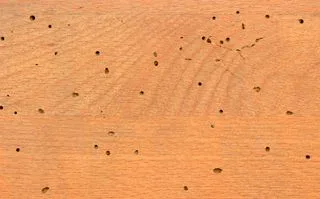
Exit holes are the clearest marker. Powderpost beetles (family Lyctidae) leave small, round holes roughly 2 mm in diameter, as described in the Australian Museum's species factsheet. The common furniture beetle (Anobium punctatum) produces slightly larger round holes, typically 1–2 mm, in seasoned softwood and older hardwood. The European house borer (Hylotrupes bajulus), a serious quarantine pest currently established in parts of Western Australia, leaves oval holes 3–10 mm in length running with the grain of coniferous timber, according to the Western Australian Department of Primary Industries and Regional Development.
Frass — the powdery mixture of wood dust and excrement pushed out of the tunnels — collects below exit holes and inside galleries. In a powderpost beetle infestation, frass from heavy larval feeding can reduce the interior of the timber to a fine powder while leaving the outer surfaces apparently intact. The colour and consistency of the frass are the main clues used in the field to separate active infestations from old, exhausted damage, and that distinction is covered in full in the section below.
The species most commonly found in Melbourne timber
Powderpost beetles (Lyctidae) are the species Protech technicians encounter most often in Melbourne hardwood flooring, furniture and structural members. Lyctus brunneus, the brown powderpost beetle, is widely distributed across Australia and targets the sapwood of seasoned hardwoods — the outer growth-ring layer that retains starch the larvae feed on. The Australian Museum notes that female powderpost beetles lay eggs into hardwood timber and the hatching grubs feed on the starch in the wood, eventually pupating and boring out through the surface. Because they require starch-rich sapwood, thoroughly seasoned or kiln-dried hardwood with low sapwood content is far less vulnerable than air-dried stock.
The common furniture beetle (Anobium punctatum) is the species behind much of the borer damage found in Victoria's older homes — particularly in softwood floorboards, roof joists and antique furniture. It favours well-seasoned timber in slightly humid, cooler conditions, which makes sub-floor voids and roof spaces in Melbourne's inner and eastern suburbs a typical habitat. Exit holes are round, 1–2 mm across, and the frass has a finer, grittier texture than the talcum-like dust of a powderpost beetle infestation. Its presence in Australia is confirmed in the Atlas of Living Australia.
The European house borer (Hylotrupes bajulus) deserves a specific note because it often comes up in searches and causes understandable concern. It attacks seasoned coniferous (softwood) timber — pine roof timbers, door frames and flooring — and DPIRD Western Australia reports that larvae can live inside infested timber for 2 to 5 years before emerging, causing severe structural weakening. It is currently established only in parts of metropolitan Perth and some regional WA areas, with strict quarantine restrictions on movement of untreated pine between states. Victoria does not have an established EHB population, but movement of pine building materials is regulated to keep it that way, as outlined by Agriculture Victoria's biosecurity pages.
Active infestation or old damage — the question that drives the treatment decision
One of the most important things a Protech inspection resolves is whether the borer damage in your timber is current or has been exhausted for years. Old, inactive damage does not need treatment, but it may leave timber weakened enough to warrant replacement. Active damage will continue to spread to adjacent timbers and should be addressed promptly.
The key indicator is the frass. Fresh bore dust from an active infestation is pale — cream to white — loose, and falls freely when the timber is tapped or vibrated. Frass that has been sitting in place for some time darkens, compacts inside the holes and accumulates as a grey, gritty deposit on surfaces below the timber. DPIRD Western Australia notes specifically that frass below exit holes is a sign of recent activity in a European house borer infestation, and the same visual principle applies to powderpost and furniture beetles. A second indicator is the exit holes themselves: fresh holes cut by emerging adults have clean, pale edges; holes present for several years develop a darker, weathered ring.
Visual assessment from the surface is not conclusive, and Protech technicians do not treat on the basis of surface appearance alone. Structural timbers — sub-floor bearers, roof joists and load-bearing members — are inspected in person, which often means accessing the roof space or sub-floor, because the condition of timber that looks sound from above can be very different once a probe is applied directly. Photographs sent to our office before an inspection can provide a useful first read, but they are no substitute for a physical assessment.
Which timbers are at risk — and which are not
Timber species and the way timber has been processed both determine how susceptible it is to borer attack. Powderpost beetles require sapwood with sufficient starch content, so they attack hardwoods — particularly Australian native hardwoods, oak, ash and other starch-rich species used in flooring and furniture — but only the outer sapwood layer. The heartwood of the same piece of timber is essentially immune. In practical terms, a hardwood floor with narrow sapwood sections may sustain very localised damage, while a floor cut from wide sapwood boards can be severely affected across the full surface.
The common furniture beetle takes a different approach and targets softwoods and older, slightly damp hardwood. Roof joists, sub-floor bearers, pine floorboards and antique furniture in Victorian and Edwardian-era Melbourne homes represent its typical range. Timber that has absorbed moisture over decades in a poorly ventilated sub-floor is considerably more attractive to egg-laying adults than dry, well-aired structural timber.
Kiln-dried timber, and timber treated with a penetrating boron-based preservative during manufacture or construction, provides effective resistance to all of the species above. Melbourne building codes have tightened the requirements on treatment of structural timber over time, which is why borer infestations are more common in older housing stock than in recently built homes. If you are purchasing an older property, including a pre-purchase building and pest inspection is the straightforward way to establish the condition of the sub-floor and roof-void timber before the sale completes.
Wood borers versus termites — a crucial distinction
Homeowners sometimes discover damaged timber and assume the culprit is termites, when it is in fact a borer beetle, or vice versa. Getting the identification right is important because the treatment approaches are entirely different, and treating for the wrong pest means the actual damage continues unchecked.
Wood borers are beetles. Their larvae feed inside seasoned, already-dead timber — floorboards, furniture, structural joists — and leave circular or oval exit holes with fine powder (frass) as the telltale signs. Termites, by contrast, are social insects that work in large colonies, consume cellulose in both live and dead timber, and characteristically leave a thin outer shell of wood intact while hollowing out the interior — tapping the surface produces a hollow sound. Termites also build mud tunnels as protected travel routes and leave a completely different damage profile with no exit holes and no loose frass.
The subterranean termite guide in our pest library covers their identification in detail. If you are unsure which pest you are dealing with — or whether both are present, which does occasionally happen in Melbourne homes with long-running structural issues — a combined building and pest inspection is the appropriate first step. Our termite treatment service and wood borer treatment service are handled by the same qualified technicians, and a single inspection can confirm what is present across the whole property.
Reducing the risk of a borer infestation
Good sub-floor ventilation is the single most effective thing a Melbourne homeowner can do to reduce borer risk. Timber that stays dry is substantially less attractive to egg-laying adults, and controlling moisture in crawl spaces and roof voids removes one of the main conditions that allow an infestation to take hold. If your sub-floor has inadequate cross-flow ventilation, adding vents or a sub-floor ventilation system is worthwhile on its own merits for general timber health — borers or otherwise.
Check second-hand furniture, reclaimed timber and salvaged building materials carefully before bringing them inside. An infested piece of furniture introduced into a home is a common origin of a new borer population in the interior timbers. Look for exit holes and tap for hollow areas; if in doubt, treat the piece with a penetrating boron product before it enters the house.
For exposed structural timber during construction or renovation, applying a boron-based preservative treatment provides lasting resistance to powderpost beetles, furniture beetles and most other species. It is low-toxicity, safe around occupants once dry, and far less costly than treatment after an established infestation. Annual pest inspections are the practical backstop — an experienced technician can identify early-stage borer activity in a sub-floor or roof space before it reaches structural timbers, and catching it at that point is considerably less disruptive than managing a widespread active infestation.
How Protech treats wood borers
Every wood borer job at Protech begins with a thorough inspection that establishes which species is present, whether the infestation is active, how extensive the damage is, and which timbers are affected. That assessment drives the treatment choice — there is no useful one-size approach to borer treatment because the species, the timber type and the extent of the infestation all bear on what will actually work.
The most common treatment for accessible structural and decorative timber is a penetrating insecticide applied to the surface, which reaches larvae in the upper galleries. For sub-floor and roof-void timber where a curative and long-term preventive result is needed, a water-based boron solution — applied by brush, spray or injection — provides both effects at low toxicity, making it suitable for occupied homes and appropriate where children and pets are present. For severe infestations where borers are present across multiple life stages and timber types, fumigation eradicates the pest at every stage in a single treatment, reaching right through the timber in a way a surface application cannot; it requires the property to be vacated while the work is carried out.
Protech has been treating timber pest infestations across Melbourne since 2001, with more than 40 years of combined team experience. Our technicians are licensed, insured and AEPMA-accredited. Every treatment is backed by our pest-free guarantee: if the problem returns within the guarantee period, we come back and re-treat at no extra charge, with the exact period confirmed in writing with your quote. For an inspection of your property's timber, call our Melbourne team on 03 9449 4244, visit our wood borer treatment page, or request a free quote online. You can also read our other species guides in the pest library.
Wood Borers in Melbourne FAQs
How do I tell if wood borer damage in my home is active or old?
The clearest indicator is the frass — the bore dust below the exit holes. Fresh frass from an active infestation is pale cream to white, loose, and falls freely when you tap the timber. Old, exhausted frass has darkened, compacted and turned grey. The edges of fresh exit holes are also pale and clean, while older holes develop a weathered, darkened border. That said, visual assessment from the surface is not definitive; structural timbers should always be checked by a technician who can probe the wood directly and access the sub-floor or roof space.
Are wood borers as dangerous as termites?
They are different pests with entirely different biology. Termites work in large social colonies and can cause catastrophic structural damage across a whole building in a relatively short period. Wood borers are beetle larvae that feed individually inside seasoned timber; the damage builds more slowly but can be substantial in older homes over many years, particularly in sub-floor and roof-void timbers. Both warrant a professional assessment when found — an inspection confirms which pest is present and what the condition of the timber actually is.
Which timber types are most at risk from wood borers in Melbourne?
It depends on the species. Powderpost beetles (Lyctidae) target the sapwood of seasoned hardwoods — hardwood flooring and furniture are the most common hosts. The common furniture beetle (Anobium punctatum) favours seasoned softwood and older hardwood in cooler, slightly humid conditions, making sub-floor bearers, roof joists and antique furniture in Melbourne's older housing stock the most common targets. Kiln-dried or boron-treated structural timber has significantly lower susceptibility.
Is the European house borer a risk in Melbourne?
The European house borer is currently established only in parts of metropolitan Perth and some regional Western Australian areas. Victoria does not have an established population. Agriculture Victoria maintains quarantine conditions on the movement of untreated pine building materials between states to prevent it spreading. If you are buying timber products or building materials that have come from WA, checking compliance with those conditions is worthwhile.
Can I treat wood borers with products from a hardware store?
Surface-applied products available over the counter penetrate only the outermost layer of timber and do not reach larvae feeding through the middle of a structural member. They may suppress adult emergence on accessible decorative surfaces, but they will not resolve an infestation in sub-floor bearers, roof joists or any timber where the affected depth exceeds a few millimetres. Professional treatment uses penetrating insecticides, boron solutions injected into the timber, or fumigation, which reach the pest at every life stage throughout the full thickness of the wood.
How much does wood borer treatment cost in Melbourne?
The cost depends on the species present, whether the infestation is active, how many timbers are affected and how accessible they are — a few infested floorboards and a sub-floor full of borer-damaged bearers are very different jobs. We give a fixed price after the inspection, before any work begins, so there are no surprises. Call us on 03 9449 4244 or request a free quote online.
Do you guarantee your wood borer treatments?
Yes. Protech's timber pest treatments are backed by a pest-free guarantee. If the infestation returns within the guarantee period we return and re-treat at no extra charge. The length of the guarantee period is confirmed in writing when your quote is issued.
Protecting Melbourne homes and businesses since 2001 — HACCP, AEPMA and NPMA accredited, rated 4.8★ from 411 Google reviews.


Sources and further reading
Learn More About Pest Solutions
Same-day service, eco-friendly treatments and a pest-free guarantee. Domestic & commercial — all Melbourne suburbs.