
Ant Control Melbourne
Species-targeted ant control & removal across Melbourne — same-day service and a pest-free guarantee.
Ant Control Melbourne
Ants are among the most frequent calls Protech takes across Melbourne, and nearly every job brings a different species to the door. The column crossing a kitchen bench in Campbellfield is usually a black house ant or a coastal brown ant; the trail streaming in under a laundry door after summer rain is often Argentine; and the pale visitors clustering around a bathroom tap are generally white-footed house ants.
Each of those species needs a different bait and different application points, which is why effective ant control starts with identifying what you are actually dealing with. Spraying a visible trail with a supermarket product clears the workers you can see, yet for the multi-queen species common in Melbourne it can split the colony and make the problem worse.
Protech has been treating ants across Melbourne since 2001, with a team carrying more than 40 years of combined experience. For same-day ant control backed by a pest-free guarantee, call 03 9449 4244 or request a free quote.
Get Free Quote Ant Species Found in Melbourne Homes & Gardens
Getting the species right decides everything that follows — the bait matrix, where it is placed and how long the job takes. These are the ants Protech technicians see most often across Melbourne, and how to tell them apart.
Black House Ant
The ant most Melburnians call a 'sugar ant' (Ochetellus glaber). Shiny black, 2–3 mm long, and drawn strongly to sweet foods and kitchen residue. It nests in wall cavities, under pavers and in garden beds, and forages along a defined trail on wall edges and window sills. This is the species behind most indoor kitchen trails — our black house ant guide covers it in full.
Coastal Brown Ant
Also called the big-headed ant (Pheidole megacephala). Despite the name it lives right across suburban Melbourne, nesting in garden soil and wall cavities and sending workers indoors along fixed trails. Workers run 1.5–2.5 mm, and the colony carries larger-headed soldiers. It is prone to fat and protein-rich foods rather than sugars, which changes how it needs to be baited. See the coastal brown ant guide for identification detail.
Argentine Ant
A pale to light-brown ant about 1.6 mm long (Linepithema humile) that forms very long foraging trails. Its colonies contain multiple queens, so a colony can survive partial treatment and split into satellite nests when disturbed. Well established across Melbourne's inner suburbs and urban fringe — the Argentine ant guide explains why this species is so persistent.
White-footed House Ant
Dark brownish-black with distinctively pale, almost white feet (Technomyrmex albipes); around 3 mm long. It trails to moisture sources — bathroom tap fittings, dishwasher seals, air-conditioning units — and, like the Argentine ant, can carry multiple queens per colony, which makes it harder to clear.
Odorous House Ant
Brown to black, 1–3 mm long (Tapinoma sessile), named for the faintly rotten-coconut smell it gives off when crushed. Less common than the species above but turns up occasionally in Melbourne homes, usually nesting near warmth and moisture.
Bull Ant & Jack Jumper
The large, aggressive garden species (genus Myrmecia). Bull ants reach up to 40 mm and sting repeatedly; jack jumpers are smaller at 10–12 mm and jump when disturbed, with a black body and orange-red legs and mandibles. Their stings cause immediate, intense pain and can trigger a severe allergic reaction. These are a garden management problem rather than an indoor one; the bull ant guide covers the sting, its first aid and nest identification.
Carpenter Ant
Larger ants that hollow out damp or decaying timber to nest, rather than eating the wood as termites do. Genuine carpenter-ant damage is uncommon in Melbourne compared with termites, but any ant nesting inside structural timber warrants an inspection to rule out timber pests. Our carpenter ant guide explains how to tell their work apart from termite damage.
For deeper identification, biology and cited health guidance on each of these species, read our ants identification guide in the Protech pest library.
Why Ants Invade Melbourne Homes
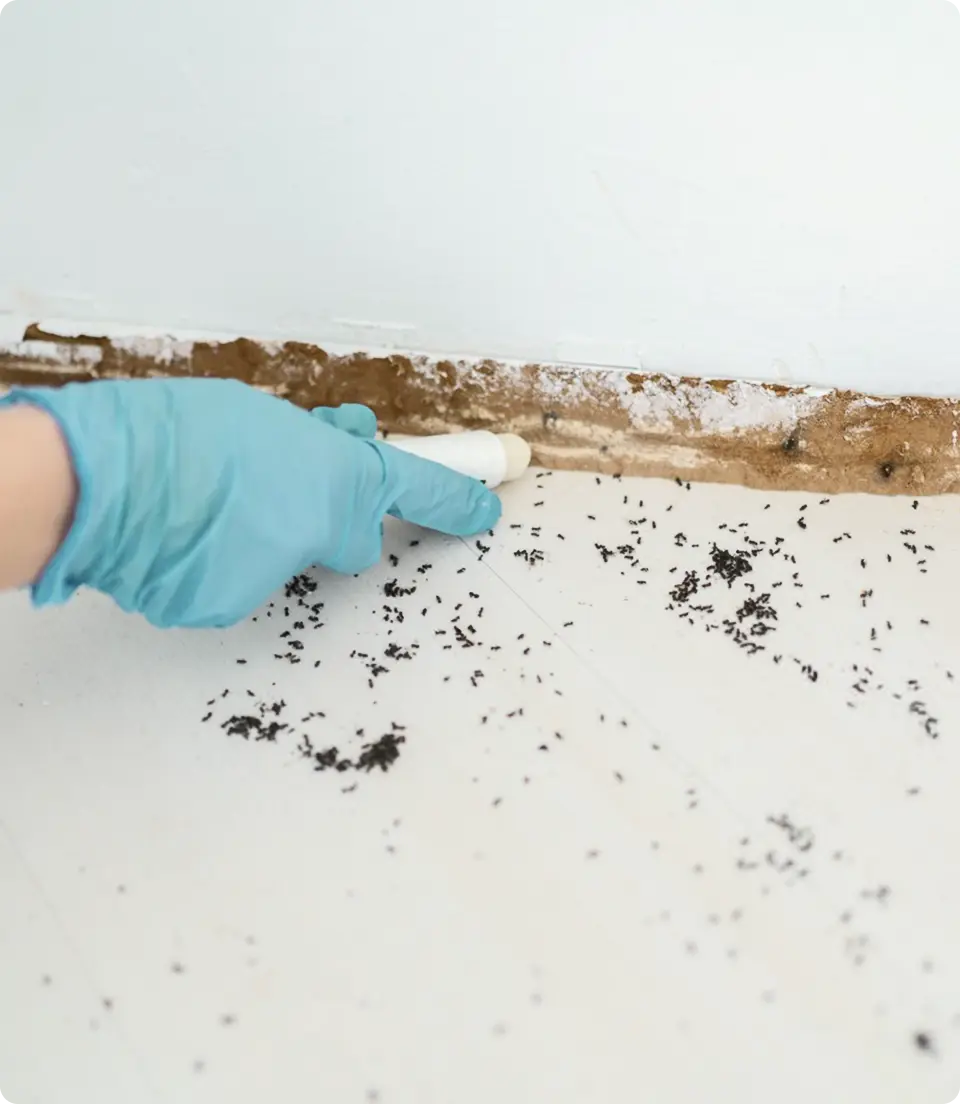
Ant colonies are driven by two needs — food and water — and a Melbourne home offers both. Workers forage individually at first, but once one finds a resource it lays a pheromone trail back to the nest, and recruits follow that chemical highway in growing numbers. The trail you see crossing a bench or skirting board is a communication pathway rather than a random scatter of individual ants.
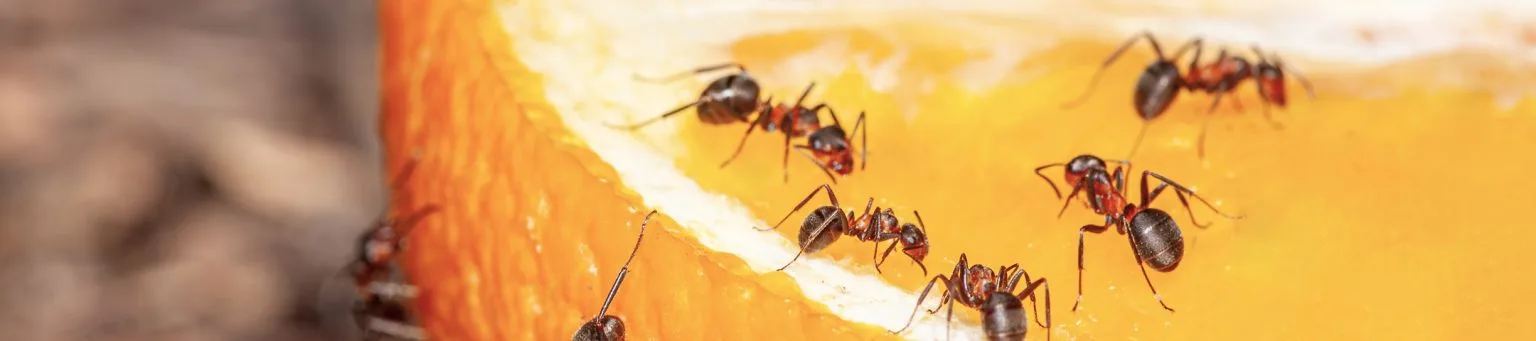
Kitchens concentrate what ants are looking for: crumbs, spillages, open fruit bowls, residue around bin lids, drips at tap fittings and the moisture behind a dishwasher. Sugary foods pull species like the black house ant; protein-rich scraps draw others. A trail can appear almost overnight when a food source is found, and it can persist for days after the food is cleared, because the pheromone residue keeps workers returning along the same route.
Season sharpens the pressure. Melbourne's warm summers bring ant populations to peak activity, and dry spells send ground-nesting colonies indoors in search of water. Heavy summer rain does the opposite — it floods ground-level nests and pushes workers upward and inward. Either way, the timing usually lines up with the point homeowners first notice a problem.
Signs You Have an Ant Infestation
- A visible foraging trail — a column of workers moving between an entry point and a food or water source, usually along the base of a wall, a window sill or the back of a bench. Trails can appear and vanish within hours as workers move between food sources.
- Nest entry points around the perimeter — cracked render, gaps around pipe penetrations, weep holes in brickwork, lifted pavers and disturbed soil in garden beds near the wall. Coastal brown ants often leave small soil craters where they enter a wall cavity.
- Ants at moisture points — clusters around tap fittings, the dishwasher seal or an air-conditioning unit point to white-footed house ants or coastal brown ants following water rather than food.
- Fine soil or debris along skirting boards — small piles of excavated material at skirting boards, bench joins or around a power point are nesting debris pushed out of a cavity, and they usually appear before any trail does.
- Winged ants (alates) indoors — a swarm of winged ants in a roof space or wall cavity means an established colony has been nesting in the structure for some time. Winged ants are often mistaken for termite alates, but ants have a pinched waist, bent antennae and forewings larger than the hindwings.
Winged ants indoors are worth taking seriously, because ant alates and termite (white ant) alates are easily confused. If you are unsure what you are looking at, a building and pest inspection settles it quickly.
What the inspection turns up
Those signs are what people notice indoors. An external inspection reads the same property differently, following the trails back out to the places the colony is living. This is Muzi Tsolakis, who founded Protech and is Victoria’s official Competency Assessor for Pest Management, on the findings from one of his ant inspections:
“During my inspection, I detected ant trails leading along the external walls of the house, fence lines, and pathways. Ant activity and nesting were identified within the garden beds, underneath the weed matting and rocks, as well as beneath the paved areas. These locations are providing suitable shelter and nesting sites for the ants.”
Muzi Tsolakis — Protech Pest Control
Weed matting, rocks and paving all offer a colony the same three conditions: warmth, moisture and cover from disturbance. Locating those nesting sites is what allows a treatment to reach the colony itself, and it is why the technician traces the trails outward across the property before deciding where the work goes.
Ant Season in Melbourne: What Changes Through the Year
Ant pressure on a Melbourne home follows the weather, and knowing where the colony is in its yearly cycle explains a lot about what you are seeing — and when treatment does the most good.
Spring and summer: peak foraging and flying ants
Warm soil and abundant food push colonies to their busiest from roughly September through February. This is when kitchen trails appear fastest, when a spill on the bench draws workers within the hour, and when dry spells send ground-nesting colonies indoors after water. Late spring and summer also bring the nuptial flights — swarms of winged reproductives leaving established colonies to found new ones. A swarm emerging inside the house tells you an established colony is nesting in or very close to the building, and that finding deserves a proper follow-up once the swarm itself has been swept up.
Autumn: colonies move deeper
As temperatures drop, foraging tapers off outdoors and colonies consolidate for the cooler months. Heavy autumn rain flushes ground-level nests and pushes colonies toward higher, drier shelter, and a wall cavity or subfloor void offers exactly that. Trails that appear indoors in autumn often mark a colony relocating into the structure, where it can carry on largely undisturbed.
Winter: quiet outside, active where warmth persists
Cold weather largely shuts down outdoor ant activity in Melbourne. Indoors is another story: a colony established in a cavity beside a heated kitchen or a warm water pipe keeps foraging through winter at a reduced level. A trail that persists into June or July is therefore a strong clue that the nest sits inside the building envelope, and an inspection at that point saves months of quiet colony growth.
The timing lesson is straightforward. Treating in early spring reaches colonies before their numbers peak, and a persistent winter trail deserves attention precisely because it should not be there.
When the Nest Is Inside the Wall
The hardest ant problems in Melbourne homes are the ones where the colony has moved into the building itself. Several of the species on this page nest readily in wall cavities — the black house ant, the coastal brown ant and the white-footed house ant among them — and a cavity gives a colony everything it wants: warmth, moisture from nearby plumbing, and protection from weather and disturbance.
The signs are distinctive. A trail that disappears behind a skirting board, into a power point or under a splashback rather than heading outdoors. Fine soil or excavated debris in small piles along skirting boards or bench joins. Activity that surges within a day or two of heavy rain, as flooded garden nests relocate upward. A trail that keeps running through winter, when outdoor colonies have gone quiet.
A nest in the wall changes how the job is done. Spraying the visible trail is at its most counterproductive here — for multi-queen species it can split the colony into new satellite nests deeper in the structure, and a repellent barrier at the entry point simply reroutes the workers through a different gap. This is where the non-repellent transfer products in our treatment do their work: applied at the harbourage zone, they are carried into the cavity by the ants themselves and spread through the colony without it ever sensing a threat.
One practical warning: resist the urge to seal the entry hole before the colony has been treated. Closing the gap does not touch the nest — it pushes the colony to open new routes somewhere less visible, and it takes away the access point through which the treatment would have reached them. Seal the gap after the colony is gone, and it becomes genuine prevention.
Why DIY Sprays and Baits Fail on Multi-Nest Colonies
The usual response to an ant trail is to spray it with a repellent product from the hardware store. That kills the workers in the trail and removes the visible problem — but for the multi-queen species common in Melbourne, the Argentine ant and the white-footed house ant, it can trigger a survival response called colony budding. When the colony senses a threat, one or more queens break away with a group of workers and found a new satellite nest elsewhere in the building. A single-queen colony sprayed along its trail may simply relocate its nest into an inaccessible cavity.
Repellent sprays applied at entry points create a chemical barrier that workers detect and route around, often into a wall cavity, which makes later treatment harder. They also blunt any bait program that follows, because workers that have met a repellent become wary of anything new in their environment.
Supermarket bait stations can work on a small, accessible colony of a single-queen species, but they rarely carry the right bait matrix for the species in front of you. Black house ants and Argentine ants take sweet gel baits; coastal brown ants and white-footed house ants are more reliably drawn to protein baits. A generic bait aimed at the wrong species is quietly ignored, and the colony keeps growing while the homeowner assumes the treatment is working.
How Protech Treats Ants in Melbourne
Every ant job starts with a species identification, because the bait matrix depends on it and getting it wrong wastes time and money. Once we know the species and where it is nesting, we place gel or protein baits directly on the active foraging trails, where workers are already moving. The workers carry the product back to the colony themselves, reaching the queens and brood that a surface spray never touches.
For colonies established inside wall cavities or subfloor voids, we apply non-repellent transfer products in the harbourage zones. Ants pick these up without detecting them and spread the active ingredient through trophallaxis — the mouth-to-mouth food sharing that connects every ant in the nest — so the colony is treated from the inside rather than the trail being disrupted at the perimeter.
Trail activity often lifts briefly after treatment before it drops, because workers are recruiting harder to the baited food source. That is the bait being taken home, and it is exactly what should happen. Trails typically clear within four to seven days for smaller infestations and up to two weeks for larger or multi-colony jobs, with a follow-up where the species or scale warrants it. The products we use are safe for use around children and pets.
To arrange an inspection, call 03 9449 4244.
Before We Arrive, and While the Bait Works
Before the visit
The single most useful thing you can do before the technician arrives is leave the ants alone. An active trail is a map — it shows the technician the entry point, the route and often the direction of the nest — and a trail that has been sprayed or scrubbed away the day before takes real time to rediscover. Spraying it is worse than useless for the multi-queen species, since it can scatter the colony before treatment even begins.
- Leave visible trails undisturbed, and make a note of where and when you have seen activity — morning trails at the dishwasher and evening trails at the pantry point to different things.
- Wipe up fresh food spills as you normally would, but skip any insect spray from the moment you book.
- Clear access under sinks and along the affected walls so the technician can reach entry points and harbourage.
- Pick up pet food bowls and store them clean until after the visit.
After the treatment
Expect the trail to get busier before it disappears. Workers recruit heavily to the baited food source and carry it back to the colony, so a lively trail in the first days is the treatment working as designed. Leave the bait placements exactly where the technician put them, and hold off on scrubbing down the treated runs and entry points until the activity has cleared, or for whatever period your technician advises on the day. Trails typically clear within four to seven days for smaller infestations and up to two weeks for larger or multi-colony jobs, and a follow-up is included where the species or the scale of the job calls for it.
What Ant Treatment Costs in Melbourne
Ant treatments with Protech start from $154 for a full internal and external treatment, ex GST. The final figure depends on the species involved, the size of the property and how accessible the nest is — a single kitchen trail from a garden nest and an established multi-queen colony inside a wall cavity are very different jobs, and the price honestly follows the work. We give you a fixed price after the inspection and before anything starts, so there are no surprises on the day. The full price list across all our treatments is published on our pest control prices in Melbourne page.
Every internal and external ant treatment carries a six-month guarantee: if ants return within that period, we come back and re-treat at no charge, including the call-out. The period goes on your paperwork at booking, and the complete guarantee schedule is on our guarantee page.
How to Keep Ants Out After Treatment
- Clear food spills promptly: even a small residue is enough to launch a trail, and black house ants respond within minutes. Wipe crumbs and liquid drops away rather than leaving them until later.
- Store dry goods sealed: keep cereals, sugar, flour and pet food in airtight containers rather than open packets, and check fruit bowls daily for overripe fruit — a frequent draw for sweet-feeding species.
- Deal with moisture: fix dripping taps, reseal dishwasher gaskets and keep air-conditioning drain lines clear. These are what bring in white-footed house ants and coastal brown ants even when a kitchen is spotless.
- Check the spots cleaning misses: the drip tray under the fridge collects moisture and food residue, and the narrow gap where the benchtop meets the wall catches cooking residue. Both feed a trail for weeks while the visible surfaces stay spotless.
- Seal the perimeter: fill cracks in rendered walls and gaps around pipe and cable penetrations, and check weep holes and expansion joints where workers enter.
- Cut the garden bridges: trim plants and shrubs touching the external walls, since they act as highways from garden nests to the building. Lift and check under pavers, pot plants and edging close to the house, where coastal brown ants build shallow networks.
- Manage garden bull ants near play areas: keep grass mown and reduce ground-level mulch and debris next to paths and play spaces, since bull ants and jack jumpers carry a genuine sting risk.
Are Ants a Health Risk?
For the small house-invading species, the main risk is food contamination. Ants move between outdoor waste, soil, drains and kitchen surfaces, picking up and depositing bacteria as they go, so any food they reach should be treated as contaminated and discarded — Victoria's Better Health Channel notes that household pests can carry disease-causing organisms from the places they forage into the home. In a food-handling business the same behaviour becomes a compliance issue as well as a hygiene one.
The serious risk comes from the stinging garden species. Bull ants and jack jumpers deliver an immediate, intense sting, and in people who are sensitised they can cause anaphylaxis — a severe, potentially life-threatening allergic reaction. First aid for an ordinary sting is to move away from the nest, wash the affected area with soap and water, and apply a cold compress to reduce the pain and swelling. Anyone stung who develops swelling beyond the sting site, hives or difficulty breathing needs medical help without delay, and anyone with a known insect-sting allergy should carry an adrenaline autoinjector when working in the garden. Our pest library ants guide cites the health authorities on this in full.
Ants in food businesses and commercial premises
For a food business, the same contamination behaviour becomes a compliance problem with real consequences. Ants crossing preparation surfaces, stock or packaging carry bacteria into a commercial kitchen just as they do into a domestic one, and a visible trail in a food-handling area is exactly the kind of finding a council environmental health inspection or a HACCP audit records. Protech's commercial pest control is HACCP-aligned and fully documented, with scheduled servicing and audit-ready paperwork, and our restaurant and café pest control covers the venues where the stakes are highest.
Office and strata-managed buildings bring their own complication: a colony in one tenancy's wall cavity can forage into the next, particularly with multi-queen species like the Argentine ant, so treating a single unit in isolation often moves the problem rather than ending it. Assessing the affected building as a whole gives a far more durable result.
Why Choose Protech for Ant Control in Melbourne
Protech Pest Control has been serving Melbourne homes and businesses since 2001, with a team carrying more than 40 years of combined experience across the full range of ant species active in Melbourne's suburbs.
- Same-day service available across Melbourne
- Certified technicians accredited to HACCP, NPMA and AEPMA standards
- Species-targeted baiting, not blanket repellent spraying
- Eco-friendly products safe for children and pets
- Backed by a pest-free guarantee, confirmed in writing with your quote
- 4.8★ from 411 Google reviews
Dealing with other pests as well? Protech also handles spiders, cockroaches and silverfish across Melbourne, and can inspect for all of them in a single visit.
Hear From Our Customers
The representative William was very thorough. He was polite thoughtful very helpful. Well recommended.
– Marguerite HeppellRichard of Protech was exceptionally thorough with his inspection and was quick to point any danger areas. His personable manner explaining and the overall thorough checking leaves us confident that our property can be kept safe from pest attack.
– Daryl GomeHave been using these guys for years. Always professional and on time. Great service and value. It’s strange how much there is to know but they also educate to assist with future issues and prevention.
– Andrew KalogirouI called Protech for a rodent infestation. They sent out someone on the same day to apply poison within the roof cavity. About 2 weeks later not a single scratching or gnawing sound. They even offered a 6 month warranty with the initial service. Would recommend.
– Luke NoyFrequently Asked Questions
What is the small black ant I keep seeing in my Melbourne kitchen?
The usual culprit is the black house ant, a shiny black species 2–3 mm long that is strongly attracted to sweet foods and kitchen residue. If the ants gather near a tap, dishwasher or air-conditioning unit, it may be the white-footed house ant, which looks similar but has pale feet and follows moisture rather than sugar. Coastal brown ants are slightly larger and trail in from garden nests. The species matters because each one responds to a different bait, which is why a professional identifies it before treating.
Why do I still have ants even though my kitchen is clean?
Ants come inside for water as readily as for food. A dripping tap, a leaking dishwasher seal or condensation around an air-conditioner is often enough to draw white-footed house ants or coastal brown ants into a spotless kitchen. Melbourne's dry summer spells also push ground-nesting colonies indoors in search of moisture. If trails keep appearing in a clean, dry kitchen, check under the dishwasher, around tap plinths and along the walls closest to garden beds.
Why did the ants come back after I sprayed them?
A repellent spray kills the workers you can see in the trail but rarely reaches the queens and brood in the nest. For multi-queen species like Argentine ants and white-footed house ants, spraying can trigger colony budding, where part of the colony breaks away and starts a fresh nest elsewhere in the building — so the trail disappears, then returns. Professional treatment uses non-repellent transfer products and baits that workers carry back to the colony, clearing it from the inside instead of scattering it.
Are the ants in my house dangerous?
For the small house-invading species — black house ants, coastal brown ants, Argentine ants — the real concern is food contamination, since they travel between drains, soil and food surfaces and carry bacteria along the way. Any food they reach should be discarded. Bull ants and jack jumpers are a different matter: their stings cause intense pain and can trigger anaphylaxis in people who are allergic. Anyone stung in the garden who develops swelling beyond the sting site, hives or difficulty breathing should seek medical help immediately.
How much does ant treatment cost in Melbourne?
Ant treatments start from $154 for a full internal and external treatment, ex GST. The final figure depends on the species involved, the size of the infestation and how accessible the nest is — a single kitchen trail and an established wall-cavity colony are very different jobs. We give you a fixed price after inspecting the property, before any work starts, so there are no surprises on the day. Our complete price list is on our pest control prices page, or call 03 9449 4244 and we will arrange a visit, most often the same day.
How long does professional ant treatment take to work?
Baiting works from the inside out, so trail activity often increases briefly before it drops — that is the bait being carried back to the colony, which is exactly what you want. Most Melbourne homeowners see trails clearing within four to seven days for a smaller infestation, and up to two weeks for larger or multi-colony situations. We include a follow-up where the species or the scale of the job calls for it.
Do you guarantee ant treatments?
Yes. An internal and external ant treatment carries a six-month guarantee — if ants return within that period we come back and retreat at no extra charge, including the call-out. We confirm the guarantee period and its terms in writing with your quote, and the full schedule across all our treatments is published on our guarantee page.
Can I get rid of ants myself?
Supermarket sprays and bait stations can knock back a small, accessible colony of a single-queen species. They tend to fall short with multi-queen species like Argentine ants and white-footed house ants, and with colonies nesting inside wall cavities or subfloor voids. Spraying a trail of these species without reaching the queens can push the colony to split and set up several new nests. A professional inspection identifies the species and the nest location, which decides whether a DIY approach is worth trying.
Are white ants a type of ant?
No. 'White ant' is the common Australian name for the termite, a completely different insect that eats structural timber and needs completely different treatment. True ants have a pinched waist and bent antennae; termites have neither. If you have found pale, soft-bodied insects in timber, skip the ant treatment and arrange a termite inspection — the two problems carry very different stakes for the building.
Do I need to leave the house during an ant treatment?
Generally the treatment works around your household. The gel and transfer products at the heart of an ant job are placed at trails, entry points and harbourage zones, and everything we use is applied at label rates by licensed technicians and is safe for use around children and pets. Your technician tells you on the day if any treated surface needs a short drying period or any area needs to be kept clear, and for how long.
Learn More About Pest Solutions
Same-day service, eco-friendly treatments and a pest-free guarantee. Domestic & commercial — all Melbourne suburbs.