

Wasps in Melbourne
How to tell a European wasp from a bee or native paper wasp, where they build their nests, and why an established colony needs a professional to clear it.
Written by Muzi Tsolakis, Founder and Competency Assessor, Pest Management Victoria. Last reviewed 27 August 2026.
Wasps are one of the more urgent calls we receive at Protech, and for good reason: an established European wasp nest in a wall cavity or underground burrow can hold tens of thousands of insects by late summer, and disturbing it without the right equipment and protection is genuinely dangerous for anyone nearby. Melbourne's warm southern summers suit the European wasp well, and our technicians find them year-round in subfloor voids, garden retaining walls, roof spaces, and dense garden beds. This guide covers how to tell the main wasp species apart from one another and from bees, where each type builds its nest, why numbers climb so fast through summer, the real sting and anaphylaxis risk they carry, and how Protech's licensed team removes nests safely.
How to identify a wasp
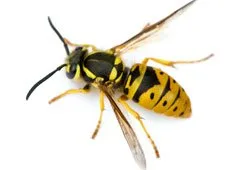
The introduced European wasp (Vespula germanica) is the species Protech removes most often across Melbourne. Workers are roughly 15 mm long with a queen reaching up to 20 mm. The body is bright yellow with distinctive black triangular markings on the abdomen and paired black spots, the legs are yellow, the antennae are black, and the two pairs of wings are transparent. The Museums Victoria species record for Vespula germanica describes the body as "yellow with black markings" and the wings as transparent — a combination that many people mistake for a bee at a glance.
The quickest way to tell a European wasp from a honeybee is to look at the body: a bee is rounder, fuzzier and more golden-brown, carrying pollen in visible leg baskets when foraging. A European wasp is sleeker, more intensely yellow, and holds its legs close to the body in flight. Bees also leave their barbed stinger behind after one sting and die; a wasp's smooth stinger lets it sting the same target repeatedly without any cost to the insect, which is the core reason a disturbed nest is so dangerous.
The English wasp (Vespula vulgaris) is the other introduced social wasp found in Victoria and looks nearly identical to the European wasp — the same yellow-and-black banding, a similar size and the same aggressive colony defence. In practice, the two species are treated identically and are often misidentified even by entomologists in the field without close examination. Native paper wasps (Polistes species) look quite different: they are slender with a very narrow waist, longer dangling legs visible in flight, and they tend towards brown, orange or reddish tones with yellow markings rather than the intense yellow-and-black of the European wasp. They are less aggressive and their open-comb paper nests are small and visible.
Nest types and where wasps build
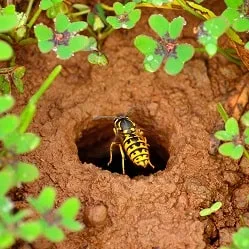
European wasps build their nests from chewed wood pulp and saliva, producing a papery grey material that gives the nest walls a layered, almost corrugated look. The Agriculture Victoria European wasp page notes that around 80 per cent of European wasp nests occur in holes in the ground or close to the ground level — beneath retaining walls, in rockeries, around the base of trees, inside unused compost heaps and in subfloor voids. The rest turn up in cavities within buildings: wall voids, roof spaces, sheds, and letterboxes. A small early-spring nest is roughly golf-ball sized, but by late summer an undisturbed colony can expand to the size of a basketball or larger, and a mature European wasp colony in a wall cavity can exceed 100,000 wasps according to Better Health Channel.
Native paper wasps build an altogether different structure — an open, downward-facing honeycomb of cells with no outer paper envelope, usually anchored to eaves, fence rails, tree branches or the underside of decking timbers. These nests are small (rarely more than a few hundred cells), visible, and far less hazardous to approach than a European wasp ground nest, though a paper wasp colony will sting if the nest is directly threatened. Mud daubers, the solitary wasps you might find building cylindrical mud tubes on brick walls, shed walls or under pergolas, are a further step removed from the social species: they do not defend a colony at all, carry no workers to mobilise in a group, and are generally harmless to people unless physically handled.
The seasonal build-up — why numbers climb so fast
European wasp colonies follow a clear annual cycle that explains why a small spring nest becomes a major problem by February. A mated queen emerges from winter dormancy in September or October, finds a cavity she considers suitable, and builds the first few cells herself, raising a founding cohort of workers. As the workers take over foraging and nest construction through spring, colony growth accelerates rapidly. By late summer the nest has expanded through multiple generations of workers and a large Melbourne nest can hold tens of thousands of individuals.
The European wasp's Australian advantage over its behaviour in its native Europe is that our milder winters allow many queens to survive, and crucially, Victorian winters are not cold enough to kill an entire colony reliably. In Europe a nest dies back each winter with only new queens surviving; in Victoria some established nests survive into a second season, producing what are called perennial nests that can grow to an extraordinary size. Agriculture Victoria's priority pest listing for the European wasp reflects this — it is formally recognised as one of Victoria's significant pest insects precisely because of how aggressively it establishes here.
The species forages up to half a kilometre from its nest and is strongly attracted to protein-based food and sweet drinks, which is why outdoor barbecues, children's lunch boxes, pet food and open bins all draw wasps in summer. Once a forager locates a reliable food source it recruits nest-mates, so the numbers around a food source can build within hours.
The sting and anaphylaxis risk
A European wasp sting is painful and causes localised swelling and redness for most people, but the more serious concern is allergic reaction. Unlike a honeybee, whose barbed stinger embeds in the skin and separates from the bee's body, a wasp has a smooth stinger and can sting the same person multiple times in a single encounter. A colony that feels its nest is under threat will mobilise large numbers of defenders simultaneously, which means a disturbed ground nest can deliver a very high number of stings in seconds.
Better Health Channel Victoria's page on the European wasp notes that approximately one in ten people who receive multiple stings develop allergic sensitivity to subsequent stings. The Better Health Channel page on allergies to bites and stings states that around three people die each year in Australia from a severe allergic reaction (anaphylaxis) caused by stinging insects, with older people and those with existing breathing conditions at greatest risk. Symptoms of anaphylaxis — difficulty breathing, swelling of the throat, abdominal cramps and collapse — can develop within minutes of a sting and require immediate emergency treatment with adrenaline.
For anyone known to have a wasp or bee allergy, the approach to a nest, even to investigate its size, is not a safe task to do without a professional. If you or someone nearby is stung and shows signs of a severe allergic reaction, call 000 immediately. For a straightforward sting with local swelling only, the general first-aid steps are to clean the area with soap and water, apply a cold pack to reduce swelling and take a pain reliever or antihistamine as directed. A wasp does not leave a stinger that needs to be removed — that step applies to bee stings.
Signs of a wasp problem at your property
The most reliable early indicator of an established European wasp nest is a consistent, steady stream of wasps flying in and out of a single point — a gap in a retaining wall, a crack in the eaves, an entry hole in the lawn or a gap beneath weatherboards. Individual wasps foraging for food around a barbecue or outdoor table do not necessarily mean a nest is on your property; the nest could be several hundred metres away. Persistent traffic in and out of one location is the tell.
For underground nests, the entry point is often a small, clean-edged hole in the soil, sometimes with a halo of loose earth around it, with workers moving quickly in and out on a clear flight path. Inside a building, you might hear a faint papery rustling or chewing sound from a wall cavity before you see any wasps — the colony expanding the nest structure. Paper wasp nests are usually visible directly: the open-comb structure under the eaves, on a fence post or in a low tree is easy to spot once you know what you are looking for.
Why DIY removal carries serious risk
Many wasp nest injuries in Australia happen because a homeowner attempts to block the entry hole, pour boiling water down a ground nest, or spray an aerosol product into a wall cavity without knowing the full extent of the nest inside. A European wasp colony responds to any perceived threat with mass mobilisation, and a nest of even moderate size can send hundreds of workers out within seconds. Ground nests are particularly hazardous because the nest extends well below the surface and the colony far outnumbers anything visible at the entry point.
Consumer wasp aerosols work on direct contact and have a limited effective range. They are adequate for a small, exposed paper wasp nest that can be reached at arm's length with a clear retreat path, but they do not penetrate a ground nest or reach the interior of a wall cavity. Using them against a large European wasp nest is more likely to agitate the colony than to clear it. Licensed pest technicians use dust insecticides that are carried into the nest on the wasps' bodies, reaching the queen and larvae deep inside the structure, and they carry protective equipment suited to nest work.
How Protech removes wasp nests
Every wasp job begins with a quick assessment to confirm the species, locate the nest entry point, and gauge the likely colony size — the treatment and the level of protection the technician puts on both depend on this. For a European wasp ground nest or wall-cavity nest, we apply a residual dust insecticide into the nest entrance; the workers carry it through the nest structure and the colony collapses typically within 24 to 48 hours. The nest itself does not need to be physically removed in most cases — it will dry out and pose no further risk once the colony is dead. Where the nest is accessible and removal is practical, we will take it out.
For paper wasp nests on eaves, fencing or outdoor structures, treatment is faster: a direct spray to the nest at dusk when workers are clustered clears the colony quickly, and the nest can be removed once it is inactive. Mud dauber tubes can be knocked down and cleared at any time — there is no colony to defend them.
If you have had a wasp sting allergy diagnosed or are unsure of your status, tell us when you call. Our technicians can plan the job so you are well clear of the treatment area, and we will confirm when the nest is inactive before you return to the garden or sub-floor space. Our wasp nest removal covers homes and commercial properties across Melbourne. You can also read our guide to other pest species in the pest library, and if you have found what looks more like a bee colony, our team handles bees and wasps — we can confirm which one you are dealing with and arrange the appropriate treatment or referral.
Every treatment is backed by our pest-free guarantee: if wasps return within the guarantee period, we come back at no extra charge. Call our Melbourne team on 03 9449 4244 or request a free quote and we will arrange a visit — for an active wasp nest we aim to get there the same day.
Wasps in Melbourne FAQs
What is the difference between a wasp and a bee?
The European wasp is sleeker and more intensely yellow than a honeybee, with a narrower waist, black antennae, and yellow legs. Bees are rounder, fuzzier and golden-brown, and carry visible pollen loads on their legs when foraging. The most practical difference is the sting: a honeybee has a barbed stinger that embeds in skin (causing the bee to die), while a wasp's smooth stinger lets it sting the same person repeatedly. If you are unsure which insect you have, call us — we can confirm the species before recommending a treatment or referral.
Are wasps dangerous?
For most people a wasp sting causes localised pain, swelling and redness that settles over a few hours. The serious risk is for anyone with a venom allergy: Better Health Channel Victoria notes that around one in ten people who receive multiple stings develop allergic sensitivity to future stings, and anaphylaxis from stinging insects causes around three deaths per year in Australia. A disturbed European wasp colony is particularly hazardous because wasps can sting repeatedly and a large nest can mobilise hundreds of defenders at once. Anyone who develops throat swelling, difficulty breathing, or feels faint after a sting should call 000 immediately.
How do I find a wasp nest I can't see?
Watch for a steady flight line — a consistent stream of wasps moving in and out of a single point rather than random foraging. For a ground nest, follow returning wasps (not departing ones) and you will usually see them drop into the entry hole. Agriculture Victoria suggests placing a small piece of meat or pet food in an open spot outdoors: a forager will collect it and fly almost directly back to the nest in a straight line, which lets you trace the direction. Once you have a location, call us — do not approach or block the entry hole yourself.
Can I remove a wasp nest myself?
A small, exposed paper wasp nest with only a few dozen cells on a fence post or eave can be treated with a consumer aerosol product at dusk when the wasps are settled, if you have a clear retreat path and no allergy history. A European wasp ground nest or any nest inside a wall cavity or subfloor is a different matter entirely. These nests can hold tens of thousands of wasps and respond to disturbance with mass stinging. Consumer sprays do not reach the interior of a ground or wall nest effectively. For anything other than a small visible paper wasp nest, professional treatment is the right call.
How long does it take to get rid of a wasp nest?
A treated European wasp ground nest or wall-cavity nest is typically inactive within 24 to 48 hours as the dust insecticide is carried through the colony. Paper wasp nests on eaves or outdoor structures clear more quickly — often within a few hours of a direct treatment at dusk. You will see a rapid drop in wasp activity at the entry point as the colony collapses. We advise giving the treated area a wide berth for 24 hours after treatment.
How much does wasp nest removal cost in Melbourne?
We give you a fixed price after we have seen the nest location, the species and its approximate size — those factors genuinely determine the time and equipment involved, so a single number would not be meaningful without seeing the nest first. The quote is free and carries no obligation. Call 03 9449 4244 or request a quote online and we will aim to get to you the same day for an active nest.
Do you guarantee wasp nest removal?
Yes. Our wasp nest removal is backed by our pest-free guarantee. If wasps return within the guarantee period we come back and re-treat at no extra charge. We confirm the length of the guarantee period in writing with your quote, because it can vary with the species and the job.
Protecting Melbourne homes and businesses since 2001 — HACCP, AEPMA and NPMA accredited, rated 4.8★ from 411 Google reviews.



Learn More About Pest Solutions
Same-day service, eco-friendly treatments and a pest-free guarantee. Domestic & commercial — all Melbourne suburbs.