

Mosquitoes in Melbourne
How to identify local species, why standing water drives every infestation, the health risks that matter in Victoria, and how our licensed team treats them.
Written by Muzi Tsolakis, Founder and Competency Assessor, Pest Management Victoria. Last reviewed 11 August 2026.
Mosquitoes are a seasonal fixture across Melbourne, but the properties our technicians are called to most often have something in common: a standing-water source close to the house that has been overlooked for a week or two. A forgotten pot-plant saucer, a partially blocked gutter, a tarp pooling after rain — any one of these can support a breeding population that turns a comfortable backyard into an uncomfortable one by midsummer. This guide covers how to tell Melbourne's common mosquito species apart, the water-dependent lifecycle that drives every infestation, the genuine health risks posed by mosquitoes in Victoria (including Ross River virus, Barmah Forest virus and the rarer Murray Valley encephalitis), the seasonal pattern to expect, and what professional treatment actually involves.
How to identify a mosquito
Not every small flying insect around a Melbourne yard is a mosquito. If they swarm at dusk but never bite, you are almost certainly looking at midges, which need a different approach.
Mosquitoes belong to the family Culicidae and are true flies (Order Diptera), recognised by their slender body, long fragile legs and a single pair of narrow, scale-covered wings. Adults are typically 4 to 6 millimetres long, with a pronounced thoracic hump when viewed from the side, and a characteristic long proboscis projecting forward from the head — the piercing mouthpart that makes them recognisable at a glance. The Australian Museum records around 350 mosquito species across Australia, with colour varying by species from a plain grey-brown to banded patterns of pale and dark scales on the legs and abdomen.
Sex matters for understanding who is doing the biting: only female mosquitoes feed on blood, which they need to develop their eggs. Male mosquitoes feed on nectar and plant sugars and die within a week or so; females live for roughly a month and can bite repeatedly throughout that time. Males are distinguishable in the hand by their bushy, feathery antennae; female antennae are finer and less prominent. At rest, some species hold the body at a distinctive angled posture with the rear end raised — a useful field identifier for Anopheles species in particular.
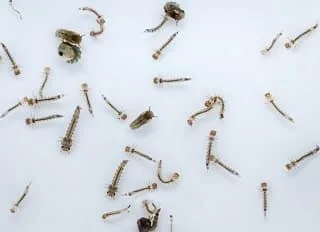
The larval stage is often the clearest sign of an active infestation on your property. Mosquito larvae (commonly called wrigglers) are aquatic and visible to the naked eye in still, shallow water — they hang just below the surface and move with a characteristic wriggling motion. The pupae (tumblers) are comma-shaped and also aquatic. Spotting wrigglers in a saucer or gutter means breeding is already underway and the source can be dealt with directly.
The lifecycle that depends on standing water
The entire reproductive cycle of a mosquito is tied to water, which is why source reduction — finding and emptying anything that holds water — is the single most powerful control lever available to a homeowner. A female lays approximately 200 eggs at a time, either directly on the water surface as a floating raft or on damp soil that will later flood. In warm Melbourne summer temperatures the eggs hatch within two to three days, larvae develop through four moults over roughly a week, and adults emerge ready to breed. The complete egg-to-adult cycle can run in as little as 10 days during a warm spell, which explains how a population builds from nothing to a noticeable problem within a fortnight of the right conditions appearing.
In Melbourne homes the breeding sources our technicians find most often are pot-plant saucers that refill after rain and are never tipped out, blocked or slow-draining gutters, bird baths left unchanged across a week, tarps and covers pooling water, old tyres, rainwater tanks with unsealed lids or unscreened overflow pipes, and ornamental ponds without fish or aeration. Properties that back onto a reserve, creek or wetland face an additional external source population that is beyond the owner's control, making on-property source reduction and perimeter treatment both more important.
The wing-beat rate of around 500 times per second produces the distinctive high-pitched whine that tends to be the first sign most people notice — particularly at night when a female is actively searching for a blood meal. Mosquitoes locate hosts by sensing warmth, exhaled carbon dioxide and certain body chemicals, which is why some people attract more bites than others in the same space.
Health risks: the diseases mosquitoes can transmit in Victoria
For most people a mosquito bite means a short-lived immune reaction — itching, redness and localised swelling that settles within a day or two. The more important concern in Victoria is the group of arboviruses (arthropod-borne viruses) that certain local mosquito species can transmit to humans. The Victorian Department of Health lists five mosquito-borne viruses reportable in the state: Ross River virus, Barmah Forest virus, Japanese encephalitis, Murray Valley encephalitis, and West Nile/Kunjin virus.
Ross River virus is the most commonly reported mosquito-borne disease in Australia. The Better Health Channel describes typical symptoms as fever, joint inflammation and pain, rash, fatigue and muscle aches, appearing 3 to 21 days after an infected bite. The virus is maintained in animal reservoirs — kangaroos and possibly other marsupials and wild rodents — and cannot pass directly between people. Most people recover within three to six months, though joint symptoms can persist longer in some cases. Barmah Forest virus follows a similar pattern: spread by mosquitoes with symptoms including joint pain, rash and fatigue, typically appearing 7 to 10 days after infection, according to the Better Health Channel. Cases in Victoria are relatively uncommon but are reported each year.
Murray Valley encephalitis is rarer but considerably more serious, with the potential for severe outcomes including brain inflammation. The Victorian Department of Health describes it as a rare illness in the state, occurring mainly in the Murray-Darling basin during periods of high rainfall and flooding that expand mosquito habitat. Japanese encephalitis became a reportable disease in Victoria following the 2022 outbreak in the Murray region; the risk remains concentrated in areas with pig farms and wetlands rather than the suburban Melbourne setting most residents encounter. The framing to carry into any decision about treatment is straightforward: avoiding mosquito bites is the most reliable way to avoid these diseases, and reducing breeding on your property reduces your exposure across the whole season.
Mosquitoes also transmit heartworm to dogs and cats, which is worth knowing for pet owners who manage a property with significant mosquito pressure even when personal bite rates seem tolerable.
Signs of a mosquito problem
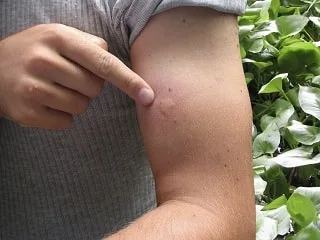
The clearest early signal is a pattern of bites that escalates day by day rather than occasional incidental contact — particularly bites occurring close to the house or in a specific part of the garden, which usually points to a breeding source nearby rather than mosquitoes drifting in from a distance. A persistent thin buzzing at night, especially indoors or around a specific shrub or water feature, confirms adults are present in numbers.
Wrigglers in any still-water container are the most actionable sign: they mean breeding is happening on your property right now and the source can be eliminated. Look in pot-plant saucers, bird baths, blocked gutter sections and anything else that has held water for more than a week. Adults resting during daylight hours in dark, humid spots — under decking, in dense shrubs, inside a garden shed — suggest the population is large enough that the available resting harborage is under pressure, which is a useful cue that numbers have built to the point where professional treatment is likely to be more effective than continued source management alone.
Biting midges: the other summer biter
Not every bite at dusk comes from a mosquito. Biting midges — tiny insects of the family Ceratopogonidae, often called sandflies along the Victorian coast and 'no-see-ums' for how easily they go unnoticed — are only one to three millimetres long, small enough to pass straight through standard flyscreen mesh. They are most active around dawn and dusk and are worst on properties close to the bay, tidal flats, wetlands and estuaries, which is why bayside and outer-coastal Melbourne suburbs notice them more than the inner suburbs.
The bite is the giveaway. A biting midge bite is much smaller than a mosquito bite at first, then itches intensely for days, and people who react strongly can develop clusters of small, very itchy welts after an evening outdoors. Biting midges are not considered significant disease carriers in Victoria, so the issue is the discomfort of the bites rather than infection — though for someone who reacts badly they can make a backyard unusable through summer.
Control differs from mosquito work in one important way: biting midges do not breed in standing-water containers but in damp sand, mud and decaying vegetation around the margins of water, so tipping out saucers does little for them. Reducing their impact comes down to avoiding exposure at dawn and dusk, fitting finer-grade insect screens than the standard mesh, and a residual perimeter treatment to the vegetation and damp harbourage where the adults rest. Where a definable damp breeding margin exists on the property, the same Bacillus thuringiensis israelensis (Bti) larvicide used for mosquitoes works on midge larvae as well. A technician will identify whether mosquitoes, biting midges or both are driving the problem, because the treatment emphasis is different for each.
Source reduction: the most effective thing you can do at home
Removing or treating every standing-water source on and around the property is the foundation of any mosquito control program, and it is worth doing thoroughly before any professional treatment because it directly amplifies the result. A weekly round of the garden with the aim of tipping out or covering anything that holds water deals with the majority of suburban breeding sites — pot-plant saucers, bird baths, buckets, upturned lids, tarps and covers. The threshold to keep in mind is roughly a week: water that has stood for seven days or more in warm weather can support developing larvae, so the emptying schedule needs to match that window.
Gutters deserve specific attention because they are one of the most productive breeding sites on a property and one of the easiest to overlook. A gutter holding a shallow channel of decomposing leaf debris and water across the back half of a house can sustain a large breeding population through summer with no visible sign from ground level. A twice-yearly clean, timed before and after autumn leaf fall, removes this as a source. Rainwater tanks should have a tight-fitting lid and a screened overflow pipe; an unscreened overflow is an open invitation. Ornamental ponds benefit from either fish stocking (goldfish and most native species will consume larvae) or a pump keeping the water circulating — still, nutrient-rich water is what mosquitoes need. If a sub-floor area on the property holds water after rain, that is also a viable breeding site; Protech offers subfloor ventilation as part of its services if dampness is a recurring issue. Good-quality insect screens on windows and doors reduce indoor exposure significantly, and a check of existing screens for tears or gaps at the edges is worth doing before the warmer months arrive.
Melbourne's mosquito season
Mosquito activity in Melbourne is not uniform across the year. Adult numbers peak through summer — December to February — but the breeding season begins in spring, when warming soil and water temperatures from September onwards start accelerating larval development. A property that carries untreated standing water through October is already several breeding cycles into the season before the first hot week arrives. Autumn (March to April) brings a second surge as summer rains create fresh water and populations that built over summer complete another generation.
Properties on Melbourne's urban fringe, particularly those near the Yarra corridor, Port Phillip Bay foreshore or council wetlands and reserves, face ongoing external pressure from large, managed breeding habitats that are outside any individual owner's control. For these properties, season-long management — source reduction combined with a perimeter residual treatment from October through to April — is more reliable than reactive treatment once adults are already present in numbers. A reactive approach targets adults that have already emerged from a breeding cycle that is often well advanced; the breeding source may still be active and producing the next generation.
How Protech treats mosquitoes
Every program begins with a thorough inspection of the property — perimeter, garden beds, any water features, roof gutters (where accessible), sub-floor and all potential standing-water sources — to map where breeding is occurring and where adults are resting during daylight. This inspection step determines what combination of treatments will be most effective for that specific property, and it is the part of the process that a DIY approach rarely covers properly.
The treatment program we put together for most Melbourne properties combines several targeted methods. Larvicide — applied directly to identified breeding water bodies — kills larvae before they develop into adults. Where fish, frogs or other aquatic life are present, we use a biological larvicide based on Bacillus thuringiensis israelensis (Bti), a naturally occurring bacterium specific to mosquito and midge larvae that degrades quickly in the environment. For larger or persistent water sources we may apply an Insect Growth Regulator (IGR), which prevents larvae from maturing into adults and interrupts the breeding cycle without the broader environmental impact of a conventional insecticide. All products we use are registered with the APVMA and are applied at label rates by licensed technicians.
Adulticide residual treatment targets resting sites — the dense vegetation, undersides of decking, shaded garden beds and fence lines where adult mosquitoes shelter during the day — reducing the adult population on and around the property between breeding cycles. The technician will also give you specific advice on the source-reduction steps that will have the most impact on your property, and point out any structural issues (gutter clearance, tank screening, drainage) that are worth addressing to reduce ongoing treatment demand. Our work is backed by a pest-free guarantee: if the problem returns within the guarantee period, we come back at no extra charge. For same-day service or a free quote, call our Melbourne team on 03 9449 4244 or visit our mosquito control service page for more on our treatment options. You can also browse related guides in our pest library.
Mosquitoes in Melbourne FAQs
When is mosquito season in Melbourne?
Breeding begins in spring — from around September — as water temperatures warm and larval development accelerates. Adult activity peaks through summer (December to February), with a second surge in autumn (March to April) after summer rains create fresh standing water. A source-reduction and treatment program starting in October, before numbers build, is more effective than a reactive response once adults are already present.
What diseases can Melbourne mosquitoes transmit?
Several mosquito species found in Victoria can transmit arboviruses to humans. The most commonly reported in the state is Ross River virus, with symptoms including joint pain, rash and fatigue. Barmah Forest virus produces similar symptoms. Murray Valley encephalitis is a rarer but more serious illness, occurring mainly during periods of high rainfall in inland Victoria. Japanese encephalitis has been reportable in Victoria since the 2022 Murray region outbreak, with risk concentrated in rural areas with pig farms and wetlands. If you develop joint pain, a rash or fatigue after being bitten, see a doctor.
Something too small to see is biting me at dusk — what is it?
If the biter is almost invisible and the bites start tiny but itch intensely for days, it is most likely a biting midge rather than a mosquito. Biting midges (sometimes called sandflies or no-see-ums) are only one to three millimetres long — small enough to pass through standard flyscreen mesh — and are worst at dawn and dusk near the bay, wetlands and tidal areas. They breed in damp sand and mud rather than standing water, so emptying containers does not help; reducing them relies on finer screens, avoiding exposure at dawn and dusk, and a perimeter treatment to the damp harbourage where they rest. Our technician can confirm whether mosquitoes, midges or both are the problem.
Why are some people bitten more than others?
Mosquitoes locate hosts by sensing warmth, exhaled carbon dioxide and certain body chemicals, including compounds in sweat and skin odour. Genetic factors, blood type, skin bacteria and even what you have recently eaten or drunk can influence how attractive you are to a mosquito. The variation is well documented, which is why two people sitting outside together can have very different experiences.
What is the most effective thing I can do to reduce mosquitoes at home?
Source reduction — finding and eliminating every standing-water source on the property — is the single most effective step. Empty pot-plant saucers, bird baths and any container that holds water at least once a week in warm weather. Clear gutters so they drain freely, cover rainwater tanks with a sealed lid and a screened overflow pipe, and keep ornamental ponds stocked with fish or well-aerated. This cuts the breeding population at the source before adults emerge, and it amplifies the effect of any professional treatment significantly.
Are the treatment products safe around children and pets?
Protech uses only products registered with the APVMA (Australian Pesticides and Veterinary Medicines Authority) and applies them at label rates using appropriate equipment. Treated areas are safe for children and pets once dry. Your technician will give you specific re-entry guidance after the treatment, and will advise on any particular precautions for pets where products are applied near water features or ponds.
How much does professional mosquito control cost in Melbourne?
Cost depends on the size and layout of the property, the number and type of breeding sources present, and whether a one-off or seasonal program suits the situation best. We give you a fixed price after the inspection, before any work begins, so there are no surprises. Call us on 03 9449 4244 or request a free quote and we can usually arrange a visit the same day.
Do you guarantee the treatment?
Yes. Our pest treatments are backed by a pest-free guarantee — if the problem returns within the guarantee period, we come back and re-treat at no extra charge. We confirm the length of the guarantee period in writing with your quote.
Protecting Melbourne homes and businesses since 2001 — HACCP, AEPMA and NPMA accredited, rated 4.8★ from 411 Google reviews.



Learn More About Pest Solutions
Same-day service, eco-friendly treatments and a pest-free guarantee. Domestic & commercial — all Melbourne suburbs.