
Beetles in Melbourne
How to identify carpet beetles and stored-product beetles, understand the damage they cause, and what a professional treatment involves.
Written by Muzi Tsolakis, Founder and Competency Assessor, Pest Management Victoria. Last reviewed 18 June 2026.
Carpet beetles and stored-product beetles are the two groups Protech technicians deal with most often in Melbourne homes, and in both cases the damage is well advanced before most people realise what has caused it. Carpet beetles work silently inside wardrobes and under rugs, where their larvae eat through wool, silk, felt and feathers over weeks or months; stored-product beetles hide inside dry food packaging, often discovered only when an adult beetle appears in a bag of flour or a jar of oats. This guide covers how to tell the adults and larvae apart, where they come from, the damage each group causes, how to spot the warning signs early, and what a professional treatment looks like.
How to identify carpet beetles
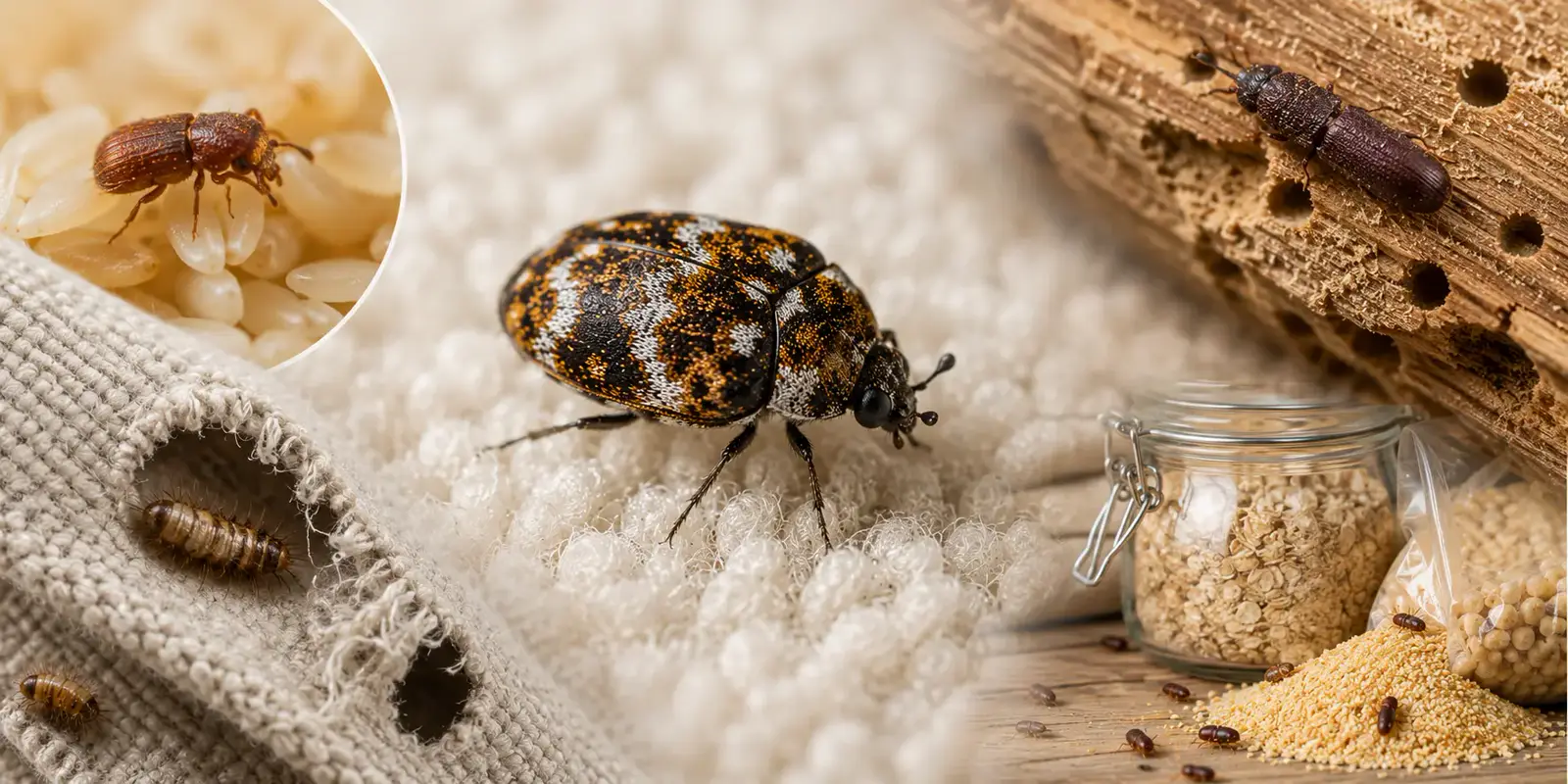
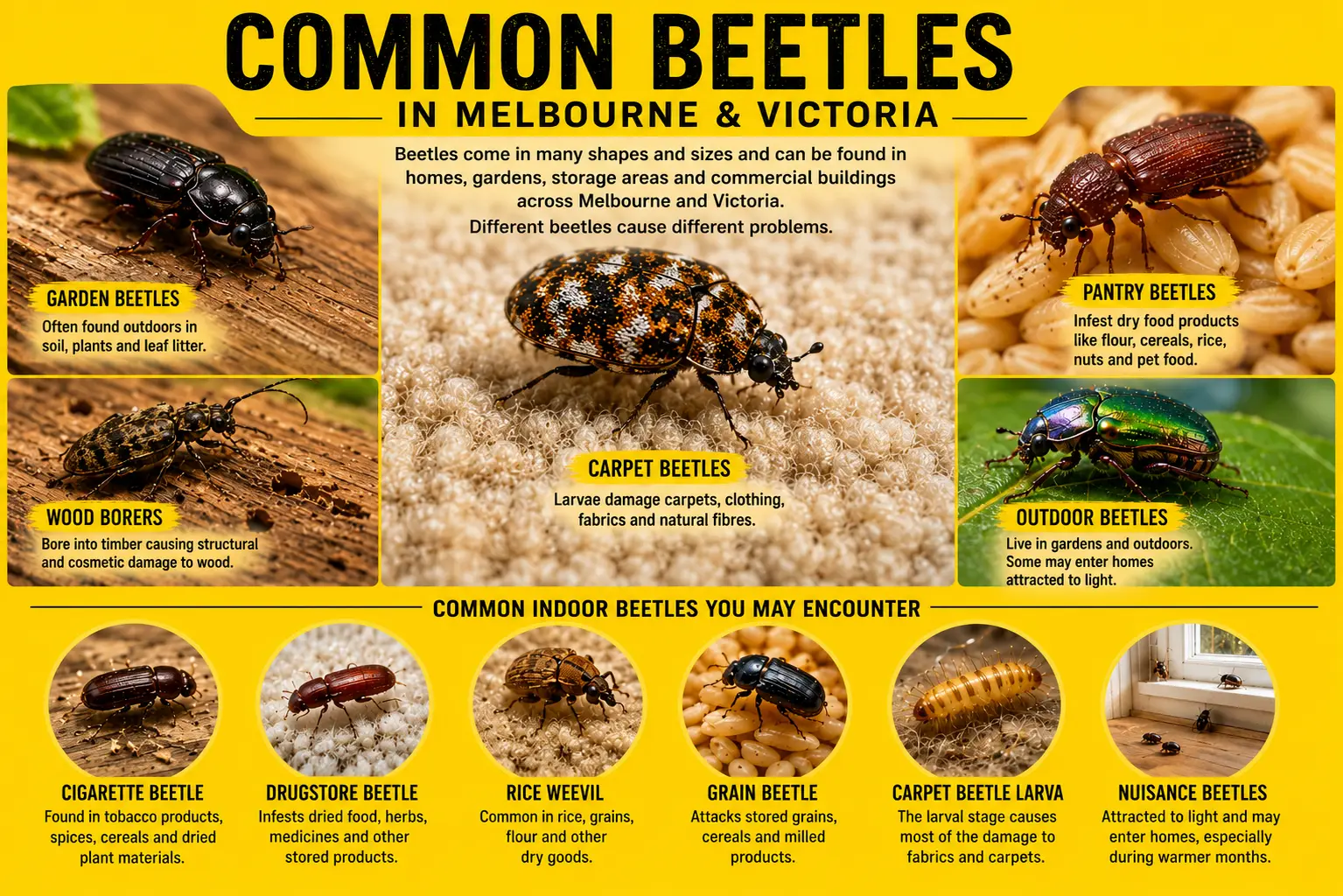
The Museums Victoria species record for Anthrenus verbasci (the varied carpet beetle) describes a small, rounded beetle with a mottled pattern of black, orange-brown and white. Adults are 2 to 3 millimetres long — about the size of a sesame seed — and because they are often the first sign of a problem, spotting them near a window is worth taking seriously. The Museums Victoria record notes that finding beetles on window sills in homes can indicate an active infestation, since adult carpet beetles are drawn toward light and tend to gather there before or after laying eggs.
The larvae are harder to spot but are the stage that actually causes the damage. They are bigger than the adults, carrot-shaped, and brown, with a brush of stiff hairs at the rear end. According to the Australian Museum's guide to Australian carpet beetles, adult females lay 40 to 90 white eggs that hatch in 8 to 15 days, and depending on species and conditions, the larvae can remain in the larval stage for anywhere from 60 days to well over a year. During that time they avoid light, feeding in dark undisturbed areas — inside folded clothing, behind skirting boards, under the edges of rugs, or inside a wardrobe where a wool sweater sits untouched for months.
Three species are commonly found in Melbourne homes: the varied carpet beetle (Anthrenus verbasci), the Australian carpet beetle (Eurhopalus riguus), and the black carpet beetle (Attagenus unicolor). Adults of all three share the same traits: very small, roughly oval, found near windows or flowers. Their larvae all share the same feeding habit: natural animal-origin fibres only. They will not touch synthetic fabrics, so damage confined to the wool sections of a blended rug, or holes in a cashmere jumper but not a polyester one, is a reliable indicator.
How to identify stored-product beetles
Stored-product beetles — sometimes called pantry beetles — are a different group entirely, though the damage they cause is just as frustrating to deal with. The species that turn up most often in Melbourne pantries are the rice weevil (Sitophilus oryzae), the sawtoothed grain beetle (Oryzaephilus surinamensis), and the red and confused flour beetles (Tribolium castaneum and T. confusum). The Australian Museum's beetle overview notes that some beetle groups, including the cigarette beetle and drugstore beetle (related stored-product pests), are significant infestors of foodstuffs in domestic and commercial premises.
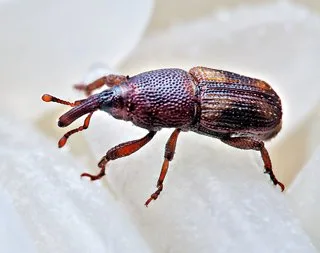
The rice weevil is one of the more distinctive: a small, reddish-brown beetle, 2 to 3 millimetres long, with a pronounced snout — the feature that sets weevils apart from all other stored-product beetles. The sawtoothed grain beetle is slender, flat, and brown, with six characteristic saw-like projections along each side of the thorax. Both adults and larvae feed inside grain, flour, and cereal products. The flour beetles are similar in size but lack the snout; they tend to infest already-milled products rather than whole grain.
The practical way to distinguish a stored-product beetle from a pantry moth or other pest is the beetle's hard wing covers (elytra) — the shell-like outer wings that fold flat along the back. Where a pantry moth leaves obvious webbing and frass in food products, stored-product beetles leave a fine floury residue, a faintly musty smell, and eventually the adults themselves moving through the infested material. Finding a weevil with a visible snout in your rice confirms the species; finding flat, brown beetles in oats or flour points to sawtoothed grain beetles or flour beetles.
Health and property risks
Carpet beetles do not bite people, but their larvae carry a genuine health risk for some households. As the Australian Museum explains, the larval hairs break off when the larvae are disturbed and can cause allergic reactions on skin contact — a condition known as carpet beetle dermatitis. The fine hairs are also small enough to become airborne and have been associated with rhinitis and asthma aggravation in sensitive individuals. The risk is highest in households with heavy, longstanding infestations where shed larval skins and hairs have accumulated in carpet fibres, inside wardrobes, or in a roof void used for storage.
The property damage that carpet beetles cause depends on how long the infestation runs undisturbed. A single generation over one season may leave only small, irregular holes in a woollen rug or a few bare patches on a fur-trimmed coat. A multi-year infestation in a storage room or linen cupboard can destroy high-value items entirely — antique rugs, museum-quality textiles, vintage fur, or a collection of woollen garments stored in boxes. Protech technicians regularly find the worst damage concentrated in areas that were simply closed up and forgotten: a spare bedroom, a roof-space storage area, or a rarely opened wardrobe.
Stored-product beetle infestations are primarily a food safety and financial concern. Heavily infested flour, rice, cereals, dried fruit, spices and pet food must be discarded. In a residential kitchen, a single infested bag of flour can spread to nearby food products within weeks as adults emerge and move between open packets. In a commercial food business, a stored-product beetle infestation puts compliance at risk and can render entire stock lines unsaleable.
Signs of a beetle infestation
With carpet beetles, the clearest early sign is the larval skin. As larvae moult through their growth stages they leave behind brownish, bristly husks — shed skins that look like tiny dried-out grubs. These accumulate along skirting boards, in the base of wardrobes, under area rugs that are rarely lifted, and inside stored clothing boxes. Finding shed skins is a more reliable prompt to investigate than finding adult beetles, because the skins mean larvae have been actively feeding in that location.
Fabric damage from carpet beetle larvae tends to appear as irregular, ragged grazing or holes on one side of the material, concentrated where the fabric meets a dark, undisturbed surface. A rug may look fine from above while the underside carries extensive grazing; a woollen blanket stored folded may have holes only in the inner layers. The damage is easy to confuse with clothes moth damage, which is caused by an entirely different pest — carpet beetle larvae tend to produce more scattered, patchy grazing, while clothes moth larvae often leave silken tubes and frass near their feeding.
For stored-product beetles, the signs are more direct: live or dead adult beetles in dry food products, a floury or musty smell, or fine powder residue inside packet seams. Rice weevils are large enough to spot in a handful of rice; flour beetle adults are smaller and may be missed until numbers are high. Check the seams of packets and the corners of pantry shelves, where frass and dead adults accumulate.
How to keep carpet beetles and pantry beetles out
Carpet beetles enter homes from outdoors — adults fly and are attracted to flowers, bird nests and dried plant material, then find their way in through gaps around windows and doors. A common but overlooked entry route is a bird nest in the roof space or under eaves: dried feathers, skin fragments and nesting material are an ideal larval food source, and once a population is established there, adults spread into the main house. Insect screens on windows reduce adult entry during the spring and early summer flight season.
For the stored-product group, the entry route is almost always an infested product brought into the home — a bag of rice with eggs already laid inside the grain, or a bag of flour that has sat on a supermarket shelf long enough for a weevil population to establish. Decanting all dry goods into sealed, airtight containers immediately after purchase breaks the cycle before it starts. This single habit, applied consistently to flour, cereals, rice, oats, dried fruit, spices and pet food, removes the breeding ground that allows pantry beetles to spread from one product to several.
For carpet beetles, vacuuming regularly and thoroughly — paying particular attention to the edges of carpets, the base of wardrobes, and underneath furniture — removes eggs, larvae and shed skins before the population can build. Store seasonal woollen and silk items clean and sealed: larvae are attracted to soiled fibres, and airtight plastic bags or rigid containers deny them both access and food. When purchasing second-hand rugs, upholstered furniture, or vintage clothing, inspect them carefully before bringing them inside, as these are a common introduction route for both carpet beetles and furniture beetles.
Why DIY control has limits
For stored-product beetles, discarding all infested food, thoroughly cleaning the pantry and transferring remaining dry goods to sealed containers often resolves a minor infestation without professional treatment. The difficulty is confirming the infestation is truly minor: beetles can lay eggs in grain long before adults are visible, the larvae of species like the rice weevil develop entirely inside the grain kernel, and a clean-looking pantry can still harbour a breeding population inside un-decanted dry goods.
Carpet beetle infestations are considerably harder to resolve without professional treatment once they are established. The larvae live and feed in locations that a vacuum does not reach reliably — inside wall cavities, under fixed floor coverings, inside roof spaces, and within the layers of stored goods in sealed rooms. Surface sprays available to householders do not penetrate to where the larvae are feeding. Beetle larvae are also tolerant of a wide temperature range, and unlike stored-product beetles they do not rely on a single food source that can simply be removed. An inspection establishes where larvae are actually feeding and nesting, which is the information that determines where any treatment needs to be applied — without that step, residual sprays used in the wrong areas deliver poor results and allow the infestation to continue.
Timber-boring beetles — furniture beetles, powderpost beetles and house longhorn beetles — are a separate category not covered in this guide. If you have found small round exit holes in timber floors, furniture or roof timbers, that is a timber pest matter and we cover it on the wood borer control page.
How Protech treats carpet beetles and stored-product beetles
Every treatment begins with an inspection that identifies the species, maps where larvae are feeding and where adults are emerging, and assesses the likely entry routes and conditions sustaining the population. For carpet beetles this typically means checking the wardrobe interiors, under fixed and loose rugs, along skirting boards, in any accessible roof or subfloor space used for storage, and around any bird nests near the building. For stored-product beetles, the inspection covers the pantry, all adjacent cupboards, and any dry food storage areas in other parts of the home.
For carpet beetles, the treatment involves a residual insecticide applied to the known harborage zones — carpet edges, skirting boards, wardrobe floors, subfloor areas, and accessible roof spaces — combined with insecticidal dust treatments where liquids cannot penetrate effectively, including inside wall cavities and roof-space storage areas. An insect growth regulator applied to known larval breeding areas disrupts the development of the next generation. The technician also identifies the conditions feeding the population and advises on removing them — a bird nest over the eaves, an undisturbed storage room, or a collection of seasonal wool items stored without protection.
Stored-product beetle treatments follow the same inspection-first logic. The technician treats the infested area with a residual product applied to shelf surfaces, cracks and corners, and seals known entry points. Because the food products themselves carry eggs and larvae, the technician will advise which goods to discard and how to prepare the pantry before and after treatment. All Protech treatments are backed by a pest-free guarantee: if the problem returns within the guarantee period, we come back and re-treat at no extra charge. You can find our full beetle control service, including timber-boring and garden beetle species, on the beetle pest control page. For more species guides, visit the pest library. To arrange an inspection, call our Melbourne team on 03 9449 4244 or request a free quote.
Beetles in Melbourne FAQs
How do I know if the holes in my wool carpet are from carpet beetles or clothes moths?
Both pests eat natural fibres, but there are differences worth knowing. Carpet beetle larvae leave irregular, patchy grazing or holes spread across the fabric, often on the underside where the material contacts the floor. Clothes moth larvae tend to stay in one feeding area and leave silken tubes or frass nearby. Carpet beetle larvae are also broader at the rear and covered in stiff bristle hairs; moth larvae are smooth, whitish grubs. Shed larval skins from carpet beetles — brownish, bristly husks — are a strong indicator. If you are unsure, our inspection will confirm which pest is responsible and what treatment is appropriate.
Can carpet beetles harm my family?
Carpet beetles do not bite people, but the fine hairs on carpet beetle larvae break off easily and can cause skin irritation and an allergic rash on contact, as the Australian Museum notes for carpet beetle species found in Australian homes. The airborne hairs have also been associated with allergic rhinitis and asthma aggravation in some individuals. The health risk is greatest in households with an established, longstanding infestation where shed larval skins have built up in carpets, wardrobes or stored textiles. Treating the infestation removes the source of the hairs.
I found small beetles in my flour — is it safe to eat?
No. Flour or food products containing live or dead beetles, larvae, eggs or frass should be discarded. Transfer them in sealed bags to an outdoor bin before disposing of them indoors. All remaining dry goods in the pantry — especially open packets — should be transferred to sealed airtight containers. A professional inspection can confirm whether the infestation has spread to other products and treat the pantry area to eliminate the remaining population.
Where do carpet beetles come from?
Adult carpet beetles fly and are most active in spring and early summer, when they visit flowers outdoors and then find their way inside through windows, doors and gaps in the building. A less obvious route is a bird nest in or around the roof: dried feathers, skin and nesting material provide ideal larval food, and the adults then spread into the home from there. Second-hand rugs, upholstered furniture and vintage clothing are another common introduction route, bringing eggs or larvae in on the fabric.
Can I get rid of carpet beetles by washing everything?
Washing or dry cleaning infested clothing and bedding at high temperatures, and steam cleaning carpets, will kill larvae and eggs in the material being treated. These measures are a useful part of the response, but they do not reach larvae feeding inside wall cavities, under fixed floor coverings, in roof-space storage areas, or in places the vacuum has not been able to access. A professional treatment maps where the population is actually established and applies residual products to those areas, which is the part that makes the result last.
How much does beetle treatment cost in Melbourne?
The price depends on the species involved, the size of the home, and how far the infestation has spread. A pantry beetle treatment for a standard kitchen is a different scope from a carpet beetle program covering multiple rooms, roof space and subfloor storage. We give you a fixed price after the inspection, before any work begins, so there are no surprises. Call us on 03 9449 4244 or request a free quote to arrange a visit.
Do you guarantee beetle treatments?
Yes. Our pest treatments, including carpet beetle and stored-product beetle work, are backed by a pest-free guarantee. If the problem returns within the guarantee period we come back and re-treat at no extra charge. We confirm the length of the guarantee period in writing with your quote.
Protecting Melbourne homes and businesses since 2001 — HACCP, AEPMA and NPMA accredited, rated 4.8★ from 411 Google reviews.



Learn More About Pest Solutions
Same-day service, eco-friendly treatments and a pest-free guarantee. Domestic & commercial — all Melbourne suburbs.