
Roof Rats in Melbourne
How to recognise the black rat, why it ends up in your roof, and how our licensed team clears it properly.
Written by Muzi Tsolakis, Founder and Competency Assessor, Pest Management Victoria. Last reviewed 5 September 2026.
The roof rat, known to scientists as the black rat, is the rodent we are called out to most when a Melbourne household hears scratching overhead at night. It prefers roof voids and wall cavities, so most homes become aware of it through sound or droppings well before anyone sees the animal itself. This guide explains how to tell a roof rat apart from a mouse, a brown rat or a protected native species, why a couple of animals turn into a settled colony, the health and property risks it brings into a home, and how our licensed technicians clear it and keep it out.
How to identify a roof rat
The other rat found in Melbourne is the heavier, ground-dwelling brown rat (Norway rat), which burrows under subfloors and decks rather than climbing into roof voids.
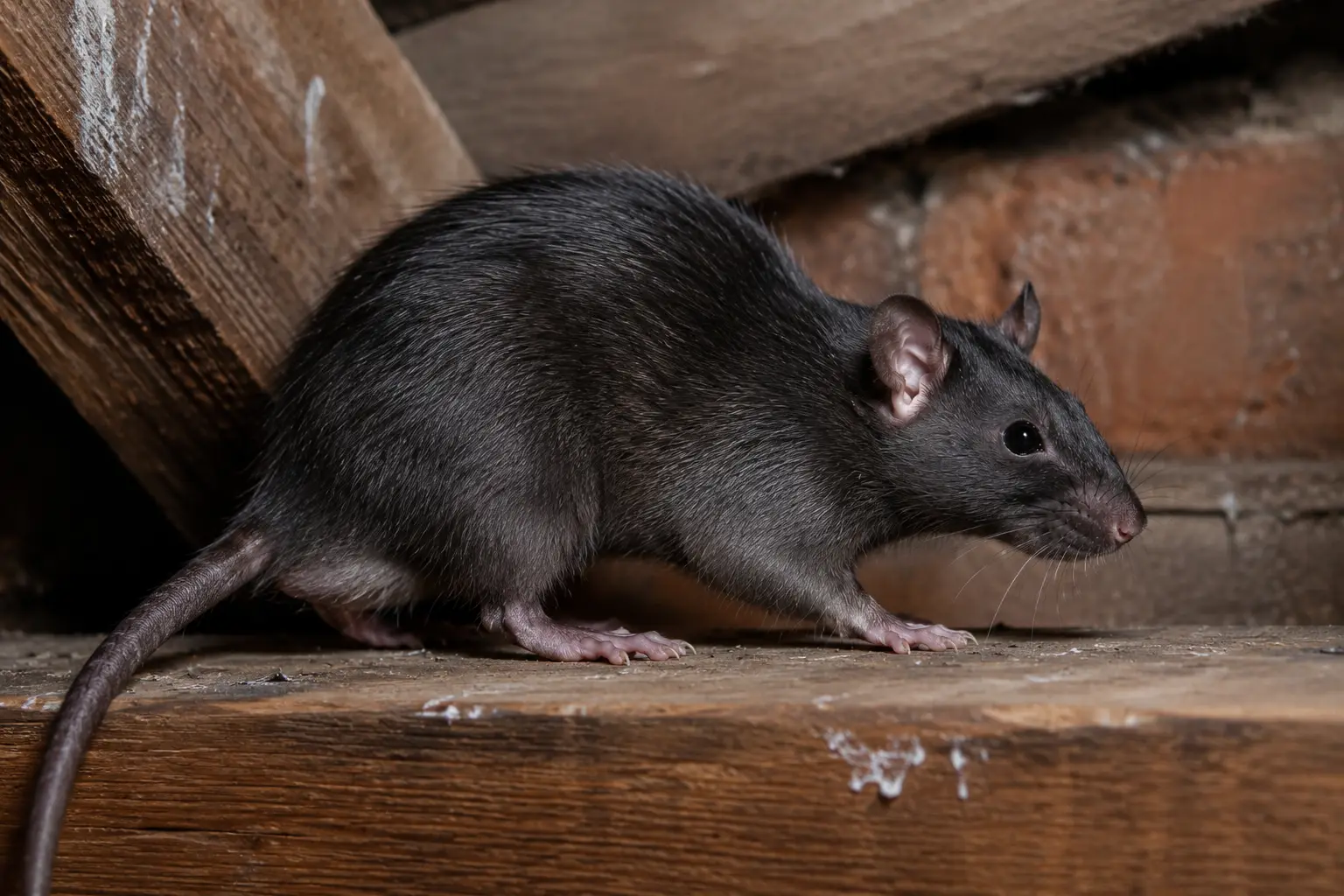
A roof rat is roughly the length of your hand from fingertip to wrist, with a slender build and a tail so long it makes the whole animal look stretched. A practical field test settles it quickly: fold one of its large, thin ears forward and it will reach close to the eye, and the scaly tail is longer than the head and body combined. For the precise figures, the head and body measure 165 to 205 millimetres with a tail of 185 to 255 millimetres, as recorded in the Museums Victoria species record; weight runs from about 95 to 340 grams, so even a well-fed adult feels light in the hand for its length.
Colour misleads people most. A roof rat can be charcoal grey or light brown above with a cream or white belly, which is some way from the jet black the name implies. Melbourne residents on the leafier urban fringe sometimes take a roof rat for a protected native such as the bush rat; the long tail, the oversized ears and a strong association with buildings give it away.
Knowing how the roof rat compares with the brown rat helps, because the two call for slightly different placement during treatment. A roof rat is slender, with a tail longer than its body, large ears and a preference for living high in roof voids and wall cavities; the brown rat we also find across Melbourne (the Norway rat) is heavier and thickset, has a tail shorter than its body and smaller ears, and burrows at ground level in subfloors, drains and garden edges. Both turn up across the city, so confirming which one you have is part of what an inspection does.
Why numbers build so quickly
Roof rats breed prolifically wherever shelter and food sit close together. A single female can produce three to six litters in a year, each holding about five to ten young that are weaned in around three weeks, according to the Australian Museum, and the young reach breeding age within a few months. For a homeowner the practical meaning is direct: if you are hearing scratching in autumn, the pair that found their way in can be a colony of thirty or forty by the time the weather warms.
A roof void gives them everything they need at once: warmth, freedom from predators and an easy run down to the kitchen. Roof rats are agile climbers, scaling brick walls, running along fence lines and power cables and crossing tree branches that overhang the gutters, then dropping inside through a surprisingly small gap. Melbourne's leafy inner-north and eastern suburbs, with their mature street trees and older rooflines, give a roof rat plenty of these aerial routes onto a house. Once in, they build nests from shredded insulation, cardboard and fabric and forage at night across ceilings, wall cavities and kitchens. They are mostly nocturnal, so the colony often grows for weeks before anyone connects the overhead scratching to a rat problem.
The health and property risks they carry
Roof rats carry genuine health and property risks that grow as the colony grows. As they move between drains, compost, subfloors and food areas they pick up and shed bacteria, and their urine and droppings can contaminate stored food, benchtops and roof insulation. The most common day-to-day concern in a home is this bacterial contamination of food surfaces and insulation, along with the dust disturbed in a roof space, which is a recognised trigger for asthma and allergies. Rats are also a recognised carrier of leptospirosis; Victoria's Better Health Channel lists rats and mice among the animals that carry the bacteria and recommends controlling rodents around the home, though serious infection is uncommon in an urban residential setting.
The property damage is just as real. Rats gnaw constantly because their incisors grow continuously and have to be worn down, and in a roof that means chewed electrical cabling, a genuine fire risk, along with damaged water pipes, ducting, sarking (the reflective foil membrane under roof tiles) and stored belongings. We regularly find insulation flattened into nesting hollows and gutters fouled with droppings. The longer a colony runs undisturbed, the more cabling, insulation and ducting it chews through, so an early call limits both the health exposure and the repair bill.
What rats in the roof sound like, and which animal it really is
Households usually describe the same soundtrack: light, quick scratching or scurrying overhead that starts within an hour or so of the house going quiet at night, travels fast along the same ceiling runs, stops dead when you bang on the plaster, then starts again a few minutes later. Gnawing adds a distinct rhythmic scraping, and in a quiet room you may hear a faint squeaking between animals. The speed and lightness are the tell — a rat crosses a ceiling in seconds, where heavier animals lumber.
Working out which animal is up there is the first genuinely useful step, because the answers call for different responses. A possum announces itself with heavy thumps and slower, irregular movement, is most active around dusk and dawn, and is protected in Victoria, so it needs removal and exclusion done lawfully rather than a rat program. Birds nesting in the eaves are a daytime sound, all flutter and chirping at the roof edge rather than movement across the ceiling. Mice make a lighter, more constant patter and are likelier in the wall cavities; rats are louder, faster and travel further in a night.
Melbourne's leafier suburbs sometimes raise the native question, and it has a tidy answer: the native bush rat avoids buildings, so the rodent running your ceiling at 10pm is overwhelmingly likely to be a roof rat or a house mouse. If the sound is nightly, follows the same routes and comes with any droppings or gnawing, treat it as an active rodent infestation and have it inspected — every week of delay is another week of breeding, chewed cabling and fouled insulation.
Signs you have a roof rat infestation
The first clue is almost always sound. Light, fast scratching, gnawing or scurrying that moves quickly along the same ceiling runs after dark, often following the same route night after night, is a reliable sign of rats in the roof void. Look next for droppings, which are spindle-shaped and around twelve to eighteen millimetres long, gathered along beams, in the subfloor and behind the kitchen kickboards.
Other tell-tale signs include gnaw marks on timber, cabling and food packaging, dark greasy smear marks where their oily coats rub against rafters and entry points, and a musky odour in an enclosed roof space. A rub mark along a fence top or a clear runway worn into roof insulation both mark a regular travel route; daytime sightings indicate numbers are already substantial, which makes an inspection the next step worth taking.
How to keep roof rats out
A few practical measures make a roof far less inviting to a roof rat, and they pair naturally with the structural proofing we carry out during a treatment.
Trim back tree branches and creepers that overhang the gutters or touch the walls, since these are the bridges a roof rat uses to reach the roofline. Seal gaps around weep holes, broken or lifted tiles, eaves and the points where pipes and cables pass through the wall, keeping in mind that a roof rat needs an opening only about the width of your finger, a gap as small as twelve millimetres. Store dry goods, pet food and birdseed in sealed containers, keep compost bins closed, and clear ground-level cover such as woodpiles and dense shrubs hard against the house. A quick check of the roof and eaves once a year catches new gaps before rats find them. You will find these prevention steps echoed across the other species guides in our pest library.
Why DIY approaches struggle with roof rats
An established roof colony needs more than supermarket snap traps and a few baits from the hardware store, which suit a single opportunist rat at best. Rats are neophobic, meaning they are wary of anything new in their environment, so they often avoid a freshly placed trap for days and learn to skirt a bait station that has been set carelessly. Catching a few animals at ground level can give a homeowner false confidence, because the breeding core in the roof void carries on untouched.
Loose baiting also creates risks that are hard to control at home. Rodenticide placed outside secured stations can be reached by pets and children, and a rat that dies in an inaccessible wall cavity leaves an odour that lingers for weeks. Second-generation baits also pose a secondary-poisoning hazard to owls and other wildlife that scavenge poisoned rats, which is why product choice, placement and tamper-resistant stations are work for a licensed technician working to AEPMA best-practice guidance for urban rodent programs. Tamper-resistant stations and trapping along the active runs we identify draw the colony away from inaccessible cavities, which reduces the chance of an animal dying in a wall, and we will tell you honestly when a structural situation makes some odour risk unavoidable. The inspection maps every entry point and harbourage; that step determines where the stations and proofing go, and it is the part a DIY effort almost always skips.
How Protech treats roof rats
Every treatment begins with a thorough inspection of the roof void, subfloor, perimeter and likely entry points so we can map where the rats are nesting, feeding and travelling. A typical home visit takes around an hour, during which the technician accesses the roof space where it is safe to do so, checks the subfloor and walks the perimeter. From there we set a program of tamper-resistant bait stations and, where it suits the situation, trapping, placed precisely on the active runs we have identified. Because roof rats are cautious of anything new, stations and traps placed on their existing travel routes draw consistent feeding from the first night, and most homeowners notice the overhead activity easing within the first week or two. Where a cavity makes some odour risk unavoidable, the technician will tell you upfront.
Closing the building against re-entry is what makes the result last. Without it, a new colony can re-establish within weeks, so we include the proofing in every treatment: we seal the gaps, broken tiles, weep holes and service penetrations the rats are using, and we point out the trees and fence lines worth trimming, which is straightforward to do yourself. The technician explains the proofing work as it is done, so you understand exactly what has been closed off and why. A follow-up visit confirms the colony has been cleared and lets us top up or remove stations as needed. Our work covers rat and mouse control for homes and commercial premises right across Melbourne, including jobs in Campbellfield, Epping and Craigieburn, and you can read our other species guides in the pest library.
Every general treatment is backed by our pest-free guarantee: if the rats return within the guarantee period, so do we, at no extra charge. If you can hear rats in the roof or have found droppings around the home, an inspection now catches the colony before it runs through another breeding cycle and compounds the damage. Call our Melbourne team on 03 9449 4244 or request a free quote, and we will arrange a visit, most often the same day, to give you an accurate price for the work.
Roof Rats in Melbourne FAQs
What do rats in the roof sound like at night?
Light, fast scratching and scurrying that starts shortly after the house goes quiet, moves quickly along the same ceiling runs night after night, and stops abruptly when you make a loud noise before resuming minutes later. Gnawing comes through as a rhythmic scraping. The lightness and speed separate rats from possums, whose movement is heavier, slower and concentrated around dusk and dawn. Sound alone rarely settles it completely, which is why an inspection checks for droppings, gnaw marks and greasy smear trails as well.
Will rats in the roof go away on their own?
It is not the way to bet. A roof void gives rats warmth, safety from predators and a short run to food, and a female can produce three to six litters a year, so a colony that has found those conditions grows rather than leaves. Activity can quieten for a few nights when something disturbs them, which is easily mistaken for the problem resolving itself. If the sounds have recurred across more than a week, assume an established and growing colony, and have the roof inspected before the damage compounds.
How do I know if it's rats in my roof and not possums?
Rats make light, fast scratching and scurrying along the same ceiling runs, usually shortly after dark, often with spindle-shaped droppings and gnaw marks nearby. A possum makes a heavier thump with slower, more irregular movement and is most active around dawn and dusk. Possums are also protected in Victoria, so it is worth confirming what you have before acting; our inspection settles it either way and ensures the right treatment or, in the case of a possum, the right referral.
Are roof rats a health risk to my family?
They carry a genuine health risk. As they travel between drains, subfloors and food areas they spread bacteria and contaminate food surfaces and insulation, and the dust disturbed in a roof space can trigger asthma and allergies. Rats are also a recognised carrier of leptospirosis, which the Better Health Channel lists among rodent-borne infections, though serious cases are uncommon in an ordinary urban home. The everyday concern is contamination, and it is why we treat an active infestation as a priority.
Can roof rats damage my house?
Yes. Rats gnaw constantly because their teeth grow continuously and need wearing down, and in a roof that commonly means chewed electrical cabling, a recognised fire hazard, along with damaged pipes, ducting and sarking (the reflective foil membrane under the roof tiles). They also flatten and foul insulation when nesting. Clearing them early and proofing their entry points limits both the safety risk and the cost of repairs.
Can I get rid of roof rats myself?
An established colony in the roof void needs a mapped program of secured bait stations and trapping, more than snap traps alone can deliver. Rats are wary of new objects and often avoid traps and bait set without care. Loose rodenticide placed outside secured stations puts pets, children and scavenging wildlife at risk, and a rat that dies in a wall cavity can leave an odour that persists for weeks. Professional treatment maps the harbourage, uses secured stations correctly and proofs the building so the problem does not simply return.
How long does it take to get rid of rats?
Activity typically drops within one to two weeks once baiting and trapping are in place. The colony then clears over the following few weeks as the program takes full effect and entry points are closed off. Heavier infestations, or a roof with many access points, generally need a follow-up visit to confirm the rats are gone.
Do roof rats carry hantavirus in Australia?
Hantavirus is carried by rodents in some parts of the world, but there is no cause for alarm here: the Victorian Better Health Channel states that there have been no recorded cases of hantavirus infection in Australia. The rodent-borne risks that do matter in a Melbourne home are the ones covered above — leptospirosis, salmonella, and the allergens and contamination that come with droppings and urine — which is reason enough to clear an active infestation promptly.
How much does professional rat control cost in Melbourne?
It depends on the property, so we give you a fixed price after the inspection and before any work begins rather than a number over the phone. The size of the home, the severity of the infestation and how easy the roof void is to access all move the figure — a two-bedroom unit and a two-storey house with dozens of entry points cannot share one price. Call us on 03 9449 4244 or request a free quote and we will arrange a visit, most often the same day.
Do you guarantee rat treatments?
Yes. Our general pest treatments, including roof rat and rodent work, are backed by a pest-free guarantee. If the problem returns within the guarantee period we come back and re-treat at no extra charge. We will confirm the length of the guarantee period in writing with your quote.
Protecting Melbourne homes and businesses since 2001 — HACCP, AEPMA and NPMA accredited, rated 4.8★ from 411 Google reviews.



Learn More About Pest Solutions
Same-day service, eco-friendly treatments and a pest-free guarantee. Domestic & commercial — all Melbourne suburbs.