
Ants in Melbourne
Identify the ant species most common in Melbourne homes, understand why they trail into kitchens, and learn how professional treatment clears them properly.
Written by Muzi Tsolakis, Founder and Competency Assessor, Pest Management Victoria. Last reviewed 5 September 2026.
Ants are among the most frequent calls we receive across Melbourne, and nearly every job brings a different species to the door. The ant trailing across a kitchen bench in Campbellfield is often a black house ant or a coastal brown ant; the column streaming in under a laundry door after rain is frequently Argentine; and the pale, persistent visitors to the bathroom tap are usually white-footed house ants. Then there are the large, aggressive bull ants in the back garden — a different problem entirely, one that carries a genuine allergy risk. This guide covers the six species Protech encounters most often in Melbourne, how an ant colony actually works from egg to queen, what flying ants mean, why they invade, what the health risks actually are, and how professional treatment clears a colony — including why spraying a visible trail can make the problem worse.
Identifying the ant species Melbourne homes actually get
Getting the species right matters before any treatment begins, because different ants need different baits and different application points. The Australian Museum notes that around 1,275 ant species have been described in Australia — the number could double with further research — and that Australian ants range in body length from roughly one millimetre to fifty. The species a Melbourne pest manager is most likely to find indoors sit at the smaller end of that range.
Black house ant (Ochetellus glaber) — the ant Melburnians most often call a 'sugar ant'. Shiny black, two to three millimetres long, six legs. It is drawn strongly to sweet foods and kitchen waste, and nests in wall cavities, under pavers and around garden beds. You will often see it foraging in a defined trail along a wall edge or window sill.
Coastal brown ant (Pheidole megacephala), also widely called the big-headed ant. Despite the coastal reference in its common name, this species is found right across Melbourne's suburban areas, nesting in garden soil and wall cavities and sending workers inside along fixed trails. Workers are roughly 1.5 to 2.5 millimetres; the colony also contains larger-headed soldiers. It is particularly aggressive at displacing other ant species from an area.
Argentine ant (Linepithema humile) — a pale to light brown ant around 1.6 millimetres long, notable for forming very long foraging trails. Colonies contain multiple queens, making them able to withstand partial treatment and prone to splitting ('budding') when disturbed. Argentine ants are well established across Melbourne's urban fringe and inner suburbs.
White-footed house ant (Technomyrmex albipes) — dark brownish-black with distinctively pale, almost white feet; about three millimetres long. Often found trailing to moisture sources — bathroom tap fittings, dishwasher seals, air-conditioning units. Like the Argentine ant, this species can have multiple queens per colony, complicating treatment.
Odorous house ant (Tapinoma sessile) — brown to black, one to three millimetres, named for the faintly rotten-coconut smell it releases when crushed. Less common than the species above but found occasionally in Melbourne homes, usually nesting near warmth and moisture.
Bull ants and jack jumpers — the large, aggressive species you are most likely to encounter in Melbourne gardens rather than inside. Bull ants (genus Myrmecia) reach up to 40 millimetres and can sting repeatedly. Jack jumpers (Myrmecia pilosula) are smaller, around ten to twelve millimetres, identifiable by their habit of jumping and by a body that is black with orange-red mandibles and legs. Both are a separate management consideration from the small house-invading species above.
Why ants form trails and why kitchens attract them
Ant colonies are driven by the same two needs as any organism: food and water. Workers leave the nest to forage individually at first, but once a worker finds a resource it lays a pheromone trail back to the colony, and recruits begin following that chemical highway in increasing numbers. That is the trail you see crossing a bench or skirting board — a communication pathway, not a random scatter of individuals.
Kitchens concentrate what ants are looking for: crumbs, spillages, open fruit bowls, residue around bin lids, drips around tap fittings, the moisture behind a dishwasher. Sugary foods draw species like the black house ant strongly; protein-rich scraps attract others. The trail can appear almost overnight when a food source is found, and it can persist for days even after the food is removed, because the pheromone residue keeps workers coming back along the same route.
Seasonal pressure intensifies the problem. Melbourne's warm summers bring ant populations to peak activity, and the drying of garden soil during dry spells drives colonies to seek moisture inside. Heavy summer rain has the opposite effect — it floods ground-level nests and pushes workers upward and inward. Either way, the timing often coincides with homeowners noticing ants for the first time.
Health and food safety risks
For the small house-invading species, the main risk is food contamination. Ants travel between outdoor waste, soil, drains and kitchen surfaces, picking up and depositing bacteria along the way. Any food they access should be considered contaminated and discarded. This is a practical concern in a kitchen but is generally a low-level health hazard compared with rodents or cockroaches.
The serious health risk comes from stinging species. According to healthdirect, there are around 90 bull ant species in Australia and they can grow up to 40 millimetres; their stings cause immediate, intense pain and can in some individuals trigger anaphylaxis, a potentially life-threatening allergic reaction. Jack jumpers are particularly well documented for severe reactions — venom immunotherapy for jack jumper allergy is available in Victoria, South Australia and Tasmania.
The Better Health Channel identifies jack jumper ants, green ants and fire ants among the insect stings that can cause anaphylaxis, which it describes as a potentially life-threatening, severe allergic reaction requiring immediate adrenaline and emergency services (triple zero). Symptoms of a severe reaction include swelling beyond the sting site, hives, difficulty breathing, and abdominal pain. Anyone stung by a bull ant or jack jumper who has not previously had an allergic reaction should monitor carefully; anyone with a known insect sting allergy should carry an adrenaline autoinjector (EpiPen) when working in the garden.
First aid for a sting that is not producing an allergic reaction is straightforward: move away from the area so you are not stung again, wash the affected area with soap and water, and apply a cold compress to help reduce the pain and swelling. Immediate intense pain followed by localised swelling and redness is the expected response and settles over hours to days. Seek emergency medical attention immediately if signs of a severe allergic reaction develop — difficulty breathing, swelling of the face or throat, dizziness or collapse — and call triple zero (000).
Inside the colony: queens, workers and a complete metamorphosis
Every ant you see foraging is one caste of a larger organism. A colony is built around one or more queens, whose only work after founding the nest is laying eggs; around the workers, sterile females who do all the foraging, nest-building and brood care; and, in season, around the winged reproductives raised to found the next generation of colonies. The workers on your bench are a fraction of the population — the queens, the brood and most of the workforce stay in the nest, which is why any treatment that only kills what you can see achieves so little.
Ants develop by complete metamorphosis, the same four-stage path as a moth or a beetle: egg, larva, pupa, adult. The larvae are legless, grub-like and entirely dependent, fed by workers on food carried back along the trails, and the pupae rest in the nest until they emerge as adults. The whole cycle typically runs from several weeks to a couple of months depending on species and temperature, and Melbourne's warm months compress it — which is why a modest spring trail can be a substantial colony by February.
Lifespan splits sharply by caste. Workers generally live from some weeks to a few months; males exist to mate and die shortly afterwards; and queens are the long game, living for years — in some species well over a decade. That longevity is the practical heart of ant control. A colony can lose foragers every day and shrug it off, because the queen replaces them faster than a surface spray removes them. Treatment succeeds when the active ingredient reaches her and the brood, and everything about a professional bait program is built around that transfer.
Flying ants: what a swarm of winged ants means
On a warm, humid day — often the first still evening after summer rain — mature colonies across a whole suburb release their winged reproductives at once. These are alates: virgin queens and males raised for a single mating flight. Swarming together in their thousands overwhelms the birds that would pick off a lone flyer and lets colonies from different nests interbreed. Within a day or two the males die, the mated queens snap off their wings, and each surviving queen digs in to found a colony of her own. The pile of discarded wings on a windowsill after a swarm is exactly what it looks like: the aftermath of the founding flight.
A flying ant swarm outdoors is a neighbourhood event and no cause for action on its own. The same swarm emerging indoors deserves attention, because alates emerge from the nest — winged ants pouring from a skirting board, a wall vent or a window frame mean an established colony inside the structure, and the emergence points mark it. Note where they appear before cleaning up; that detail shortens the inspection considerably.
The identification that genuinely counts is separating a flying ant from a termite alate, because the two swarm in similar conditions and the stakes are entirely different. An ant alate has a pinched waist, elbowed antennae and forewings larger than its hindwings; a termite alate is thick-waisted and straight-antennaed, with two pairs of wings of equal length. Our subterranean termite guide covers the termite side of that comparison, and if the insects on your windowsill have the even waist and equal wings, treat it as a termite matter and have it inspected promptly.
Australia's ants beyond the kitchen
The species that trail indoors are a narrow slice of what Australia's roughly 1,275 described ant species are doing outside, and a few of the outdoor natives are worth knowing by sight. Meat ants (Iridomyrmex purpureus) are the medium-sized, purplish-bronze ants whose colonies clear and gravel the top of their large ground nests — conspicuous, busy by day, and best simply left alone, since they neither nest indoors nor forage in kitchens. They defend the nest energetically but carry no sting.
The green-head ant (Rhytidoponera metallica) is the small ground ant with an unmistakable metallic green sheen, common in lawns and garden beds. It does sting — the 'green ants' named in Victorian anaphylaxis guidance are ants of this kind — so it belongs in the same careful category as the bull ants and jack jumpers covered earlier, and a genuine consideration for households where children play barefoot on the grass.
The banded sugar ant (Camponotus consobrinus) is the large orange-and-black ant Melbourne sees on warm evenings, foraging after dark along fences, trunks and eaves. Despite lending its name to every small black ant in the kitchen, the true sugar ant is a mostly outdoor, night-active nectar and honeydew feeder that only occasionally wanders inside. None of these three natives calls for treatment in an ordinary garden; knowing them by name mostly saves a household from treating a harmless colony that was never coming indoors.
What ants eat, and the work they do outdoors
Ants are opportunists, and each pest species leans a particular way: sugars and nectars for the black house ant, protein and oils for the coastal brown, moisture above all for the white-footed house ant. Outdoors, much of the sweet feeding is on honeydew — the sugary secretion of aphids, scale insects and other sap-suckers, which many ant species tend and defend on garden plants the way a farmer minds stock. A rose bush thick with aphids and patrolled by ants is often the true source of the trail heading up the wall behind it, and it is the kind of detail an inspection is designed to find.
The same appetite makes ants genuinely useful in the garden. They scavenge dead insects, aerate soil with their tunnelling, prey on the eggs and larvae of other pests, and several Australian plants rely on ants to carry and bury their seeds. A garden with ants in it is a garden working normally. The line we draw in practice is the building envelope: colonies nesting in the lawn and beds are part of the landscape, while trails running indoors, nests in wall cavities and swarms emerging inside are a pest problem with a defined fix.
That distinction shapes honest treatment advice. The aim of professional ant control is a building free of foraging trails and structural nests rather than a block with no ants on it, which no treatment can deliver and none should promise. Managing the attractants — the honeydew crops, the food and moisture sources, the entry gaps — is what keeps the result durable once the invading colonies themselves have been cleared.
Signs you have an ant infestation
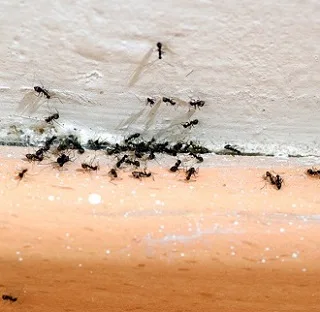
The most obvious sign is a visible foraging trail — a column of workers moving between a nest entry point and a food or water source. In a kitchen this often runs along the wall base, window sill edge or the back of a bench. Trails can appear and disappear within hours as workers abandon an exhausted food source and find another.
Nest entry points are worth looking for around the perimeter: cracked render, gaps around pipe penetrations, weep holes in brickwork, lifted pavers and disturbed soil in garden beds near the house wall. Some species, particularly the coastal brown ant, leave small soil craters at entry points when nesting in wall cavities.
A cluster of winged ants — alates, the reproductive caste — is a different sign altogether. Winged ants emerge during warm humid weather to mate and found new colonies. A swarm of winged ants indoors, particularly in a roof space or wall cavity, suggests an established colony has been nesting in the building structure for some time. Winged ants are often confused with termite alates, but ants have a distinctly pinched waist, bent antennae and forewings that are larger than the hindwings — characteristics that distinguish them clearly from white ants.

Prevention: reducing what draws ants inside
Clean up food spills and crumbs promptly — even small residues are enough to launch a trail. Store dry goods, cereals and pet food in sealed containers rather than open packets. Fruit bowls left out at room temperature are a frequent attractant, especially for black house ants; keep them in the fridge or check them daily for overripe fruit.
Address moisture as carefully as food. Fix dripping taps, reseal dishwasher door gaskets, and check that air-conditioning drain lines are clear. These are the sources that draw white-footed house ants and coastal brown ants even when kitchens are kept clean.
At the building perimeter, seal cracks in rendered walls, fill gaps around pipe and cable penetrations, and check weep holes and expansion joints. Trim plants and shrubs that touch or overhang the external walls, since these serve as bridges from garden nests to the building. Lift and check under pavers, pot plants and garden edging close to the house — coastal brown ants in particular build extensive shallow networks under hard surfaces.
For garden bull ant management, keep grass mown and reduce ground-level debris such as bark chip mulch immediately adjacent to play areas and pathways. Bull ants are most active during the warmer months of the day. You will find related prevention guidance across our other pest library guides.
Why spraying visible trails can backfire
The most common DIY response to an ant trail is to spray it with a repellent product from the hardware store. This kills the workers in the trail and removes the immediate visible problem — but for species with multiple queens, like the Argentine ant and white-footed house ant, it can trigger a survival response called colony budding. When the colony detects a threat, one or more queens separate with a group of workers and found a new satellite colony elsewhere in the building. A single-queen colony that is sprayed along its foraging trail may simply relocate its nest to an inaccessible cavity.
Repellent sprays applied at entry points create a chemical barrier that workers detect and route around, often into a wall cavity, which can make subsequent treatment harder. They also reduce the effectiveness of any bait program that follows, because workers that have encountered a repellent become wary of anything new in their environment.
Professional treatment works differently: non-repellent transfer products and gel or protein baits are applied at foraging sites and along the trails, not across them. Workers carry the active ingredient back to the colony in the food they transport, and it spreads through trophallaxis — the mouth-to-mouth food sharing that connects every ant in the nest. The colony is treated from the inside rather than the foraging trail being simply disrupted at the perimeter. This approach takes longer than a spray to show visible results — typically four to fourteen days — but it clears the colony rather than relocating it.
How Protech treats ants in Melbourne homes
Every ant job begins with a species identification, because bait matrix matters: black house ants and Argentine ants respond well to sweet gel baits; coastal brown ants and white-footed house ants are more reliably drawn to protein-based baits; and bull ant nest treatment at the garden level uses different chemistry again. Getting this wrong wastes time and money.
Once the species and nest sites are identified, we place gel or protein baits directly on the active foraging trails where workers are already moving — they carry the product back to the colony themselves, reaching the queens and brood that a surface spray never touches. For species that have established inside wall cavities or subfloor voids, we apply non-repellent transfer products in the harbourage zones, which spread through normal colony contact. We do not rely on repellent perimeter sprays as the primary treatment for the species listed in this guide.
After treatment, the trail activity typically increases briefly before it drops, because workers are recruiting more heavily to the baited food source. This is normal and expected — it means the bait is being taken back to the colony. Most Melbourne homeowners notice the trails clearing within four to seven days for smaller infestations and up to two weeks for larger or multi-colony situations. A follow-up is included where the species or infestation scale warrants it.
Our ant treatment is backed by a pest-free guarantee: if ants return within the guarantee period, we come back and retreat at no extra charge. We confirm the guarantee period in writing with your quote. For professional ant control across Melbourne — from inner-city terraces to outer-suburban homes — call our team on 03 9449 4244 or request a free quote. You can also read about our full ant control and removal service or browse the other species guides in our pest library.
Ants in Melbourne FAQs
What is the small black ant I keep seeing in my Melbourne kitchen?
The most likely candidate is the black house ant (Ochetellus glaber), a shiny black species two to three millimetres long that is strongly attracted to sweet foods and kitchen residues. The white-footed house ant is another possibility if the ants appear near moisture sources like taps or a dishwasher — it is similarly dark but has pale, almost white feet. Coastal brown ants (big-headed ants) are slightly larger at up to 2.5 millimetres and tend to trail from garden nests into kitchens. The distinction matters for treatment because each species responds to a different bait type.
Are the ants in my kitchen dangerous?
For the small species common in Melbourne kitchens — black house ants, coastal brown ants, Argentine ants — the main concern is food contamination rather than direct harm. They carry bacteria from outdoor foraging into food preparation areas, which is reason enough to act promptly, but they do not sting or bite in a medically significant way. Bull ants and jack jumpers are a different matter: their stings cause intense immediate pain and can trigger severe allergic reactions including anaphylaxis, particularly in people who have been stung before. Anyone stung by a large garden ant who develops symptoms beyond localised swelling should seek medical attention without delay.
Why do I have ants even though my kitchen is clean?
Ants do not only enter for food. Moisture is an equally strong attractant — a dripping tap fitting, a leaking dishwasher seal or the condensation around an air-conditioning outlet is often enough to bring in white-footed house ants or coastal brown ants. Melbourne's dry summer spells also drive ground-nesting species inside in search of water. If your kitchen is clean and dry and trails still appear, check under the dishwasher, around tap plinths and at the base of the walls closest to garden beds.
Why did the ants come back after I sprayed them?
Repellent sprays kill the foraging workers visible in the trail but rarely reach the queens and brood in the nest. For species with multiple queens — Argentine ants and white-footed house ants in particular — a spray can trigger colony budding, where a portion of the colony separates and establishes a new satellite nest elsewhere in the building. The trail disappears temporarily, then reappears. Professional treatment uses non-repellent transfer products and gel or protein baits that workers carry back to the colony, clearing it from within rather than simply disrupting the foraging trail.
How much does ant treatment cost in Melbourne?
We give a fixed price after inspecting the property, before any work begins, so there are no surprises on the day. The price varies with the species involved, the size of the infestation and how accessible the nest site is — a small kitchen trail and an established wall-cavity colony are very different jobs. Call us on 03 9449 4244 or request a free quote and we will arrange a visit, most often the same day, and give you an accurate price for the work.
Do you guarantee ant treatments?
Yes. Our ant control treatments are backed by a pest-free guarantee. If ants return within the guarantee period we come back and retreat at no extra charge. We confirm the guarantee period and its terms in writing with your quote, so you know exactly what is covered.
Can I treat ants myself?
Over-the-counter sprays and supermarket bait stations can reduce a small, accessible colony of a single-queen species. Where they tend to fall short is with multi-queen species like Argentine ants or white-footed house ants, and with colonies that have nested inside wall cavities or subfloor voids. Spraying a trail of these species without reaching the queens can cause the colony to split and establish multiple new nests. A professional inspection identifies the species and nest location, which determines whether a DIY approach is viable or whether it is likely to push the colony further into the building.
How long do ants live?
It depends entirely on caste. Worker ants generally live from some weeks to a few months, males die shortly after the mating flight, and queens live for years — in some species well over a decade. The queen's longevity is why an ant problem outlasts every surface spray: a colony replaces lost foragers faster than you can kill them, and it only ends when treatment reaches the queen and the brood in the nest.
What are the flying ants that appear on warm evenings?
They are alates — winged virgin queens and males released by mature colonies for a mating flight, usually on a warm, humid evening and often across a whole suburb at once. Outdoors the swarm is harmless and over within a day or two. Winged ants emerging inside the house are a different signal, because they come out of the nest itself: a colony is established somewhere in the structure, and the spot they emerged from marks it. Check the waist and wings before assuming ants at all — a thick waist and two equal pairs of wings mean termites, which needs a prompt inspection.
What do ants eat?
Almost anything, though each species leans a particular way — sugars for black house ants, protein and oils for coastal browns, moisture-linked foraging for white-footed house ants. Outdoors a great deal of their sweet feeding is honeydew from aphids and scale insects, which ants tend on garden plants and defend. That is worth knowing at home, because a trail up the outside wall often starts at an aphid-infested plant rather than in your kitchen, and dealing with the honeydew source is part of a lasting fix.
Protecting Melbourne homes and businesses since 2001 — HACCP, AEPMA and NPMA accredited, rated 4.8★ from 411 Google reviews.



Learn More About Pest Solutions
Same-day service, eco-friendly treatments and a pest-free guarantee. Domestic & commercial — all Melbourne suburbs.