
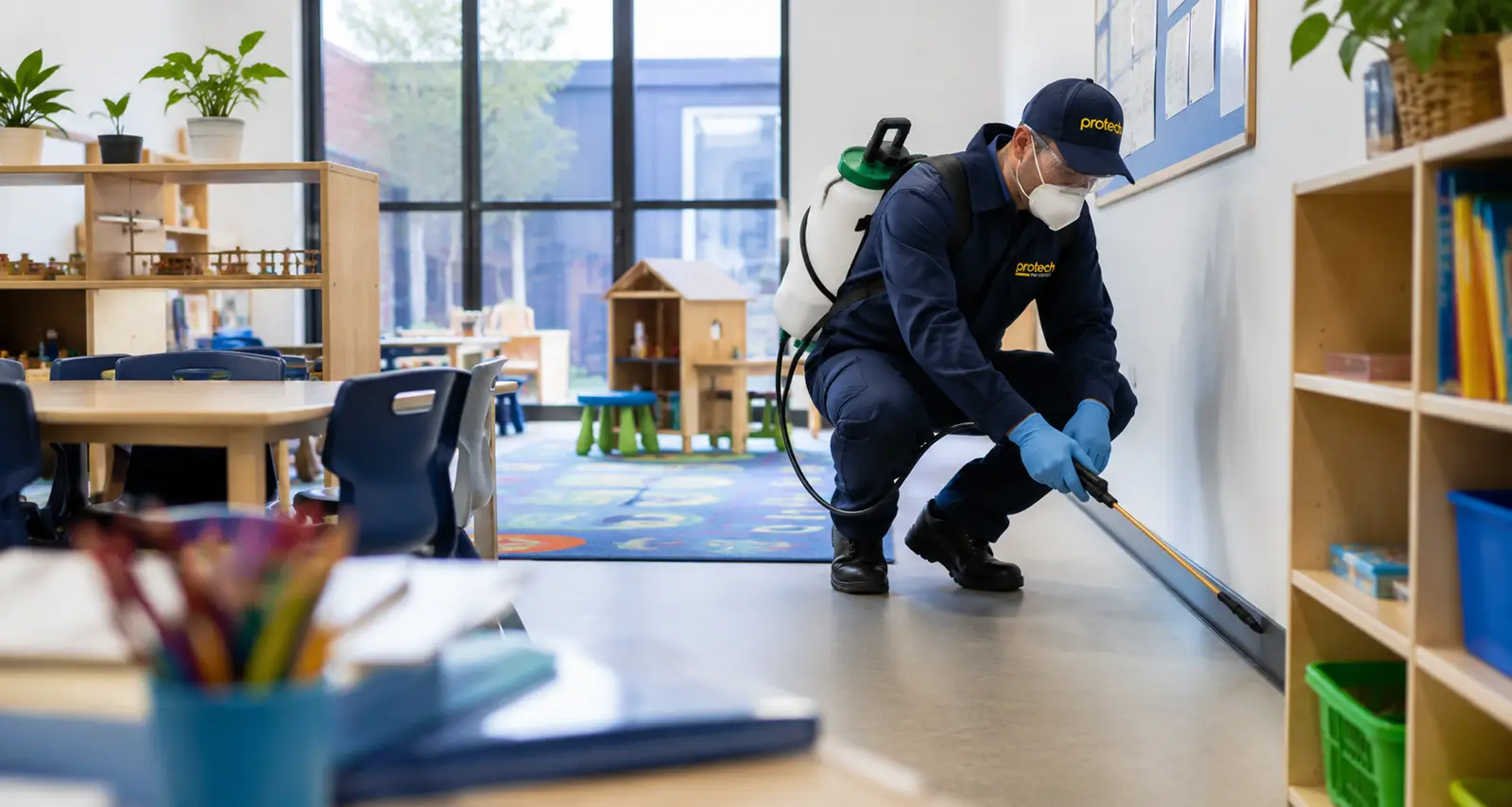
Schools & Childcare Centres
Safe, discreet, compliance-focused pest management for Melbourne schools, kindergartens and childcare centres — scheduled around your hours and backed by our pest-free guarantee.
School & Childcare Centre Pest Control Melbourne
Safe, professional pest management for educational facilities
A pest sighting in a classroom, a wasp nest near a playground or a single complaint from a parent can put a facility’s reputation and the safety of the children in its care at risk. Protech Pest Control gives Melbourne’s schools and childcare centres the professional, discreet pest management they need to operate with confidence every day.
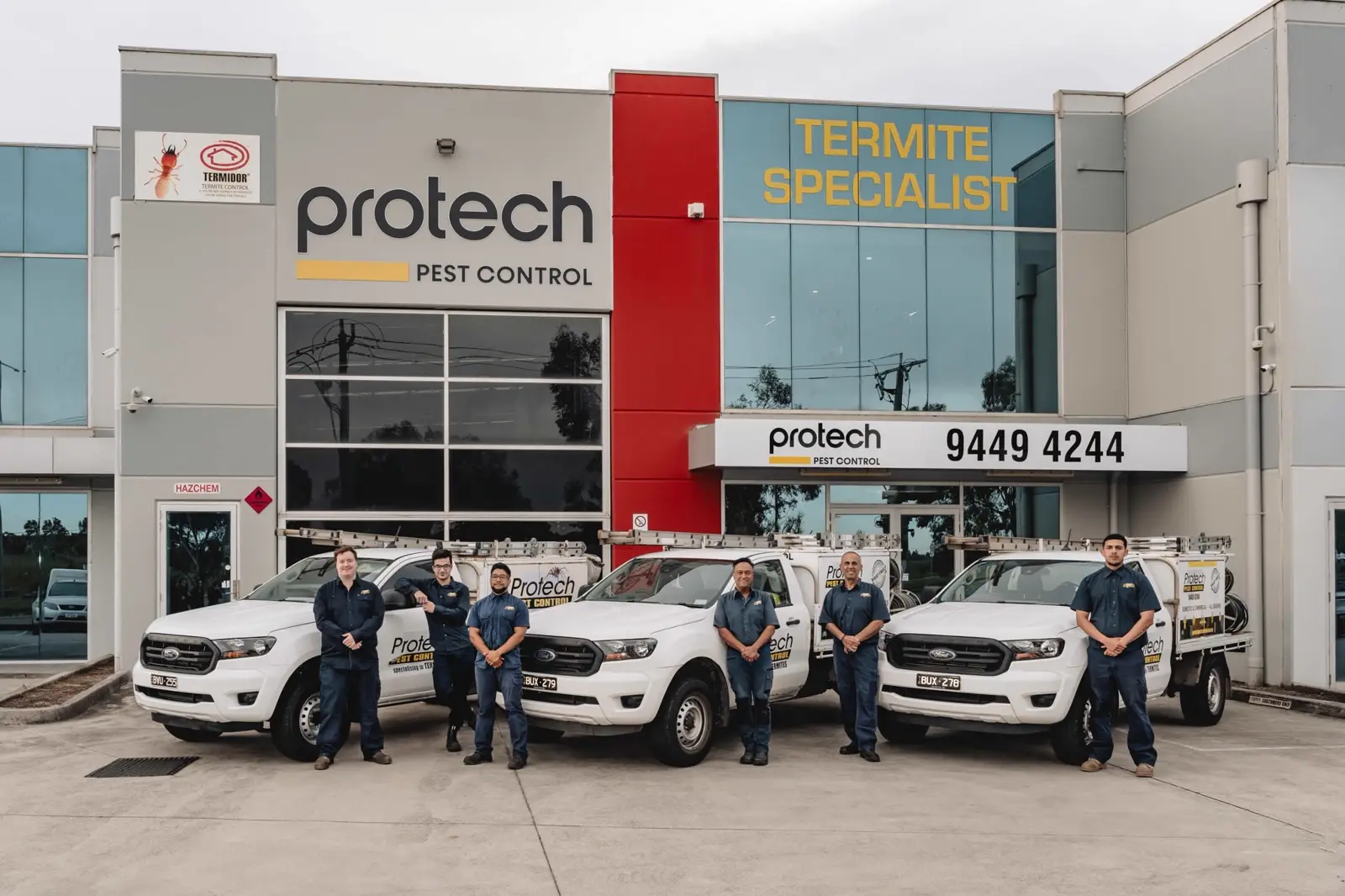
With over 40 years of combined industry experience and a company history going back to 2001, we understand the challenges educational facilities face. Our tailored commercial pest control programs deliver real protection with minimal disruption to students, staff and daily operations.
To arrange a program for your site, call Protech on 03 9449 4244.
Why educational facilities are at risk
Educational environments are naturally attractive to pests. Food consumption areas, warm indoor spaces, roof voids, storage rooms and the low-occupancy periods over school holidays all create ideal conditions year-round. Without proactive management, the consequences can be serious.
A single pest incident can result in:
- Spread of bacteria and disease among students and staff
- Contaminated food preparation areas in canteens and kitchens
- Damage to buildings, infrastructure and stored equipment
- Health and allergy risks for children and staff
- Disruption to learning environments and daily operations
- Loss of parent confidence and damage to your facility’s reputation
Effective pest management keeps your facility safe, compliant and trusted throughout the school year.
Pests We Manage in Educational Facilities
Our technicians regularly manage and prevent rats and mice, cockroaches, ants, spiders, wasps and bees, flies, birds, fleas, possums and termites — the full range of pests that threaten the safety, hygiene and daily operations of schools and childcare centres across Melbourne.
We look where pests actually hide
Pest activity is rarely visible until it is already established. Our technicians inspect the areas most commonly missed in routine cleaning, because that is exactly where infestations begin.
High-risk areas we assess include:
- School canteens and kitchens
- Childcare food preparation areas
- Staff rooms and lunch areas
- Classrooms and portable buildings
- Roof voids and ceiling spaces
- Storage areas and maintenance rooms
- Bin and waste storage areas
- Playgrounds and outdoor eating zones
- Subfloors and drainage areas
- External building perimeters
By identifying risks early, we prevent infestations before they become a disruption to students, staff or operations.
Pest Management Built Around Your Facility
Every educational facility operates differently. We build each program around your site, your risks, your school hours and your safety obligations.
Our pest management services for schools and childcare centres include:
- Routine inspections and preventative treatments
- Integrated Pest Management (IPM) programs
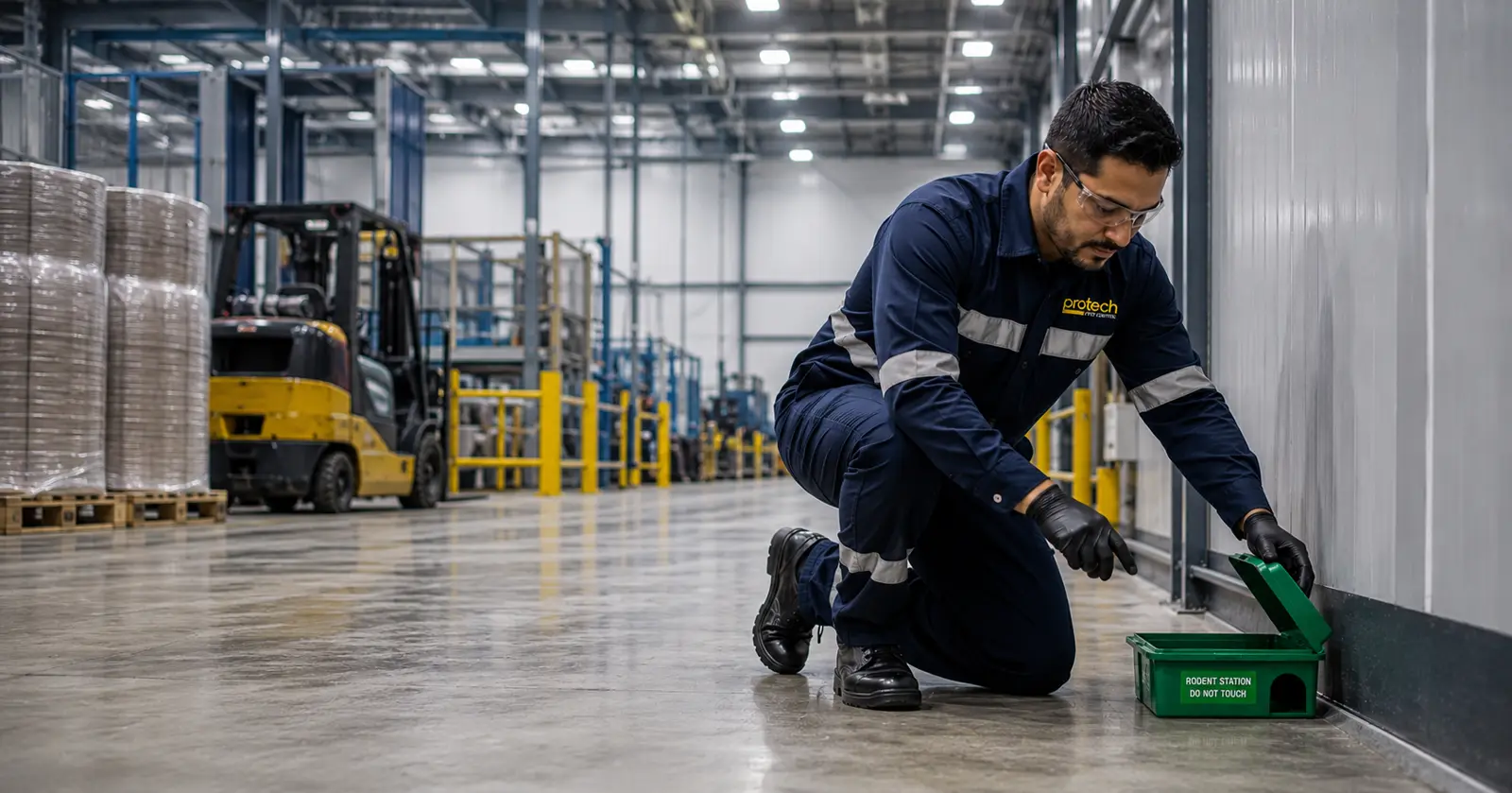
- Rodent monitoring and physical proofing
- Cockroach management programs
- Wasp and bee management
- Bird proofing and exclusion systems
- Termite inspections and management
- Digital reporting and compliance documentation
- Site-specific risk assessments and corrective action recommendations
For sites with children present, we favour treatments suited to sensitive environments and time the more intensive work for weekends, holidays and after-hours periods so learning and play areas stay clear. If you would like more detail on our approach, see our pet and child safe pest control page.
Schools and Early Learning Centres Are Two Different Jobs
Both settings have children in them, and that is roughly where the similarity ends. The buildings, the risks, the servicing windows and the product choices all follow from what the site actually is, so we write the two kinds of program separately.
What a school campus involves
A school is a property portfolio in miniature: multiple buildings of different ages, portable classrooms sitting on stumps or piers with an accessible void underneath, a canteen, a gym and change rooms, science and art rooms with store cupboards, a library, sheds, sports fields, bins, long external perimeters and often mature trees against the roofline. Roof voids and portable subfloors are the two spaces that account for most rodent and possum activity, and both are ignored by routine cleaning. The campus also empties out for weeks at a time, and a building with no people in it and no bins being emptied is a building where an unnoticed population can establish quietly over the break.
What an early learning centre involves
A childcare or kindergarten site is smaller and the constraints are tighter. Infants and toddlers are at floor level, put objects in their mouths, sleep on site and eat on site, so the surfaces and the low-level cavities carry more weight than they would anywhere else. A centre typically packs a kitchen, a laundry, a nappy change area, cot rooms, play rooms and a heavily used outdoor space into one small footprint, and the bin area is often within a few metres of an outdoor play zone. Ant trails along skirtings, cockroaches around the kitchen and laundry, spiders in outdoor equipment and rodents drawn to food storage are the recurring issues, and every one of them is addressed with placement and proofing first.
Why the work happens in holidays, on weekends and after hours
Scheduling is a safety control as much as a courtesy. Timing the more intensive work for school holidays, weekends, pupil-free days and after-hours windows means treated surfaces have dried and the re-entry period has passed long before anyone returns, rooms can be worked properly with furniture moved and cupboards opened, and no class or session is interrupted. School holidays are also the only realistic window for the larger jobs, including roof void and subfloor work, bird proofing, external proofing and termite work. For centres that run close to fifty weeks a year, we work early mornings, evenings and closure days, and the calendar is agreed with your director or business manager at the start of the agreement so nothing arrives unannounced.
Product choice and re-entry
Products are APVMA-registered and applied strictly to label by licensed technicians, and placement does most of the work. Targeted gels, baits in secured stations and crack-and-crevice application in cavities and voids keep the product where children cannot reach it, and broadcast application in occupied learning and play areas is avoided. Treated surfaces are clear once dry, which is usually one to two hours indoors and often under an hour for an outdoor perimeter treatment in warm weather, and your technician confirms the exact re-entry time for the products used before leaving the site. Our pet and child safe pest control page sets out the approach in full.
Playgrounds, Canteens and the Rooms in Between
Playgrounds, sandpits and outdoor learning areas
Outdoor areas generate most of the complaints a facility actually receives, because that is where children and insects meet. Ants nest under soft-fall, pavers, sandpit edges and garden beds and forage across play equipment, and a nest under a sandpit or a rubber softfall edge will keep producing foragers until it is treated at the colony. Spiders take up residence inside play equipment, in the hollow sections of climbing frames and slides, under seats and benches, in shade sail fixings and behind outdoor storage, and redbacks in particular favour exactly those dry, sheltered, undisturbed cavities. European wasps and bees build in wall cavities, eaves, retaining walls, ground nests near sports fields and the vegetation around outdoor eating areas, and a nest near a lunch area is the single most urgent outdoor problem a school can have. Bins, drink taps, fruit trees and food waste in outdoor eating zones are what draws them in, so the treatment and the housekeeping recommendations are issued together.
Canteens, kitchens and food preparation areas
A school canteen or a centre kitchen is a food premises and is inspected as one. Cockroaches behind and under appliances, in motor housings and along cable runs, ants working in from an external nest, rodents in dry storage and flies around bins and food waste are the standard risks, and the places that need attention are the ones nobody can reach: under and behind the fridge, the oven, the dishwasher and the servery, inside the void behind a splashback, and around the floor waste. Where the site handles or prepares food, the program is written to the same standard we apply on food premises, and our HACCP pest control page sets out what an environmental health officer or an auditor receives. Chemical application is kept away from food-contact surfaces and open food, with monitoring, proofing and targeted placement doing the work in those zones.
Classrooms, libraries and store rooms
Inside the buildings the risk is quieter and slower. Store rooms, art and craft cupboards, science preparation rooms and book storage collect paper, cardboard, dried food used in classroom activities, seed, art materials and forgotten lunch boxes, and silverfish, cockroaches, ants and pantry moths all live comfortably on that. Libraries and book stores are a silverfish problem in particular, since paper, glue and still air in a rarely disturbed corner is everything they need. Classrooms themselves usually show the symptom of a problem that starts somewhere else, so a sighting in a room is treated as a prompt to inspect the roof void, the subfloor, the nearest store room and the external wall behind it.
Talking to parents and staff
A pest sighting in a school or a centre becomes a communication problem within hours, and the facilities that handle it well are the ones that can answer plainly. Our reports are written so an administrator can tell a parent what was found, what was applied, when the area was safe to use again and what has been put in place to stop it recurring, without needing to interpret a technician’s shorthand. Where a notice needs to go out, we can supply the product and safety data sheet information behind it, and we will attend at a time that keeps the work out of view of children and parents where you would prefer that.
Documentation your department or regulator will accept
Every station, monitor and inspection point on the site is numbered and plotted on a site plan, and each visit records what was found, what was applied with product and batch details, and any corrective action raised. That builds a service history and a pest-activity trend log a reviewer can follow, which is what a department review, a licensing or assessment visit, a council inspection or an internal audit actually asks for. Reports are issued through our digital reporting system after every visit, and multi-campus operators and centre groups can hold every site under one commercial pest control agreement with consistent paperwork across the whole network.
Audit-Ready Documentation, Every Single Visit
Schools and childcare centres are required to maintain safe, hygienic environments and demonstrate compliance with their health and safety obligations. We build our programs to support your documentation requirements as a core part of the service.
Every service visit generates a detailed digital report covering pest activity, treatment records, site observations and corrective action recommendations. Everything you need for safety audits, council inspections and internal compliance reviews is accurate, on time and ready to present.
Our documentation includes:
- Detailed digital service reports
- Pest activity trend monitoring
- Site maps and treatment zone records
- Corrective action recommendations
- Service history and monitoring data
- Audit and compliance documentation
Educational Facilities We Service
We work with Melbourne educational facilities of every scale, including childcare centres, early learning centres, kindergartens, primary schools, secondary schools, colleges, universities, TAFEs, school campuses, and sporting and recreation facilities.
Why Melbourne Schools & Childcare Centres Choose Protech
Local, accredited and trusted since 2001 — rated 4.8★ from 411 Google reviews.
Deep industry experience
We understand the operational and safety requirements of educational facilities across Melbourne, and we deliver practical, long-term pest solutions built around your environment.
Fast, reliable response
Pest issues in schools and childcare centres need prompt attention. We respond quickly and time treatments around school hours and holiday periods to keep disruption to a minimum.
Genuinely tailored programs
Every facility is different. Each program is customised to your site layout, pest risks, operational schedule and safety obligations.
Prevention first
We identify and address the root causes of pest activity so problems are resolved at the source. Long-term prevention means fewer disruptions and a safer environment for everyone.
Professional compliance support
Our reporting systems make safety audits and inspections straightforward, with documentation formatted to meet the standards administrators and auditors expect.
Child-safe, fully licensed service
Every technician is fully licensed, insured and trained to deliver safe, discreet pest management — backed by our HACCP, NPMA and AEPMA accreditation and our pest-free guarantee.
Frequently Asked Questions
Are your treatments safe for children and staff?
Yes. We select products and methods suited to environments where children are present, and we schedule the more intensive work for weekends, school holidays and after-hours periods so classrooms and play areas are clear. Every technician is licensed, insured and trained to work safely on education sites, and our work is backed by our pest-free guarantee.
Can you work around school hours and holiday periods?
We build the program around your timetable. Routine inspections and preventative treatments are timed to keep disruption to students and staff to a minimum, and larger jobs are booked into holidays and low-occupancy windows wherever possible.
Do you provide documentation for audits and inspections?
Every visit generates a detailed digital report covering pest activity, treatments applied, site observations and any corrective actions. The records are formatted for safety audits, council inspections and internal compliance reviews, and we keep your full service history on file.
What pests do you treat in schools and childcare centres?
We manage rodents, cockroaches, ants, spiders, wasps and bees, flies, birds, fleas, possums and termites across classrooms, canteens, kitchens, roof voids, storage areas and outdoor zones. We can put a preventative program in place or respond to an active problem.
Do you treat head lice?
No. Head lice are a human health issue and no pest control treatment applies to them. They live on people and cannot survive away from a host for long, so they are managed through the treatments a pharmacy supplies, together with the notification and exclusion advice in your state health guidance and your own centre or school policy. Cleaning or treating a classroom will not resolve a head lice outbreak, and no pest management business should offer to. We are happy to say so on the phone and save you the callout.
How long do children need to stay out of a treated area?
As a general rule, treated surfaces are clear once they are completely dry. Indoors that is usually one to two hours; an outdoor perimeter treatment in warm weather can dry in well under an hour. The product label sets the requirement, so your technician confirms the exact re-entry time for the products used on your site before leaving, and we schedule the work so the room or play area is clear for that period without affecting your day.
Is pest control at a childcare centre different from a school?
Yes, and the programs are written differently. An early learning centre has infants and toddlers at floor level, mouthing objects, sleeping on site and eating on site, with a small building, a nappy change and laundry area, a kitchen and an outdoor play space in constant use. A school campus is a much larger property with multiple buildings, portables, a canteen, sports fields, sheds, roof voids and long external perimeters, and it empties out for weeks at a time. The pest risks, the product choices and the servicing windows follow from those differences.
Can you provide the documentation our department or regulator asks for?
Yes. Every visit generates a digital service report covering pest activity, treatments applied with product and batch details, monitoring results, site observations and any corrective actions, together with safety data sheets, a numbered site plan and our licence, insurance and accreditation certificates. The pack is formatted for a department review, a licensing or assessment visit, a council environmental health inspection or an internal audit, and your full service history stays on file so it can be produced on request.
Great to deal with and easy to speak to. I had a few issues with previous pest control companies but Protech came out and did a wonderful job and didn’t even leave a mess which the other two companies did.
– Andrew KalogirouProtect Your Facility With Professional Pest Management
Talk to the Protech Pest Control team about a tailored pest management program for your Melbourne school or childcare centre. Call 03 9449 4244 or request a free quote.
Learn More About Pest Solutions
Same-day service, eco-friendly treatments and a pest-free guarantee. Domestic & commercial — all Melbourne suburbs.