
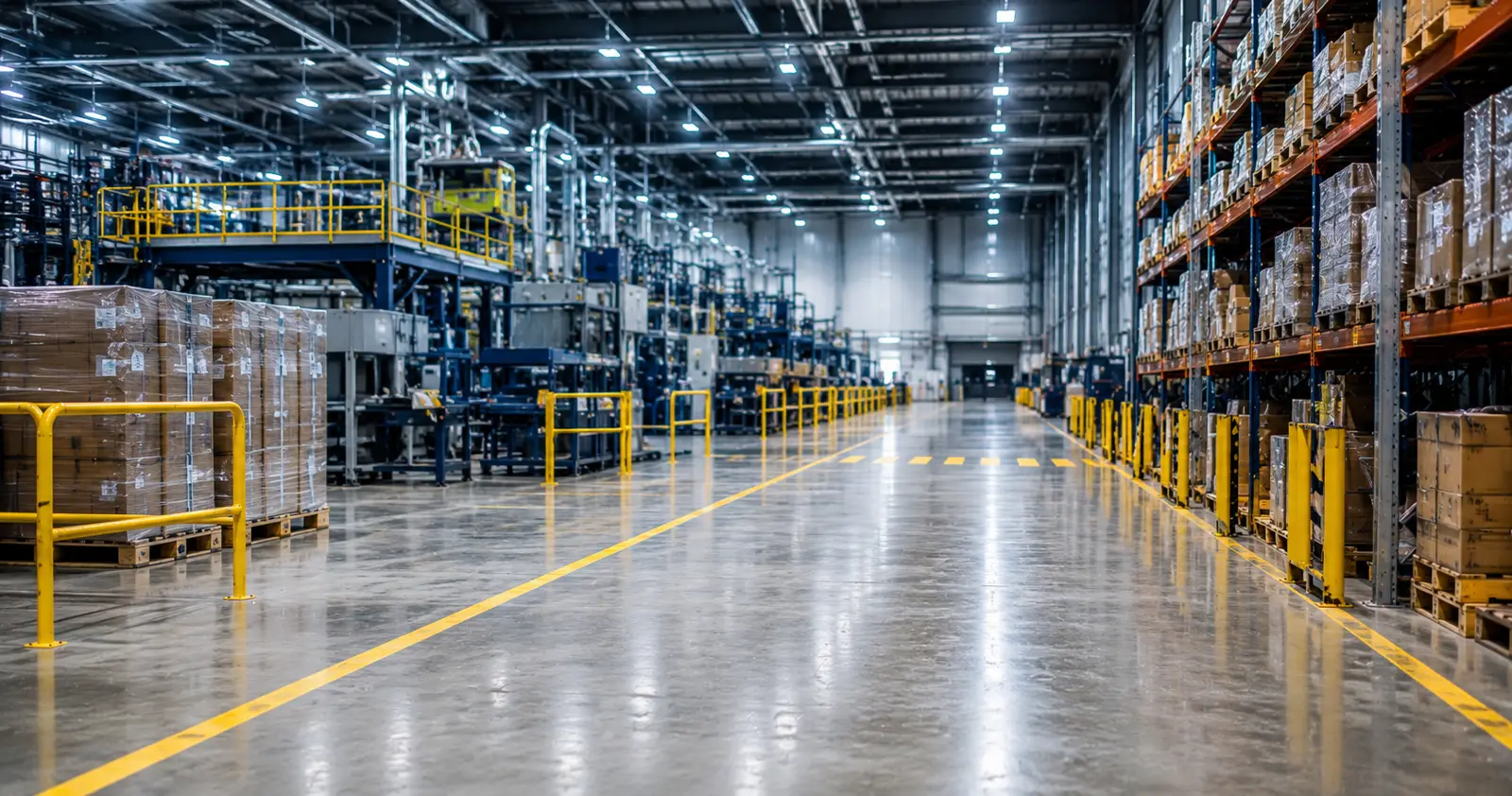
Factory, Warehouse & Industrial
Tailored, preventative pest management for factories, warehouses and industrial facilities across Melbourne.
Factory, Warehouse & Industrial Pest Control Melbourne
Professional Pest Management for Factories & Industrial Facilities
At Protech Pest Control, we understand that protecting your facility, your products, and your operations from pest activity is critical to maintaining safe, compliant, and efficient industrial environments.
Factories, warehouses, manufacturing facilities, and industrial sites require proactive pest management to ensure safe, hygienic, and disruption-free operations for staff, visitors, and production processes.
With large storage areas, continuous deliveries, warm operational environments, loading docks, roof voids, and machinery harbourage areas, industrial facilities can create ideal conditions for pests to thrive if not professionally managed.
That’s why factories and industrial businesses across Melbourne trust Protech Pest Control to deliver tailored, preventative pest management solutions designed specifically for the industrial sector.
Professional Pest Management for Industrial Facilities
Industrial environments require a program built around the scale and risk of the site.
At Protech Pest Control, we provide strategic long-term pest management programs focused on prevention, compliance, and minimal disruption to production and daily operations.
Our experienced technicians work closely with manufacturing facilities, warehouses, distribution centres, food production facilities, packaging plants, logistics facilities, industrial factories, processing plants, storage facilities, and commercial workshops across Melbourne.
We understand the importance of maintaining a safe, compliant, and efficient environment for staff, management, and site visitors.
Common Pest Issues in Factories & Industrial Facilities
Factories and industrial environments can attract a wide range of pests due to access to food, water, warmth, shelter, and constant movement of goods and deliveries.
Common pests we manage include rats and mice, cockroaches, flies, ants, stored product pests, birds, spiders, wasps, fleas, and possums — the full range of pests that threaten the safety, compliance, and daily operations of industrial facilities across Melbourne.
If left unmanaged, these pests can:
- Contaminate products and packaging
- Damage stock and infrastructure
- Spread bacteria and disease among staff
- Create workplace health and safety risks
- Cause equipment and electrical damage
- Impact audits and compliance requirements
- Disrupt production and operational efficiency
High-Risk Areas We Inspect
Our technicians carry out detailed inspections and site risk assessments to identify potential pest activity, harbourage areas, and entry points throughout your facility.
Areas commonly inspected include:
- Production and manufacturing areas
- Warehouses and storage facilities
- Loading docks and dispatch zones
- Roller door entry points
- Staff lunchrooms and kitchens
- Waste and bin storage areas
- Roof voids and ceiling spaces
- Plant and equipment areas
- External perimeters
- Subfloors and drainage systems
- Pallet storage zones
- Service penetrations and utility areas
Routine inspections help detect pest risks early before they escalate into larger infestations or operational disruptions.
Warehouse Pest Control
Warehousing carries a pest risk profile of its own, and it is different enough from a production floor to be worth setting out separately. A warehouse is a large enclosed volume with relatively few staff moving through it, racking that puts stock well above head height and out of easy view, and doors that spend much of the working day open to the yard. Stock arrives from suppliers whose own housekeeping you cannot see, sits for weeks or months, and leaves again on a pallet that a customer will open. Each of those conditions favours a different pest, and each one is managed differently.
Loading docks are the main entry route
Most pest activity in a warehouse begins at the dock. Roller doors held open through a working day, worn dock seals, damaged weather strips and gaps under levellers give rodents and crawling insects a direct path from the yard into the storage area. External lighting above an open dock draws flying insects towards the opening after dark, and they follow the light straight in. Our technicians check the seal along the base of every roller door, the condition of dock shelters and levellers, the gaps around service penetrations at the dock face and the drainage grates in the apron, then set out what needs physical proofing and what can be managed through door discipline and housekeeping.
Racking runs, pallet storage and stock integrity
Rodents travel along walls and structural lines, which makes the base of a racking run against an external wall one of the first places we inspect. Pallets stacked hard against a wall remove the inspection lane that makes activity visible, and shrink-wrapped stock left undisturbed on the floor for months becomes harbourage that nobody opens up. Stored-product pests such as flour beetles, weevils and pantry moths breed inside dry goods, grain, pet food, ingredient stock and the packaging around them, and they usually arrive in a delivery that was already infested. Monitoring in dry-goods and ingredient bays is set up to pick that up while it is still confined to one pallet, which is the difference between quarantining a consignment and writing off a bay. Gnawed packaging, droppings on a carton or an infestation found by a customer costs far more than the stock itself once a rejected consignment, a supplier corrective-action request or a failed audit is added to the bill.
Bird pressure in high roof spaces
High-bay roof structures, purlins, gantries, sprinkler runs and light fittings give pigeons, starlings and sparrows secure roosting points well out of reach of a broom. Droppings then fall onto stock, packaging and pick faces below, nesting material blocks box gutters and downpipes, and the mess builds up on walkways and mezzanines where staff work. Our bird proofing and netting work for warehouses covers netting to close off roof voids, canopies and mezzanine undersides, spikes and wire systems on ledges and beams, and proofing at the dock openings birds use to come and go. Netting and proofing carry six years of workmanship cover and up to ten years on the product, subject to annual inspections.
Perimeter baiting and internal monitoring
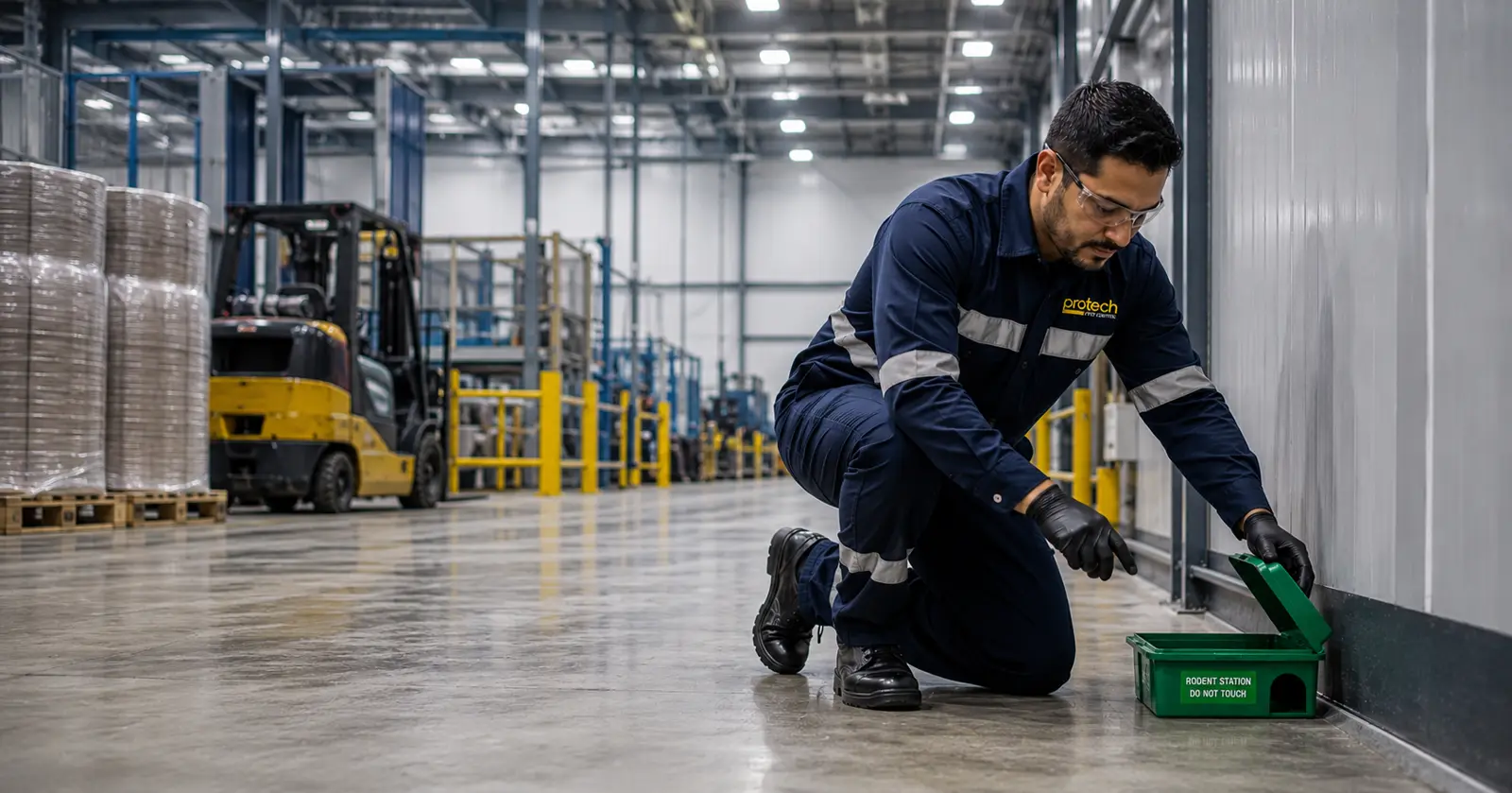
A large storage building is protected from the outside in. Lockable, tamper-resistant external bait stations are installed at set intervals around the perimeter so rats and mice are intercepted in the yard before they reach a doorway, with internal monitoring stations placed along walls, behind racking legs, in plant rooms and beside dock doors to show whether anything has crossed the perimeter line. Every station is numbered and plotted on a site plan, and the readings from each visit build a pest-activity trend log that shows where pressure is coming from, whether it is seasonal and whether the program is holding. That record is the same one an auditor asks to see, and it is issued through our digital reporting system after every visit.
Warehouse and distribution work sits inside the same scheduled agreement as the rest of our commercial pest control programs, so a business running a production plant, a storage facility and a head office gets one provider, one reporting format and one point of contact across all three.
Tailored Industrial Pest Management Programs
No two facilities operate the same way. Each program is built around your industry, your operational requirements, your production schedules and the risks specific to the site.
Our industrial pest management services include:
- Routine inspections and preventative treatments
- Integrated Pest Management (IPM) programs
- Rodent monitoring and proofing
- Cockroach management programs
- Bird proofing and exclusion systems
- Fly control solutions
- Warehouse fumigation services
- Stored product pest management
- Digital reporting and compliance documentation
- Site-specific risk assessments and preventative proofing recommendations
Our technicians work efficiently and discreetly to minimise disruption to production, staff, and logistics operations.
Integrated Pest Management (IPM) Programs
At Protech Pest Control, we focus on long-term prevention through Integrated Pest Management (IPM) strategies.
Our IPM programs identify and eliminate the conditions that allow pests to survive and breed, through routine monitoring and trending, risk identification, environmental management, exclusion and proofing works, corrective action recommendations, and preventative maintenance strategies.
This proactive approach helps reduce recurring pest issues while supporting safer and more efficient industrial operations.
HACCP-Aligned & Compliance-Focused Documentation
For food production facilities, warehouses, and compliance-sensitive industries, maintaining proper pest management documentation is essential.
Every service visit generates a detailed digital report covering pest activity, treatment records, site observations, and corrective action recommendations. Everything your facility needs for third-party audits, internal compliance reviews, and industry standards — accurate, on time, and ready to present.
Our documentation includes:
- Detailed digital service reports
- Pest activity trend analysis
- Site maps and monitoring records
- HACCP-aligned pest management programs
- Audit-ready documentation
- Corrective action reports
- Service history and treatment records
Bird Proofing & Industrial Exclusion Works
Bird activity in industrial environments can create significant hygiene, safety, and operational issues. Bird droppings, nesting materials, blocked gutters, and damaged infrastructure can quickly impact production environments and workplace safety.
Protech Pest Control provides professional bird management solutions including bird netting, bird spikes, bird wire systems, loading dock bird proofing, roof and canopy exclusion systems, humane deterrent systems, and industrial bird laser systems — all professionally installed to provide long-term protection for industrial and commercial facilities.
Distribution Centres, Plant Rooms and the Rest of a Large Site
A big industrial site is several different environments under one title deed, and a program that treats it as a single space will miss most of the risk. The production floor, the storage building, the plant room, the waste compound and the lunchroom each attract a different pest for a different reason. The servicing schedule is written zone by zone, with its own frequency, its own monitoring points and its own corrective actions for each.
Distribution centres and manufacturing plants
Distribution centres run high pallet turnover, long picking aisles and near-continuous vehicle movement, so pressure comes in with the freight and concentrates at the dock and the inbound staging area. Manufacturing plants carry a different problem: product residue, spillage under lines and in conveyor pits, warmth from motors and machinery, and hard-to-reach voids inside plant that cannot be shut down for a treatment. On a manufacturing site the inspection focuses on the places cleaning cannot reach, and the corrective actions we write are usually about spillage capture, drainage and access for cleaning as much as about treatment.
Plant rooms, voids and service risers
Plant rooms, switch rooms, compressor rooms, service risers and suspended ceiling voids are warm, dry, dark and rarely entered, which makes them the most reliable rodent harbourage on an industrial site. Cable trays and pipe runs then act as travel routes between buildings, so activity found in a plant room usually explains sightings somewhere else entirely. We inspect these spaces on every scheduled visit, proof the penetrations where services pass through walls and slabs, and record the findings against the site plan so the pattern is visible over time.
Waste compounds and the external yard
The bin compound is the single largest food source on most industrial sites. Overflowing skips, uncleaned bins, standing liquid in the compound and vegetation along the fence line support flies, cockroaches and rodents within metres of the building, and the birds that scavenge there roost on the roof above. Yard housekeeping, bin washing frequency, compound drainage and the setback between stored materials and the building wall are all recorded as corrective actions where they need attention, because treatment alone will not hold a site whose yard is feeding the population.
Staff amenities as an internal source
Lunchrooms, kitchenettes, locker rooms and vending areas are where an internal cockroach or ant population usually starts on an otherwise clean industrial site. Food brought in by staff, crumbs behind and under appliances, warm motor housings in fridges and vending machines, and bins emptied on a weekly cycle give a small population everything it needs. Amenities are treated and monitored as their own risk zone, separate from production, so an issue there is caught before it spreads along service routes into areas where product is handled.
How a large-site program is structured
The order is deliberate. We start with the external perimeter, because a pest intercepted in the yard never becomes an internal problem and never appears in a production area. Lockable stations are set at intervals around the building line, with the spacing tightened where the site backs onto vegetation, waterways, adjoining industrial land or a rail corridor. Physical proofing follows: door seals, roller door bases, service penetrations, vents, gutters and roof access points. Only then do internal monitoring points go in, placed along walls, at racking ends, in plant rooms, in amenities and around production lines, and numbered against the site plan. Servicing frequency is set by risk, so a food-grade production area may be attended monthly or fortnightly while a dry-goods store on the same site is quarterly. Frequency is then reviewed against the trend data at each contract review and adjusted where the readings justify it.
For multi-building sites and property portfolios, our facilities management pest control programs bring every building under one agreement and one reporting format. Where the site handles or stores food, the program is written to our HACCP pest control standard so the paperwork satisfies an auditor without rework.
Why Industrial Facilities Choose Protech Pest Control
Industrial Experience That Delivers Results — With over 40 years of combined experience, we understand the operational challenges and compliance requirements faced by factories and industrial facilities across Melbourne.
Fast Response Times — Pest issues can quickly impact production and operations. Our team responds promptly to minimise disruption and downtime.
Preventative Long-Term Solutions — We focus on identifying and addressing the root causes of pest activity, so the same problem does not return season after season.
Tailored Site-Specific Programs — Every facility receives a customised pest management program based on operational risks, production schedules, and industry requirements.
Detailed Reporting & Compliance Support — Professional digital reporting helps support audits, compliance, and site management requirements.
Professional & Discreet Service — Our technicians work safely and efficiently within active industrial environments with minimal disruption to staff and operations.
Complete Pest Management Solutions — From rodents and cockroaches to birds and warehouse fumigation, we provide complete industrial pest management services under one roof.
Industrial Facilities We Service
We provide pest management solutions for manufacturing facilities, warehouses, distribution centres, food production facilities, packaging plants, logistics facilities, industrial factories, processing plants, storage facilities, and commercial workshops across Melbourne.
Protect Your Facility with Professional Pest Management
At Protech Pest Control, we help factories and industrial facilities maintain safe, compliant, and pest-free environments with professional pest management programs tailored to your operations.
Factory, Warehouse & Industrial Pest Control FAQs
What does factory and industrial pest control involve?
A managed program built around your site — an inspection to map the risk points across production, storage and loading areas, targeted treatment and monitoring for rodents, cockroaches, flies, stored-product pests and birds, external perimeter protection, and physical proofing of entry points. It runs on a scheduled cycle with a digital report after each visit, so pests are kept out before they establish on site.
Can you work around our production schedule and shifts?
Yes. We plan servicing around your operating hours and production runs, including early mornings, evenings, weekends and shutdown periods, so treatment and monitoring happen without holding up the line or contaminating product. The schedule is set with your site manager and adjusted as your operations change.
Do you provide documentation for audits and compliance?
Every visit generates a detailed digital report covering pest activity, treatments, monitoring results, site observations and corrective actions, formatted to support food-safety and industry audits such as HACCP, BRC and SQF as well as internal site management. We keep your full service history on file so it is ready when an auditor asks.
What pests do factories and warehouses get?
Rodents drawn to stored goods and warm voids, cockroaches in amenities and plant rooms, flies and stored-product pests around production and waste, and birds roosting in high roof spaces and loading docks. Large sites with many entry points and constant deliveries need perimeter protection and monitoring as well as reactive treatment.
How much does industrial pest control cost?
Industrial and warehouse work is quoted per site. The figure depends on the size and layout of the facility, the pests present, the servicing frequency your risk profile calls for and the monitoring equipment the site needs, so we assess the facility and give you a fixed program price before any work begins. Quotes are free. Call us on 03 9449 4244 and we will set a program that fits your operations and your compliance requirements. Our published prices cover the residential and one-off services a commercial client also buys, such as a termite inspection from $220.
Do you provide warehouse pest control?
Yes. Warehouses, distribution centres and third-party logistics sites are a core part of our commercial work. A warehouse program is built around the dock face and the perimeter first, because that is where almost all pest pressure enters, then extended inward with monitoring along walls, racking runs and dry-goods storage. Bird proofing for high roof structures and stored-product pest monitoring for ingredient and dry-goods bays are added where the stock profile calls for them.
How are bait stations and monitors placed across a large site?
External stations are lockable, tamper-resistant and set at intervals around the building perimeter so rodents are intercepted in the yard before they reach a doorway. Internal monitors go along walls, behind racking legs, in plant rooms and near dock doors, which are the routes rodents actually use. Every station is numbered and plotted on a site plan, and the readings from each visit build a trend log that shows where the pressure is coming from and whether the program is holding.
What are stored-product pests and how do they reach a warehouse?
Stored-product pests are the beetles, weevils and moths that breed inside dry goods, grain, flour, pet food, packaging and ingredient stock. They usually arrive in a delivery that was already infested, which means the first sign is often a single pallet or bay showing activity while the rest of the racking is clean. Monitoring in dry-goods storage is set up to pick that up early, while it is still confined, and we work back through the delivery records to identify the source.
Client Testimonials
Great to deal with and easy to speak to. I had a few issues with previous pest control companies but Protech came out and did a wonderful job and didn’t even leave a mess which the other 2 companies did.
– Andrew KalogirouLearn More About Pest Solutions
Same-day service, eco-friendly treatments and a pest-free guarantee. Domestic & commercial — all Melbourne suburbs.