
Facilities Management Pest Control
Portfolio-wide pest management for Melbourne facilities and asset managers — scheduled servicing, reactive callouts and consolidated reporting under one agreement.
Pest Management as Part of Your Asset Program
A facilities manager is measured on things a pest contractor rarely thinks about: attendance against the planned maintenance calendar, response times on reactive work orders, a clean audit trail for every attendance, and reporting that can be handed to a client or a board without being rewritten first.
Protech Pest Control works to those measures. We have serviced Melbourne buildings since 2001, with more than 40 years of combined industry experience, accreditation with HACCP, NPMA and AEPMA, CM3 contractor prequalification and fully licensed and insured technicians. Every attendance produces a digital report against the individual asset, and a portfolio can be run through a single point of contact who answers for all of it.
Pest activity is a building condition, driven by structure, waste handling, drainage, roof access and tenant behaviour. Managing it belongs alongside cleaning, waste and building maintenance in the same maintenance program. Our full range of sector programs sits on the commercial pest control page.
One Agreement Across the Whole Portfolio
Managing pest control building by building creates the problems facilities teams know well: four contractors with four report formats, no way to compare activity across the portfolio, and a scramble for paperwork every time a client asks for compliance evidence. A single agreement removes that overhead.
A single point of contact, where you want one
Where you want the portfolio run that way, your nominated contact holds the servicing calendar for every building, coordinates the technicians attending them, and takes escalations for the whole contract. Site contacts still deal with the technician on the day for practical arrangements, and anything above that goes to one person who knows the portfolio history.
Consolidated reporting
Every building reports into the same portal in the same structure. You can open one site, a region or the entire portfolio, download twelve months of service history for an audit, and see pest-activity trends developing across buildings before any single site has a problem. That cross-portfolio view is the part a building-by-building arrangement can never give you.
One invoice, per-site cost visibility
Each site is priced individually, and where it suits your finance process we bill the portfolio on one consolidated document while asset managers still see what each building costs. Reactive callouts are itemised against the asset that generated them, which makes a recurring problem building visible in the numbers as well as in the reports.
Consistent standards at every address
The same program specification, equipment standard, product range and report format apply everywhere. An auditor or a client representative arriving at any building in the portfolio finds documentation identical in structure to every other building on the contract.
Documentation That Feeds Your Systems
Facilities and asset managers are audited on evidence, and a pest program that produces good outcomes with poor paperwork will fail a compliance review anyway. Our reporting is built to be handed on.
- A digital report after every attendance — pest activity found, devices inspected and their condition, treatments applied with the product name and rate, site observations, and the corrective actions we recommend to the building owner or occupier.
- Numbered site plans — each bait station, monitor, fly unit and trap mapped and numbered per building, which gives an auditor a physical reference and gives your team a record of what is installed in the asset.
- Chemical registers and safety data sheets — every product is APVMA-registered, applied to label by a licensed technician, and recorded with its safety data sheet available for the site file. Our published sheets sit on the safety data sheets page.
- Pest-activity trend logs — activity recorded per device over time, which turns a series of visits into evidence about whether the program is working at that asset.
- Reactive callout records — every unscheduled attendance is documented against the site in the same sequence as the scheduled program, so the service history is complete.
- Portal access around the clock — reports, invoices and job photos download whenever they are needed, including at the moment a client asks for them. Compliance documentation exports in seconds.
Where your organisation runs a maintenance system or work-order platform, the report for each attendance downloads as a document you can attach to the corresponding work order and close it out with evidence. Our reporting platform is described in full on the digital reporting page.
Planned Servicing and Reactive Attendance
A facilities pest program runs on two tracks, and both belong in the agreement.
Planned preventive servicing
Scheduled attendances are set per building against its risk profile and the standard it is held to. A single-tenancy office might sit on a quarterly cycle; a retail centre with a food court is usually monthly; a food-manufacturing site may need fortnightly attendance to satisfy its own audit program. Each visit inspects the fixed monitoring points, treats where activity is present, checks the proofing and entry points, and records the condition of the asset.
The value of the planned track is early detection. A rodent monitor showing activity in a roof void in March is a small job; the same colony discovered in a ceiling tile above a tenant’s kitchen in June is a work order, a complaint and a reputational problem.
Reactive callouts
Between scheduled visits, pests appear at the worst moment: a wasp nest by a building entrance in high summer, cockroaches reported in a tenancy the week before an audit, birds nesting on a plant deck ahead of an inspection. Reactive attendance is part of a facilities agreement, with the response commitment written into the contract and matched to the asset. Protech operates 24/7 including emergency callouts, and same-day attendance is normally available across Melbourne.
Program review
Recurring callouts at one building are treated as a signal about the asset. We review the trend data, identify the structural or operational cause — a failed door seal, a bin compound washed down into a drain, a roof penetration left open after a services upgrade — and recommend the proofing or frequency change that ends the cycle. The recommendation goes in the report, which gives you the documentation to justify the capital or maintenance spend it needs.
Pest Risk by Asset Area
Pest pressure in a commercial building concentrates in a handful of predictable places, and a facilities manager who knows them can plan proofing and cleaning around them. These are the areas our technicians inspect on every scheduled attendance.
- Loading docks and goods entries — roller doors left open, pallet timber, spillage and standing water make docks the primary entry point for rats and mice, cockroaches and stored-product pests. Dock seals, strip curtains and a clean apron do more for a building than any treatment applied inside it.
- Waste compounds and bin rooms — the single strongest attractant on most sites. Overfilled bins, wash-down water with no drainage fall, and compactors that are cleaned rarely support rodents, flies and cockroaches, and the pressure travels from the compound into the building.
- Plant rooms and service risers — warm, quiet and rarely entered, plant rooms and riser cupboards are prime rodent harbourage, and cabling penetrations between floors give them a route through the whole building.
- Roof voids and ceiling spaces — rodents, possums and birds all use roof spaces, and damaged eave vents, lifted tiles and gaps around new services penetrations are how they get in. Roof-void activity usually appears in a tenancy complaint before anyone inspects the void.
- Car parks and basements — drainage pits, sump rooms and grease-trap surrounds hold water and organic matter, supporting cockroaches and rodents, while the ramp entry is an open door at every hour of the day.
- Tenancy fit-outs and vacancies — a fit-out opens walls, ceilings and services voids and moves food waste around the floor. A vacant tenancy with services capped and no cleaning becomes a harbourage that the neighbouring tenants feel first.
- Food courts and shared kitchens — grease behind equipment, floor wastes and shared void space between tenancies mean a cockroach problem in one operator becomes a centre problem quickly.
- Building perimeters and landscaping — garden beds against walls, irrigation, mulch and rubbish accumulation give pests harbourage right at the facade, and external perimeter treatment and monitoring is the first line of the program.
Working With Cleaning, Waste and Maintenance Contractors
Most persistent pest problems in a managed building are solved by another trade. Our reports say so plainly, and they say which trade.
Cleaning. Grease behind cooking lines, food debris under fixed equipment, floor wastes and spillage in loading areas feed cockroach and fly populations continuously. Where a treatment is being undone by a cleaning gap, we identify the location and the frequency needed, so you can direct it to the cleaning contractor with evidence attached.
Waste. Bin numbers, collection frequency, compound wash-down and drainage fall are the variables that decide whether a waste compound supports a rodent population. We record the condition of the compound on each visit and recommend the changes that reduce the pressure, and the effective change is often an increase in collection frequency.
Building maintenance. Door seals, dock seals, mesh over vents and weepholes, sealing services penetrations, drainage repairs and roof capping are the permanent fixes for entry. We specify the proofing work by location so your maintenance team or trade contractor can quote and complete it, and we verify it on the next attendance.
Projects and fit-outs. Works that open ceilings, walls and services voids move existing pest populations through a building and create new entry points. Where we know a fit-out or upgrade is planned, we schedule attendance around it and inspect the affected areas at completion.
This coordination is where a facilities manager gains the most from a single accountable pest contractor. The pest report becomes a maintenance instruction with a location, a cause and a recommended action, which is documentation you can act on and evidence you can produce later.
Onboarding a New Site or Portfolio
Taking on a building from another contractor is where compliance records usually break. Our onboarding closes the gaps before the first scheduled service.
- Site walk and equipment audit. We inspect each building with your facilities contact and record every bait station, monitor, fly unit and trap already installed, including the ones forgotten in roof voids and plant rooms.
- Program specification. Servicing frequency, pests covered, equipment standard, access and induction arrangements, out-of-hours requirements and the reporting format are agreed per building and written into the agreement.
- New site plan. Each building receives a fresh plan with every device numbered and mapped, which becomes the reference for your audit folder and for every technician who attends.
- Baseline report. The first attendance records the condition of the asset, active pest pressure, structural entry points and the proofing recommendations, which gives you a documented starting position for the portfolio.
- Portal set-up. Your team receives portal access with the sites configured, so reports and compliance documents are available from the first visit onward.
Onboarding is planned around the number of buildings, with the existing servicing cycle maintained throughout so no site is left unserviced. Where a portfolio is going to a formal tender, our submission process is set out on the tenders and service contracts page.
Buildings and Portfolios We Service
Protech services facilities managers, asset managers, property managers and building managers across metropolitan Melbourne, covering:
- Office buildings and commercial tenancies, including multi-tenant floors and vacant tenancies between leases
- Strata and owners corporation common property, where the reporting has to be tabled at a committee meeting
- Managed residential and commercial property portfolios, including tenancy turnovers and end-of-lease work
- Retail centres, food courts and shopping precincts
- Factories, warehouses and distribution centres with large perimeters and constant goods movement
- Government, council and public facilities with formal procurement and reporting requirements
- Healthcare and aged-care facilities where treatment planning has to work around vulnerable occupants
- Schools, campuses and childcare centres serviced outside occupied hours
Specialist services attach to the same agreement where the asset needs them: termite management for buildings with timber structure or slab penetrations, bird proofing and netting for rooftops, plant decks, signage and loading areas, and subfloor ventilation where moisture is driving activity underneath the building.
Why Melbourne Facilities Managers Choose Protech
Reporting written for your audience. Every report is presented so it can go straight to a landlord, a tenant, an auditor or a board, with the pest activity, the treatment, the product and the recommended corrective action all in one document.
One accountable contact for the portfolio. An account manager who holds the servicing calendar for every building, handles escalations, and answers for the contract as a whole.
24/7 attendance, including emergencies. Reactive callouts sit inside the agreement, with same-day attendance normally available across Melbourne and round-the-clock response for situations that cannot wait.
Accredited, licensed and prequalified. HACCP, NPMA and AEPMA accreditation, CM3 contractor prequalification, fully licensed and insured technicians, and APVMA-registered products applied strictly to label.
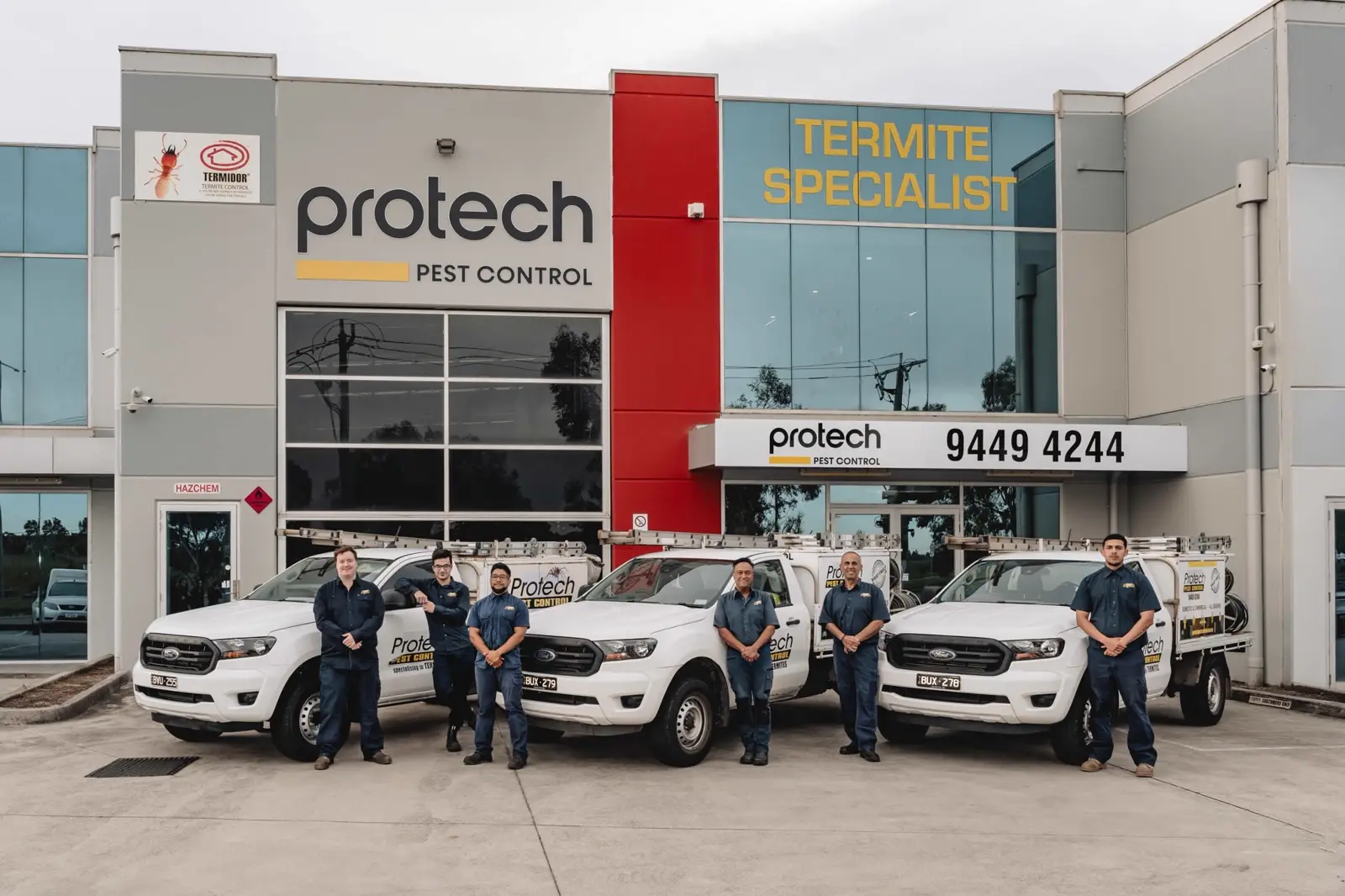
A genuinely local team. Operating from Campbellfield since 2001 with more than 40 years of combined industry experience, rated 4.8 stars from 411 Google reviews, and covering metropolitan Melbourne with our own technicians.
Guarantee terms in writing. Commercial pest management carries the guarantee terms set out in your service agreement, matched to the service frequency, and those terms are agreed before the contract starts. See the guarantee page for our full position.
Facilities Management Pest Control FAQs
Can you cover a portfolio of buildings across Melbourne under one agreement?
Yes. Facilities managers, asset managers and multi-site operators hold a single agreement, while each building keeps its own servicing frequency and its own site plan. Reporting, a named point of contact and consolidated invoicing are arranged around how your organisation needs to receive them. A quarterly office tenancy, a monthly retail centre and a fortnightly food-manufacturing site all sit under the same contract, and every one of them reports in the same format. Our coverage runs right across metropolitan Melbourne from our Campbellfield base.
Can we give your service reports to our client or tenant?
Yes, and they are written on the assumption you will. Each visit produces a digital report covering pest activity found, devices checked, treatments applied with the product and rate, site observations and any corrective action we recommend, and it is presented as a document you can forward to a landlord, a tenant, a board or an auditor without rewriting it. Reports, invoices and job photos download from the customer portal at any hour, so an urgent request from a client can be answered the same day. The detail is on our digital reporting page.
How quickly do you attend a reactive callout between scheduled services?
The response commitment is written into your service agreement and matched to the asset, because a rodent sighting in a food court and a wasp nest in a car park carry different urgency. Protech runs 24/7 availability including emergency callouts, and same-day attendance is normally available across Melbourne. Every reactive attendance produces its own report, so the callout is documented against the site in the same record as the scheduled program.
Can technicians work outside occupied hours and around tenants?
Yes. We service tenancies, retail centres, offices and public buildings before opening, after close and during planned shutdowns, and we plan attendance with your building manager so treated areas are clear when occupants return. Where a site requires an induction, a permit to work, escorted access or key and alarm handling, that is agreed and recorded before the first visit.
Who can raise a callout, and how is it tracked?
Whoever your agreement nominates — the facilities helpdesk, an account manager, a building manager or a named site contact. Each attendance is recorded against the individual site, so the service history a facilities manager pulls at the end of the year includes scheduled visits and reactive callouts in one sequence, with the pest activity that triggered each one.
What documentation do we receive for audits and compliance?
HACCP-aligned service reports, treatment records naming the APVMA-registered product and application rate, safety data sheets for every product used on site, a site plan showing numbered bait-station and monitoring-device locations, and a pest-activity trend log per building. The pack is structured to sit straight into an audit folder for HACCP, a food-safety program, an internal asset audit or a client compliance review. Our safety data sheets, insurance certificates and accreditations are also published on the safety data sheets page.
How is a facilities portfolio priced?
Commercial pest management is quoted as a custom price for each site job, built from the building area and complexity, the servicing frequency, the monitoring equipment installed, the reporting required and the reactive callout arrangement. Each site is priced individually, and the portfolio can be consolidated into a single schedule and a single invoice where that suits your finance process. Termite management, bird proofing and netting, and stored-product treatments are quoted separately against the asset that needs them.
Talk to Protech About Your Portfolio
Bring every building onto one agreement with one contact, consolidated audit-ready reporting and 24/7 reactive attendance across Melbourne. Call 03 9449 4244 or request a free quote and send through your site list.
Learn More About Pest Solutions
Same-day service, eco-friendly treatments and a pest-free guarantee. Domestic & commercial — all Melbourne suburbs.