
Pest Control Eltham
Mature canopy, bushland reserves and timber homes on big treed blocks — pest control for the pressures that come with living in Eltham, from a team on the northern run.
Pest Control in Eltham
Treed blocks, bushland reserves and houses built to sit among them
Eltham is one of the few Melbourne suburbs where the bush was kept. Streets through Eltham, Eltham North and Research hold mature indigenous canopy, blocks are generous, and the housing follows the local building tradition: mud brick, weatherboard, exposed timber beams, split levels stepping down a slope and deep eaves designed for shade. Diamond Creek runs through the middle of the suburb, the Yarra sits to the south, and reserves such as Eltham Lower Park, Edendale and the Diamond Creek trail corridor bring bushland right up to back fences.
All of that is why people choose Eltham, and it is also why the pest pattern here looks nothing like a suburban estate twenty minutes away. Wildlife has habitat and access, timber is everywhere, and the species we are called about most are the ones that live in the canopy and the leaf litter.
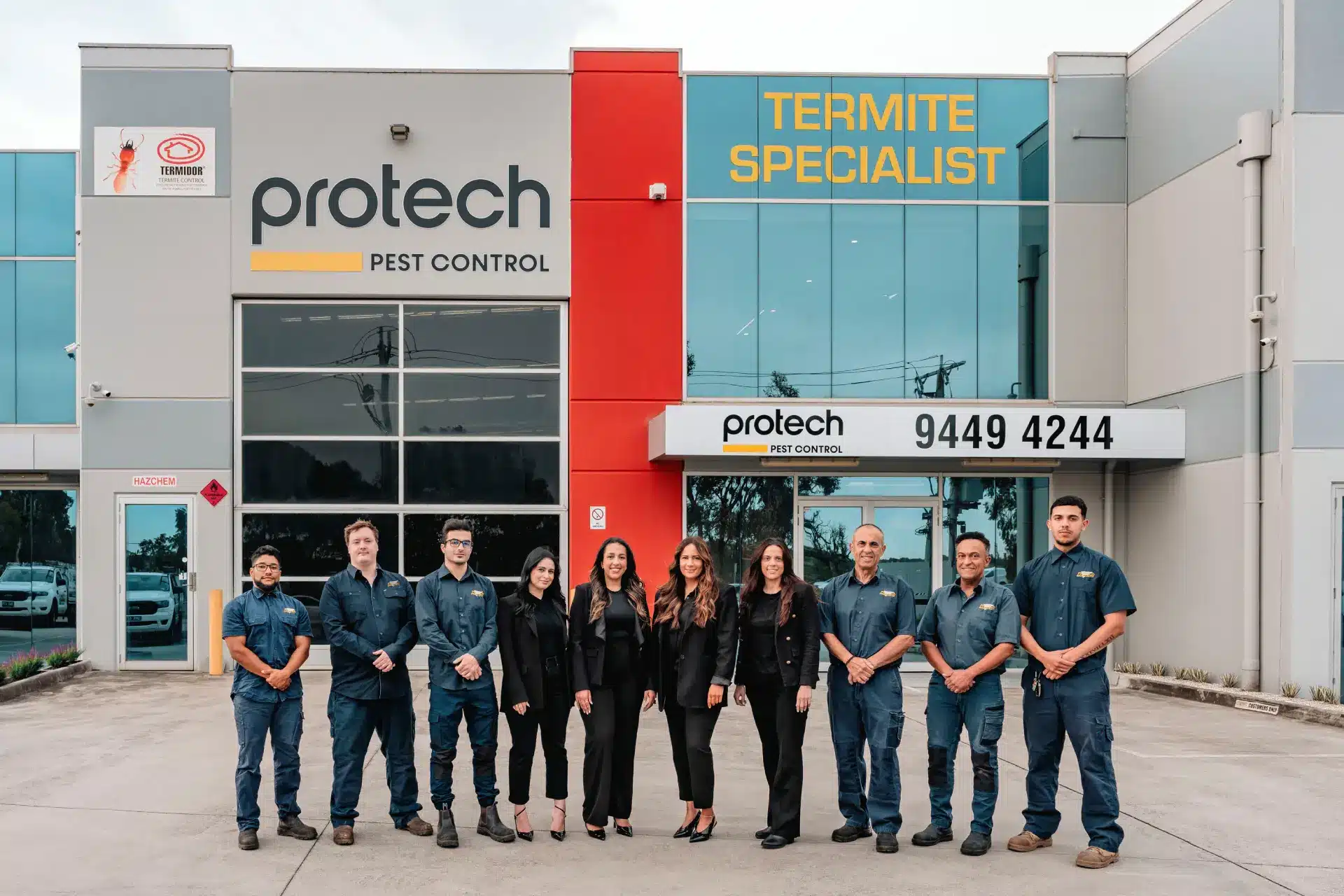
Protech has serviced Melbourne homes since 2001, with more than 40 years of combined on-the-tools experience behind the team. We are rated 4.8 stars from 411 Google reviews and hold HACCP, AEPMA and NPMA accreditation, and every job carries our pest-free guarantee.
Possums in Eltham Roofs: the Suburb’s Signature Problem
More Eltham enquiries come to us about possums than any other single issue. Brushtail possums have continuous canopy to travel along, reserves to breed in and a housing stock that gives them easy entry: deep eaves, split-level rooflines with multiple junctions, timber fascia that weathers and lifts, and the gap where a lower roof meets an upper wall. Ringtails are common in the gardens and will use a dense shrub or a pergola as a drey, although it is the brushtail that gets into the roof.
Once a brushtail is in a roof void the cost adds up faster than people expect. Insulation is flattened and fouled, wiring gets chewed, urine soaks into plaster and the smell works its way into bedrooms below. The nightly noise across the ceiling is usually what prompts the call.
What Victorian law allows, and why proofing is the real fix
Possums are protected native wildlife in Victoria. They cannot be relocated to a reserve or another suburb, and a possum taken from a roof has to be released on the same property. That single rule is why trapping on its own never solves an Eltham possum problem: the animal is back inside within a night or two through the same gap. Our work is in two halves, humane removal and then a thorough proofing pass that closes every viable entry point across the roofline, with a one-way exit used where a possum is still inside. We can also install a possum box so the animal has somewhere legitimate to go on the property.
Rats in the same roof voids
Roof rats use the identical highways, which is why Eltham homes often have both. Overhanging branches, service cables, trellis and timber fences all deliver rodents to the roofline, and the leaf litter and woodpiles common on a bush block give them cover at ground level. We bait and trap to bring the numbers down, then proof, because an Eltham roof that is open to possums is open to rats too.
Termites on Eltham’s Treed Blocks
Eltham combines most of the conditions subterranean termites want. Mature eucalypts hold moisture at the base and shed limbs that decay in the leaf litter, blocks often carry retained stumps and old sleepers, timber retaining walls step down the slopes, and decks and pergolas are commonly fixed straight to the house. A good deal of Eltham housing also pre-dates modern barrier standards, and the local preference for timber framing and timber cladding gives termites a direct route once they reach the structure.
Mud brick itself is not the vulnerability, despite how often that comes up. The timber frame, the bearers and joists, the window reveals and the roof structure are what termites are after, and a mud-brick home on a treed slope carries the same exposure as a weatherboard beside it.
Our termite inspection covers the full perimeter, the subfloor where there is access, the roof void, fencing, retaining walls, garden beds, stumps and anything fixed to the house. On Eltham properties the report usually has as much to say about conditions as about activity: a garden bed built up over the weep holes, a timber retaining wall in direct soil contact, a dripping tap behind a shrub, or firewood stacked against the wall. Where treatment is needed we use a chemical barrier or a baiting system, chosen to suit the construction, the slope and the soil, and we explain which applies before quoting. A property with extensive landscaping is often better suited to baiting, and we will say so.
Spiders, Wasps and Ants on a Bush Block
Huntsman, black house and redback spiders
Huntsman spiders live under the loose bark of eucalypts and come inside through gaps around older timber window reveals, weatherboard junctions and open eaves, usually on warm evenings and ahead of a weather change. They are harmless, although finding one on a bedroom ceiling is nobody’s idea of a good night. Black house spiders colonise window frames, eaves and the corners of verandahs, and redbacks take the dry voids in timber retaining walls, under outdoor furniture, in meter boxes and inside stacked pots. A perimeter and harbourage treatment combined with attention to the entry gaps is what brings the indoor traffic down.
European wasps along the bushland edge
Eltham is one of the suburbs where European wasps cause the most trouble. Nests go into bank faces, timber retaining walls, wall cavities, roof voids and compost heaps, and a colony builds through summer until a nest near a deck or a play area becomes genuinely dangerous. European wasps are aggressive when disturbed and can sting repeatedly, so a nest is a job for a technician. We also handle bee swarms and hives, and relocate honey bees where that is a safe option.
Ants and the rest
Sugar ants and black house ants work in from established garden beds and leaf litter, trailing along slab edges, paving joints and the base of timber decking. We also get regular calls for fleas on properties with pets and wildlife traffic, wood borer in older timber, and silverfish in the cool, dark storage spaces common in split-level homes.
Pest Control Services We Provide in Eltham
- Possum removal, roof proofing and possum box installation, carried out under Victorian wildlife law
- Rat and mouse control with full roofline proofing for bush-block homes
- Termite inspections, barriers and treatments for timber-framed homes on treed blocks
- Spider control for huntsman, black house spiders and redbacks
- Wasp and bee nest removal, including European wasp nests in banks and retaining walls
- Ant control for garden beds, paving and decking
- Flea treatments for homes with pets and wildlife traffic
- Wood borer treatment and silverfish control for older timber and storage areas
- Pre-purchase building and pest inspections, worth having on any treed Eltham block
- Commercial pest control for Eltham village shops, cafés, schools and childcare centres
Not sure what you have found? Send a photo or a short description through our contact page and we will identify it and tell you how we would treat it.
Eltham Pest Control FAQs
Why do Eltham homes get so many possums in the roof?
Eltham has mature indigenous canopy on most streets, bushland reserves along Diamond Creek and the Yarra, and a housing stock full of deep eaves, timber detailing and split-level rooflines. Brushtail possums have abundant habitat and easy access, so roof voids are an obvious next step for them. Victorian law requires humane removal with release on the same property, so the part that actually resolves it is finding and sealing the entry point after the animal is out.
Are mud-brick and timber homes in Eltham more at risk from termites?
Timber-framed and timber-clad homes on treed blocks do need closer attention, though the mud brick itself is not the issue. The risk comes from what surrounds the house: mature eucalypts, retained stumps, old sleepers, timber retaining walls, decks and pergolas fixed to the building, and garden beds built up over the weep holes. Many Eltham homes also pre-date modern barrier standards. An annual termite inspection is the sensible baseline here.
We get huntsman spiders inside constantly — is that normal in Eltham?
It is very normal on a treed Eltham block. Huntsman live under loose bark on eucalypts and move indoors through gaps around older timber window reveals, weatherboard junctions and open eaves, particularly on warm evenings and before a weather change. They are harmless to people, although nobody enjoys finding one above the bed. A perimeter and harbourage treatment, combined with attention to the entry gaps, cuts the traffic down substantially.
Do you treat bushland-edge properties for wasps?
Yes, and Eltham is one of the suburbs where we see European wasps most. Nests go into retaining walls, bank faces, wall cavities, roof voids and compost heaps, and they build through summer to a point where a nest near a deck or play area is genuinely dangerous. Please do not try to treat a European wasp nest yourself; call us on 03 9449 4244.
How quickly can you get to Eltham?
Eltham is on our northern and north-eastern run with Diamond Creek, Greensborough, Templestowe and Ivanhoe. Same-day or next-day appointments are usually available, 7 days a week including after-hours emergencies; call 03 9449 4244.
From Eltham we also cover Greensborough, Templestowe, Ivanhoe, Doreen and Mill Park, plus Eltham North, Research, Diamond Creek, Montmorency and Lower Plenty. See our full service areas.
Book Eltham Pest Control Today
Call 03 9449 4244 or request a free quote — for possums, termites and everything else a treed Eltham block brings, backed by our pest-free guarantee.
Last reviewed: October 2026
Learn More About Pest Solutions
Same-day service, eco-friendly treatments and a pest-free guarantee. Domestic & commercial — all Melbourne suburbs.