
Fleas in Melbourne
How to recognise a flea infestation, why treating only the pet leaves the problem unsolved, and how our licensed team clears it properly.
Written by Muzi Tsolakis, Founder and Competency Assessor, Pest Management Victoria. Last reviewed 18 June 2026.
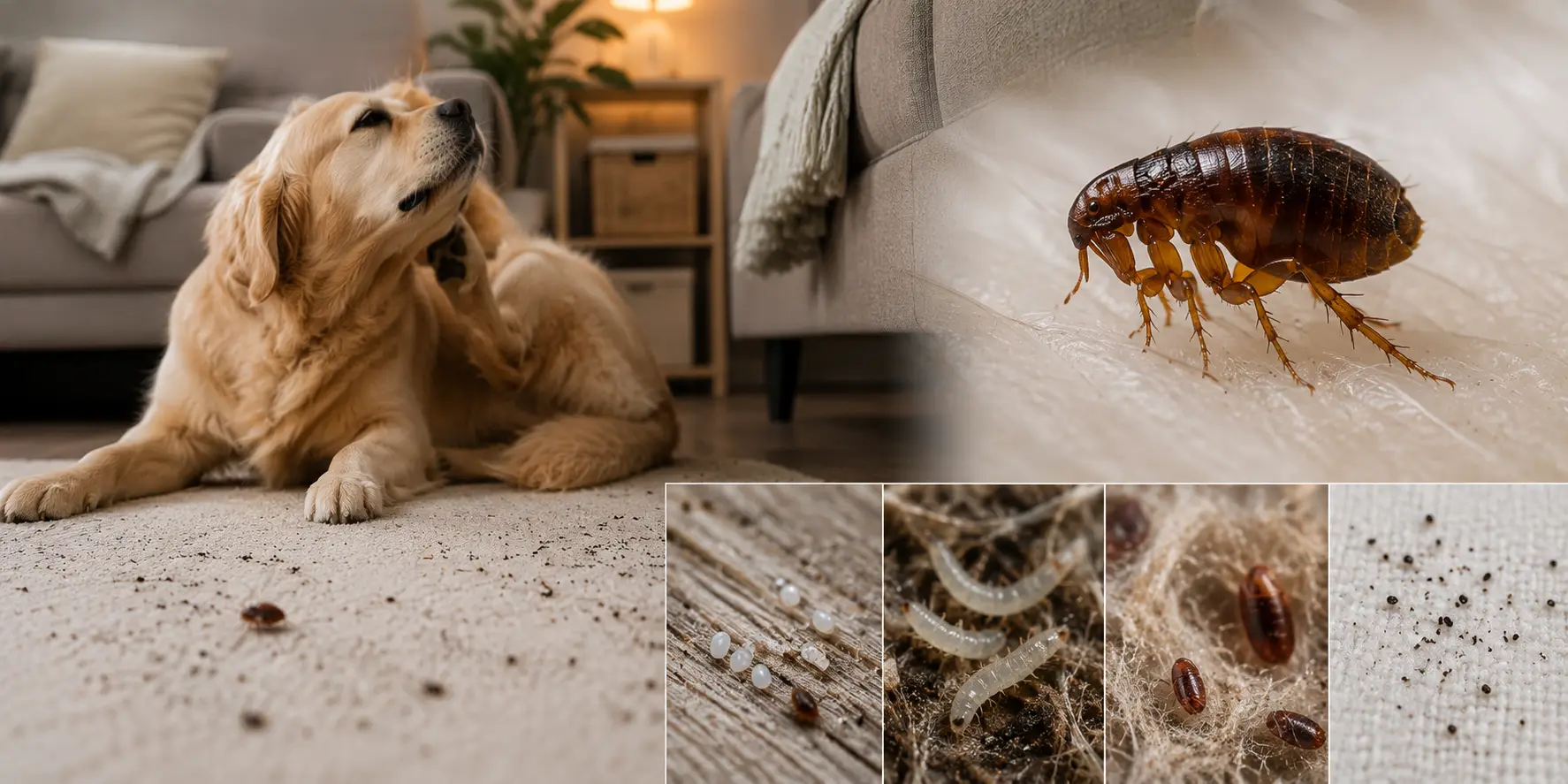
The cat flea, Ctenocephalides felis, is the species we find in the overwhelming majority of Melbourne flea jobs — on cats and dogs alike, despite the name. What catches most homeowners off guard is where most of the infestation is hiding: the adult fleas on the pet are a small fraction of the total population. The eggs, larvae and pupae are down in the carpet fibres, pet bedding and subfloor, which is why a treatment that addresses only the animal almost always leaves the home re-infested within days. This guide covers how to identify fleas and flea bites, how the four-stage life cycle drives re-infestation, the health risks, what makes an empty home explode with fleas the moment someone walks in, and why professional treatment — coordinated with your vet — is the only approach that clears all life stages at once.
How to identify a flea
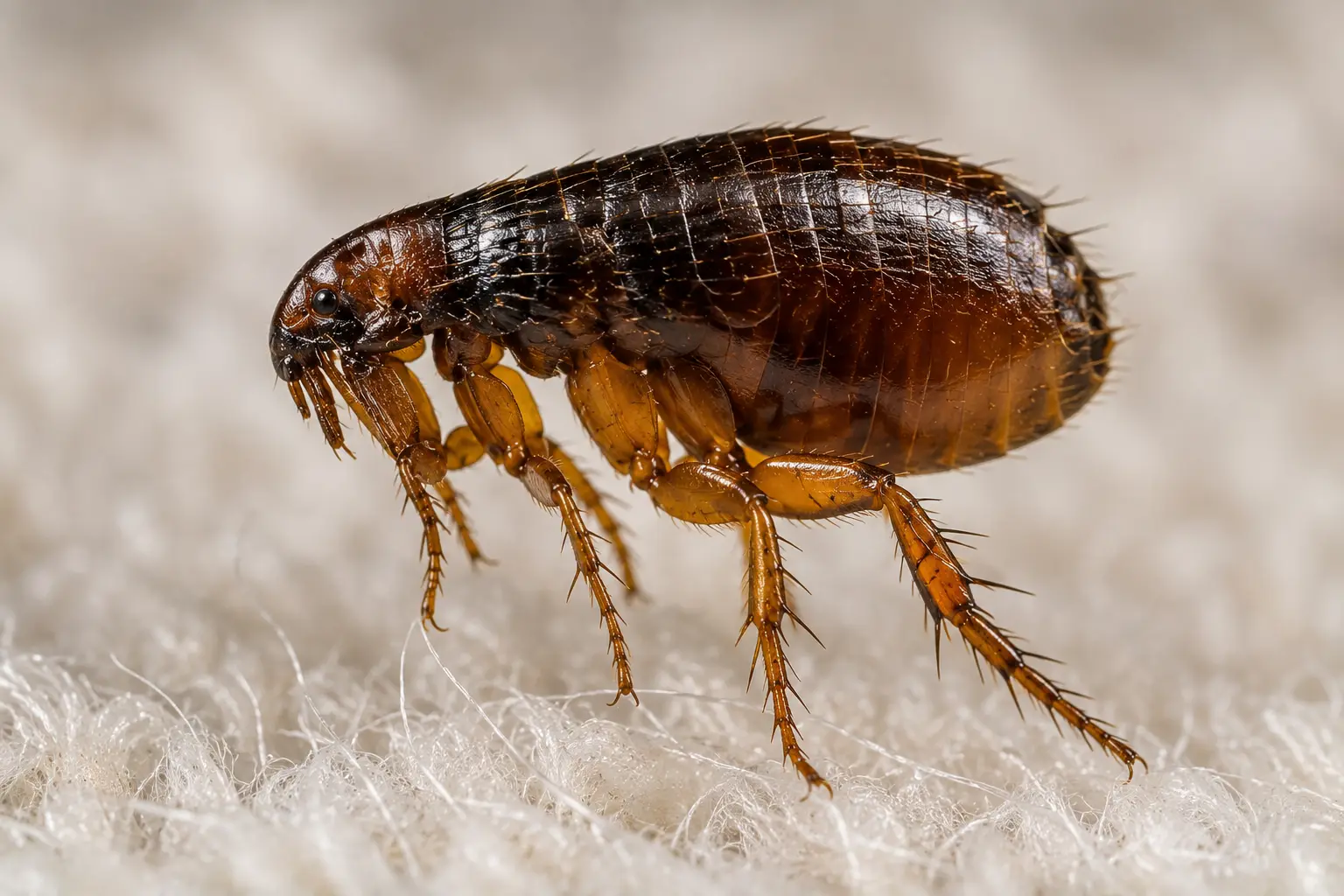
An adult flea is a small, dark-brown, wingless insect, roughly two to three millimetres long, with a hard, laterally flattened body that lets it slip through fur with ease. Its hind legs are much longer and more powerful than the front pairs, giving it an extraordinary jumping range relative to its size. Under good light — a white piece of paper placed near the pet is a practical trick — fleas appear as fast-moving specks that hop clear when disturbed rather than crawling like lice.
The cat flea, Ctenocephalides felis, is recorded in the Australian Faunal Directory as the species most commonly associated with domestic animals in Australia. Despite its name it is the flea most often found on dogs, rabbits and other mammals as well as cats, and it is the species our technicians encounter in practically every Melbourne flea job. A flea you find on your dog is almost certainly Ctenocephalides felis, not the dog flea (Ctenocephalides canis), which is now comparatively uncommon in Australia.
Tell-tale signs on the pet include persistent scratching or biting at the base of the tail, the groin or the belly, and small dark specks in the coat — flea dirt (dried digested blood), which turn reddish-brown when dampened on a piece of tissue. The animal's skin may show reddened or scabby patches where repeated biting has broken the surface.

The four-stage life cycle — and why most of the population is in your carpet
Fleas develop through four distinct stages: egg, larva, pupa and adult. Understanding where each stage lives is the key to understanding why a flea problem keeps coming back when only the pet is treated.
A female flea lays her eggs on the host animal, but the eggs are dry and smooth and simply fall off into the environment — into carpet fibres, pet bedding, cracks in floorboards and, in homes with a subfloor, the soil underneath. The larvae that hatch are pale, worm-like and avoid light, burrowing down into carpet pile and organic debris where they feed on flea dirt and other material. Over several weeks they spin a sticky cocoon, entering the pupal stage, and it is at this point that the infestation becomes particularly hard to break: the cocoon is physically tough, and adult fleas inside can remain dormant inside it for weeks to months, waiting for a signal that a host is nearby. As the Better Health Channel notes, vibration — such as footsteps — prompts adult fleas to emerge from their cocoons, which explains a pattern Protech technicians hear about often: a family returns from a holiday, or a tenant moves into a property that has been vacant for weeks, and is immediately overwhelmed by biting fleas that seem to appear from nowhere.
The practical consequence is straightforward. At any point in a flea infestation, adult fleas on the pet are a small proportion of the total population; the bulk of the population is in the environment as eggs, larvae and dormant pupae. A treatment that addresses only the animal — even a highly effective vet-prescribed product — removes the adults but leaves the environmental reservoir intact. New adults emerge from the carpet and re-infest the pet within days, and the cycle continues. Breaking that cycle requires treating the animal and the environment simultaneously.
Health and allergy risks
Flea bites are the most immediate concern for people in an infested home. The Better Health Channel describes a typical reaction as a red, swollen weal developing within about half an hour of a bite, most often on the lower legs and feet — the areas closest to flea-populated carpet. The bite is intensely itchy, and scratching commonly leads to secondary skin infections. Some people develop increased sensitivity after repeated exposure, so that reactions become more pronounced over time.
Fleas are also a route of tapeworm transmission. According to the Better Health Channel, fleas can transmit tapeworm larvae, and anyone who has been in a heavily infested home — particularly children who may accidentally swallow an infected flea — should seek advice on tapeworm treatment from their doctor or pharmacist. Pets in the same household are exposed to the same risk and should be wormed at the same time they receive flea treatment.
In pets, repeated exposure to flea saliva can trigger flea allergy dermatitis, an intensified allergic reaction to the saliva injected during a bite. A pet with this condition can develop raw, inflamed skin from a single flea bite and requires veterinary management alongside environmental pest treatment. If your cat or dog seems to react to fleas more severely than expected, raise this with your vet when you book their treatment — it is common and manageable once identified.
Fleas have historically been vectors of murine typhus and, outside Australia, bubonic plague, though these diseases are not a practical concern in a Melbourne residential setting. The everyday health burden from fleas in urban homes is biting, secondary infection and tapeworm risk.
Signs of a flea infestation at home
A pet that scratches, bites at its coat or shakes its head excessively is often the first signal, but by the time you notice this the environmental population in your carpet and bedding is typically already established. Run a fine-toothed comb through the pet's coat over a white surface and look for both live fleas and flea dirt. If the specks smear red when wet, you have confirmation.
Move through the house in light-coloured socks — fleas that jump onto the fabric are easy to spot. Pay attention to rooms the pet frequents: their sleeping spot, favourite chair or the area near the back door. Vacuuming the carpet and then examining the bag or canister contents can also reveal larvae. If the home has a timber subfloor, the area underneath is a significant reservoir; flea activity there is harder to detect but worth mentioning to the technician at inspection.
Empty or recently vacated homes are a particular case. If you are moving into a property where a pet was kept, or returning from a holiday of more than a week or two, treat the home as potentially flea-positive even before you see a bite — the dormant pupae may be waiting for exactly the vibration your return provides.
How to reduce flea pressure at home
A few consistent habits significantly reduce the risk of a flea population building to infestation level, and they are worth keeping up even after a professional treatment clears the current problem.
Keep pets on a year-round vet-approved flea prevention product; a single pet that lapses in treatment can re-seed the environment quickly. Wash pet bedding in hot water regularly, as heat kills all life stages. Vacuum carpets, rugs and upholstered furniture frequently, paying extra attention to areas where the pet rests, and dispose of the vacuum contents in a sealed bag immediately — vacuuming removes eggs and larvae and also stimulates dormant pupae to hatch early, where they are then exposed to any residual treatment product. In homes with a subfloor, clearing debris from under the house removes a significant harbourage that is otherwise very difficult to address with surface treatments.
If you are moving into a home that previously had pets, vacuum before you bring in any furniture and ask the previous owners whether the pet was on flea prevention. A professional treatment before you move in is a sensible precaution if there is any doubt.
For guidance on preventing other biting insects at home, see our pest library.
Why treating only the pet — or DIY sprays alone — often falls short
The most common reason a flea problem persists after an owner has treated it themselves is the mismatch between where the product is applied and where the population is concentrated. An over-the-counter carpet spray applied after a quick vacuum will kill the adult fleas it contacts and possibly some larvae, but the pupae in their cocoons are physically protected from most surface-applied insecticides. Those dormant adults emerge days or weeks later and re-infest the pet, leading to the experience of a problem that seems to come back almost immediately after treatment.
Over-the-counter insect growth regulators (IGRs) are available and genuinely useful — they interrupt larval development and prevent new adults from forming — but they need to be applied at the right dilution and to all the right surfaces to be effective. Product choice, application rate and coverage are the variables that most DIY treatments get wrong, and a flea infestation in carpet is three-dimensional: eggs and larvae settle into the base of the pile, and a light surface spray does not reach them.
Professional treatment uses a combination of a knockdown adulticide and an IGR applied by a licensed technician who knows where to direct the product and at what rate. This is why the industry body AEPMA guidelines for urban flea programs specify coordinated pet and environment treatment — addressing both at once is what closes the cycle rather than interrupting it temporarily.
How Protech treats fleas
Every flea treatment begins with a walkthrough of the property to identify where the infestation is concentrated: the pet's sleeping areas, the carpeted rooms it uses most and, where access allows, the subfloor. We ask about the pet's treatment history and schedule, because our treatment needs to be timed to coincide with the vet-prescribed application — treating one without the other on the same day reduces the outcome significantly. If the pet has not been booked in with the vet, we will advise on timing before we proceed.
The treatment itself applies a professional-grade combination of adulticide and insect growth regulator across carpets, rugs, soft furnishings, skirting boards and any subfloor areas that are accessible. The IGR is the critical component: it prevents flea eggs and larvae from developing into new adults, so that the pupae that survive the initial knockdown — and some will, because the cocoon protects them — hatch into an environment where they cannot establish a breeding population. We ask that all people and pets remain off treated surfaces until the product has dried, typically a few hours.
We also walk you through the preparation steps that make the treatment far more effective: vacuuming all carpets immediately before we arrive (which draws dormant pupae out of the cocoon and into contact with the product), washing all pet bedding in hot water on the day, and clearing the floor space of toys and clutter. A follow-up check is included in the program; if activity continues beyond what we expect as the pupal population hatches through, we revisit and assess.
Protech treats flea infestations across Melbourne for both residential and commercial premises. For the full range of insect species we treat, our flea control service page covers the treatment detail, and you can find related guides on other biting insects in our pest library. Call our Melbourne team on 03 9449 4244 or request a free quote and we will arrange a visit, usually the same day.
Fleas in Melbourne FAQs
Where do fleas come from if I don't have a pet?
Fleas can enter a pet-free home through several routes: a visiting animal, wildlife such as a possum or bandicoot that passes through the garden, or a property where a previous tenant or owner kept pets. The pupal stage can lie dormant in carpet for weeks to months and hatch when vibration signals that a host is present, so an infestation from a previous occupant's pet can activate when new residents move in. A professional inspection will identify the likely source and the current scope of the problem.
Why does the infestation seem worse after I vacuum?
This is a normal and expected part of flea treatment, not a sign that vacuuming made things worse. Vacuuming produces vibration that stimulates dormant pupae to hatch ahead of schedule, bringing a wave of new adults out of their cocoons. When this happens after a professional treatment, those adults emerge into a treated environment and are exposed to the residual insecticide. The temporary increase in visible fleas after vacuuming is actually part of the treatment working as intended.
Can fleas make people sick?
The Better Health Channel notes that fleas can transmit tapeworm larvae, and anyone who has been in a heavily infested home — particularly children — should seek advice on tapeworm treatment. Flea bites cause an intensely itchy weal that commonly leads to secondary skin infection from scratching, and some people develop increasing sensitivity to bites with repeated exposure. In Melbourne homes, the main health concerns are bites, secondary infection and tapeworm risk.
Why do fleas appear when I come back from a holiday?
When a home has been unoccupied for a period, flea pupae in the carpet build up while the pet is away or the house is empty, because there are no hosts to trigger their emergence. As the Better Health Channel explains, vibration from footsteps prompts dormant pupae to hatch simultaneously, so returning to a home after a holiday can produce an immediate and heavy wave of newly emerged adults all at once. This is not unusual and responds well to professional treatment.
Do I need to treat my pet and the house at the same time?
Yes, and the timing matters. Adult fleas on the pet represent only a portion of the infestation; the majority of the population is in the environment as eggs, larvae and dormant pupae. Treating only the animal removes the adults but leaves the environmental reservoir to produce a new generation. Treating only the home removes the environmental stages but leaves adults on the pet to re-seed the carpet immediately. Both need to happen on the same day for the treatment to close the cycle.
How much does professional flea treatment cost in Melbourne?
We give you a fixed price after an inspection, before any work begins, so there are no surprises. The cost varies depending on the size of the home, the extent of the infestation and whether a subfloor requires treatment — a one-bedroom unit and a four-bedroom house with a timber subfloor are genuinely different jobs. Call us on 03 9449 4244 or request a free quote and we will arrange a visit, usually the same day.
Is the flea treatment guaranteed?
Yes. Our flea treatments are backed by our pest-free guarantee: if the problem returns within the guarantee period, we come back and re-treat at no extra charge. We will confirm the length of the guarantee period in writing with your quote. The guarantee is on our work; it assumes the pet treatment arranged with your vet is also carried out on schedule, since treating the environment without the animal leaves the cycle open.
Protecting Melbourne homes and businesses since 2001 — HACCP, AEPMA and NPMA accredited, rated 4.8★ from 411 Google reviews.



Learn More About Pest Solutions
Same-day service, eco-friendly treatments and a pest-free guarantee. Domestic & commercial — all Melbourne suburbs.