

Farming & Agriculture
Preventative, HACCP-accredited pest management for Melbourne farms and agribusinesses — protecting crops, produce and stored goods, and backed by our pest-free guarantee.
Pest Control for Farming & Agricultural Properties
Pests cause disruption across many industries, and in agriculture they have a direct effect on productivity, yield and profitability. An infestation on farmland can escalate quickly when it is not managed well, affecting both crop quality and output.
Rodents such as rats and mice are among the most persistent threats to farming operations. They damage crops through feeding and burrowing, contaminate produce with droppings and compromise stored goods, which makes timely, effective rodent control essential for any agricultural property.
To arrange an inspection for your property, call Protech on 03 9449 4244.

Protech Pest Control — Every Farmer’s Best Bet
Flying insects also pose a significant threat to agricultural operations. They can damage crops during growth and contaminate produce in storage, and they spread quickly between fields and storage areas, which increases the risk of loss when the problem goes unmanaged.
At Protech Pest Control we develop tailored pest management programs for agricultural environments that reduce the impact of these pests and protect valuable produce. Our team delivers safe, effective control for farms and agribusinesses of every size, with a focus on long-term prevention and environmental responsibility. Our commercial pest control programs bring together rodent management, bird proofing, termite protection, subfloor work and Integrated Pest Management under one provider.
How Can We Help You?
After a thorough pest inspection of your property, we develop a comprehensive preventative pest management plan built around your agricultural needs.
You also receive a detailed report outlining recommendations for proofing, hygiene improvements and general pest control measures that reduce future risk.
We use environmentally responsible, biodegradable treatments that protect crops and produce while managing pest activity effectively.
Our team holds the certifications this work calls for, including HACCP accreditation, and every technician is trained in agricultural pest management. Each service is supported by a strong focus on quality outcomes, so you can be confident your pest concerns are handled professionally from the first phone call.
Agricultural Pest Management Programs
No two properties operate the same way, so we build each program around your buildings, your storage and the pests most active in your area. Our agricultural pest management services include:
- Thorough property inspections and site risk assessments
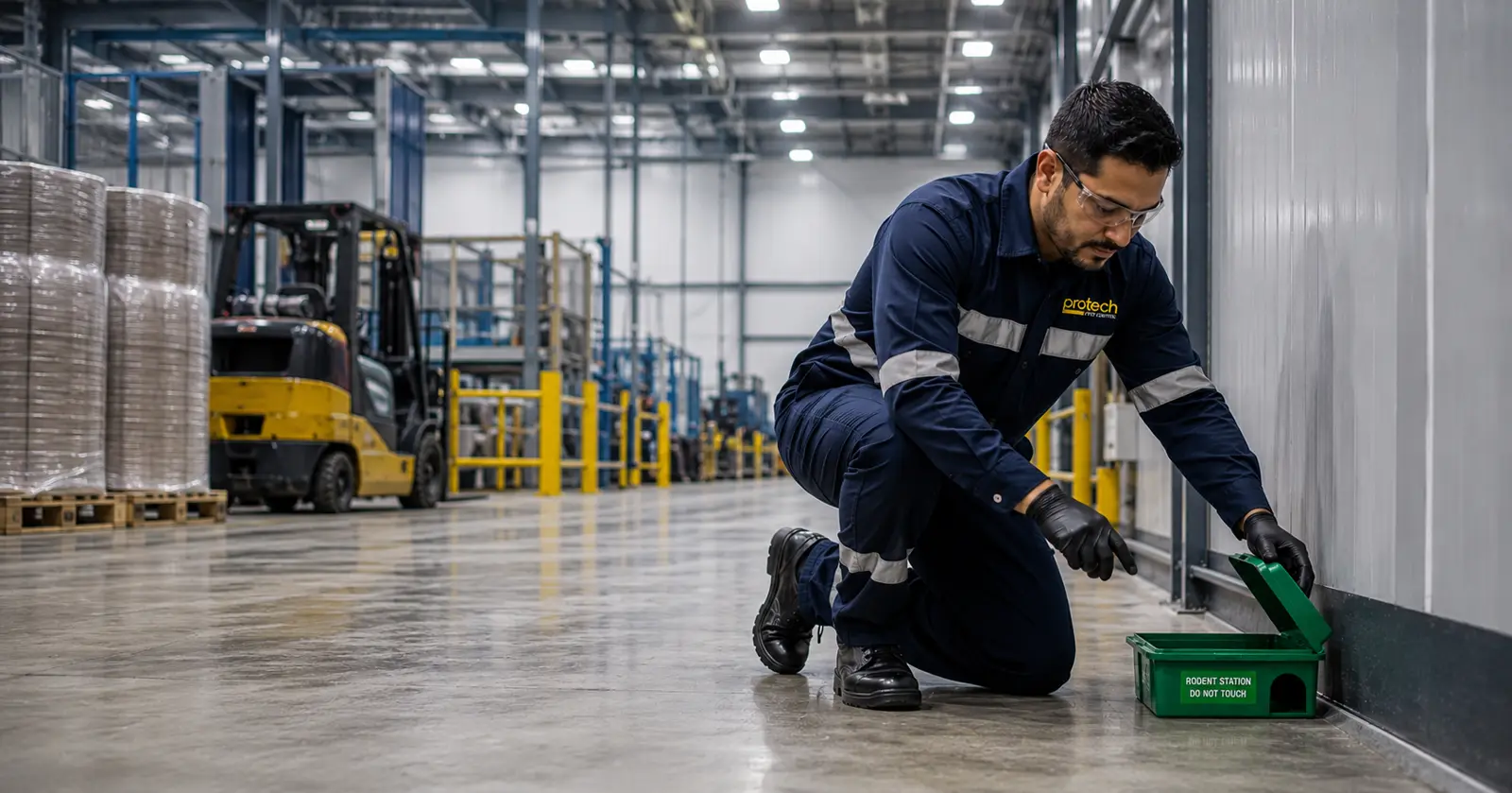
- Rodent monitoring, baiting and physical proofing
- Bird proofing and exclusion for sheds and storage
- Fly and flying-insect management
- Stored-product pest management for grain and produce storage
- Termite inspections and protection for farm buildings
- Subfloor and structural pest work
- Integrated Pest Management (IPM) programs
- Digital reporting and compliance documentation
The focus stays on prevention and long-term control, so treatments target the conditions that let pests enter and survive on the property and deal with the problem at its source.
Grain, Fodder and Farm Storage
On most properties the recoverable losses sit in storage. A paddock recovers; a silo of contaminated grain or a shed of spoiled fodder does not. Storage is also the part of a rural property that behaves like a building, which makes it the part a pest management program can genuinely protect.
Silos, bunkers and seed storage
Grain weevils, rice weevils, lesser grain borer, flour beetles, saw-toothed grain beetles and moths such as the Indian meal moth all breed inside stored grain, seed and processed feed. They arrive with an incoming load, or they survive in residue left in the base of a silo, an auger, an elevator boot or a bin from the previous season and infest the new fill from the inside. Silo hygiene between fills does more for the problem than anything applied afterwards, so our inspection covers residue in the cone and the base, the condition of seals, lids, aeration fittings and inspection hatches, spillage around the pad, and the state of the augers and handling gear. Monitoring in storage is set up to detect activity while it is confined to one bin, and we record what we find against the delivery history so an infested incoming load can be traced.
Hay, fodder and feed sheds
Stacked hay, silage and bagged or bulk feed give rodents shelter, food and a nesting medium in the same structure, and a stack that has stood since the last cut is rarely opened up until it is used. Rodents nest inside the stack, run along the base of walls and behind stacked bales, and chew through bags and wiring in the same shed. Feed sheds and their approaches are inspected on every visit, with stations set around the outside of the structure and monitoring inside along wall lines, at door openings and behind the stack face where activity is actually detectable.
Bird pressure over stock feed and sheds
Sparrows, starlings, pigeons and corvids follow feed. They roost in machinery sheds, hay sheds, dairies and packing sheds, sit on rafters and purlins above feed troughs, bunkers and open storage, and drop faeces onto feed, water troughs and clean equipment below. The feed they take is a direct loss, and the fouling is a contamination and biosecurity problem in its own right. Our bird proofing work for rural properties covers netting to close off shed openings and roof spaces, spikes and wire on rafters, purlins and ledges, and proofing of the entry points birds use to get in and out. Netting and proofing carry six years of workmanship cover and up to ten years on the product, subject to annual inspections.
Packing, processing and the buildings around them
Packing sheds, grading lines, cool rooms, workshops, staff amenities and the farmhouse each carry their own risk and are serviced accordingly. Where produce is washed, graded or packed on site, the same standards apply that we work to in a processing plant, and the program is written to match. Properties supplying a processor will find that our dairy and food processing pest control programs use the same documentation, so the paperwork reads consistently from the farm through to the plant.
Local Melbourne Expertise
As a Melbourne-based company, we understand local pest activity, seasonal conditions and the challenges Victorian properties face. Our technicians are licensed, insured and trained to industry standards, and we back every job with clean, consistent workmanship and honest advice.
Ready to leave your pest worries to us? Call the team today on 03 9449 4244.
Rodent Programs, Biosecurity and What Is Achievable on an Open Site
Why an outdoor baiting program is built differently
An enclosed building has a countable number of entry points, so a perimeter line of stations will intercept most of what tries to get in. A rural property has no equivalent boundary. Pressure arrives across open ground from paddocks, drains, channels, fence lines, waterways, silage pits and neighbouring land, and the population outside the buildings is effectively unlimited. A program that tries to bait an open property will consume product indefinitely and prove nothing.
So the program protects what can be defended. Rings of lockable, tamper-resistant stations go around each shed, silo, feed store, packing shed and dwelling, secured in place and positioned along the runs rodents actually use, which are wall lines, fence lines, pipe and cable routes and vegetation edges. The structures themselves are proofed at the doors, vents, eaves, service penetrations and roller-door bases. Spillage, stored rubbish, disused equipment and vegetation against walls are recorded as corrective actions, because an unmanaged food source near a building will beat any baiting program. Products are APVMA-registered and applied by licensed technicians, and stations are chosen and secured to reduce the risk to working dogs, livestock, poultry and native wildlife. Full detail on the species and the methods is on our rat and mouse control page.
Seasonal pressure and when the work needs to happen
Rural pest pressure runs on a calendar and the servicing schedule is built around it. Rodent numbers build through spring and summer while feed is abundant outdoors, then move hard into sheds, silos, dairies and dwellings as the weather cools and outside food runs short, which makes autumn the point at which proofing and baiting need to already be in place. Harvest and the weeks after it bring grain, dust and spillage into storage and concentrate stored-product pest risk for the following months. Flies build through the warm months around stock, effluent, manure and waste, and wasp activity peaks in late summer around sheds and eating areas. Booking the preventative work ahead of each of those periods costs far less than reacting after it.
Biosecurity and contractors on the property
A pest management contractor is a vehicle and a person moving between rural properties, which makes us part of your biosecurity picture. Where a property operates a biosecurity plan, sign-in requirements, designated parking, wash-down or footwear and equipment protocols, we work to them and record the arrangement as part of the servicing plan. Rodents and birds carry the same considerations in the other direction, because both move disease and contamination between feed, water, stock and stored product, and both are far easier to manage as an ongoing program than as an emergency.
What a pest management program can and cannot do here
Being straight about the boundary saves everyone time. Broadacre and in-crop treatment is agronomic work for a spray contractor or agronomist and sits outside what a pest management business does, and no honest provider will offer to eradicate rodents from open farmland. What our work covers is the structures and the stored product: sheds, silos, grain and feed stores, packing and processing areas, workshops, dairies, amenities and dwellings, together with the perimeter around each of them and the hygiene conditions that feed the population. That is where the losses are recoverable and where a program can be measured. Every visit is documented through our digital reporting system with numbered stations mapped against a site plan and a pest-activity trend log, so you can see across a season whether the pressure is falling, and the whole property can sit under one scheduled commercial pest control agreement.
Why Melbourne Growers Choose Protech
Local, accredited and trusted since 2001 — rated 4.8★ from 411 Google reviews.
Root-cause solutions
We work out how pests are entering, feeding and surviving on your property, then treat the source so the problem does not keep returning.
Full pest coverage
Rodents, birds, flies, stored-product pests, termites and subfloor work — a complete program for the buildings and storage that keep your operation running.
Fast response times
Reliable service across Melbourne when you need it, so an emerging problem is dealt with before it spreads through fields, sheds or storage.
Proven experience
More than 40 years of combined industry knowledge and a company history going back to 2001, with clean, consistent, high-quality workmanship.
Honest advice
No pressure tactics and no unnecessary upselling. We tell you what we find and recommend only the work your property genuinely needs.
Fully licensed and accredited
Our technicians are licensed, insured and trained to industry standards, and our HACCP accreditation supports work in sensitive food-production and agricultural settings.
Frequently Asked Questions
What farm and agricultural pests does Protech manage?
Our agricultural programs cover rats and mice, birds, flies and other flying insects, and stored-product pests, along with termite and subfloor work on farm buildings. We treat sheds, silos, grain and produce storage, packing areas and the structures around them.
Are your treatments safe around crops and produce?
We use environmentally responsible, biodegradable treatments chosen to suit food-production and agricultural settings, and we focus on proofing and hygiene so there is less reliance on chemical control over time. Our HACCP accreditation supports work in these sensitive environments.
How does a farm pest management program start?
We begin with a thorough inspection of the property, then build a preventative plan tailored to your operation. You receive a written report with recommendations for proofing, hygiene improvements and ongoing control, so you can see exactly what we found and what we advise.
Do you service agricultural properties around Melbourne?
We are a Melbourne-based team servicing Greater Melbourne and the surrounding areas. Call us on 03 9449 4244 to confirm coverage for your property and to arrange an inspection.
How is a rodent baiting program on a farm different from one in a building?
An enclosed building has a countable number of entry points, so a perimeter line of stations will intercept most of what tries to get in. A rural property has no equivalent boundary. Pressure arrives across open ground from paddocks, drains, fence lines, waterways and neighbouring land, and the population outside is effectively unlimited. So the program protects the assets that can be defended: rings of lockable, tamper-resistant stations around each shed, silo, feed store and dwelling, physical proofing of those structures, and housekeeping controls on spillage. Stations are lockable and secured in place to reduce the risk to working dogs, livestock and wildlife, and every station is numbered and mapped so the readings can be compared visit to visit.
What stored-product pests attack grain and feed?
Grain weevils, rice weevils, lesser grain borer, flour beetles, saw-toothed grain beetles and moths such as the Indian meal moth all breed inside stored grain, seed, pellets and processed feed. They are usually brought in with an incoming load or survive in residue left in a silo or bin from the previous season, which is why silo hygiene between fills does more for the problem than anything applied afterwards. We inspect storage, monitor for activity and set out the hygiene and proofing corrections the site needs.
Can you treat an entire paddock or crop?
No, and we will tell you that up front. Broadacre and in-crop treatment is agronomic work carried out by a spray contractor or agronomist, and it sits outside what a pest management business does. Our work covers the structures and the stored product on the property: sheds, silos, feed and grain stores, packing and processing areas, workshops, staff amenities and dwellings, together with the perimeter around them. That is where the recoverable losses usually are.
Does pest pressure on a farm change through the year?
Yes, and the servicing schedule is built around it. Rodent numbers build through spring and summer while feed is abundant outdoors, then move hard into sheds, silos and dwellings as the weather cools and outside food runs short, so autumn is when proofing and baiting need to already be in place. Harvest and the weeks after it bring grain, spillage and dust into storage and concentrate stored-product pest risk. Flies and wasps peak through the warm months around stock, effluent and waste. We time inspections and preventative work ahead of each of those periods.
We had Joe come out and be very understanding and professional with the job required. We have used other companies in the past and not had the success that Protech provided. From the first phone call to the office they were prompt, efficient and very professional. Thanks Joe.
– Peter SherryProtect Your Property With Professional Pest Management
Talk to the Protech Pest Control team about a tailored program for your Melbourne farm or agribusiness. Call 03 9449 4244 or request a free quote.
Learn More About Pest Solutions
Same-day service, eco-friendly treatments and a pest-free guarantee. Domestic & commercial — all Melbourne suburbs.