
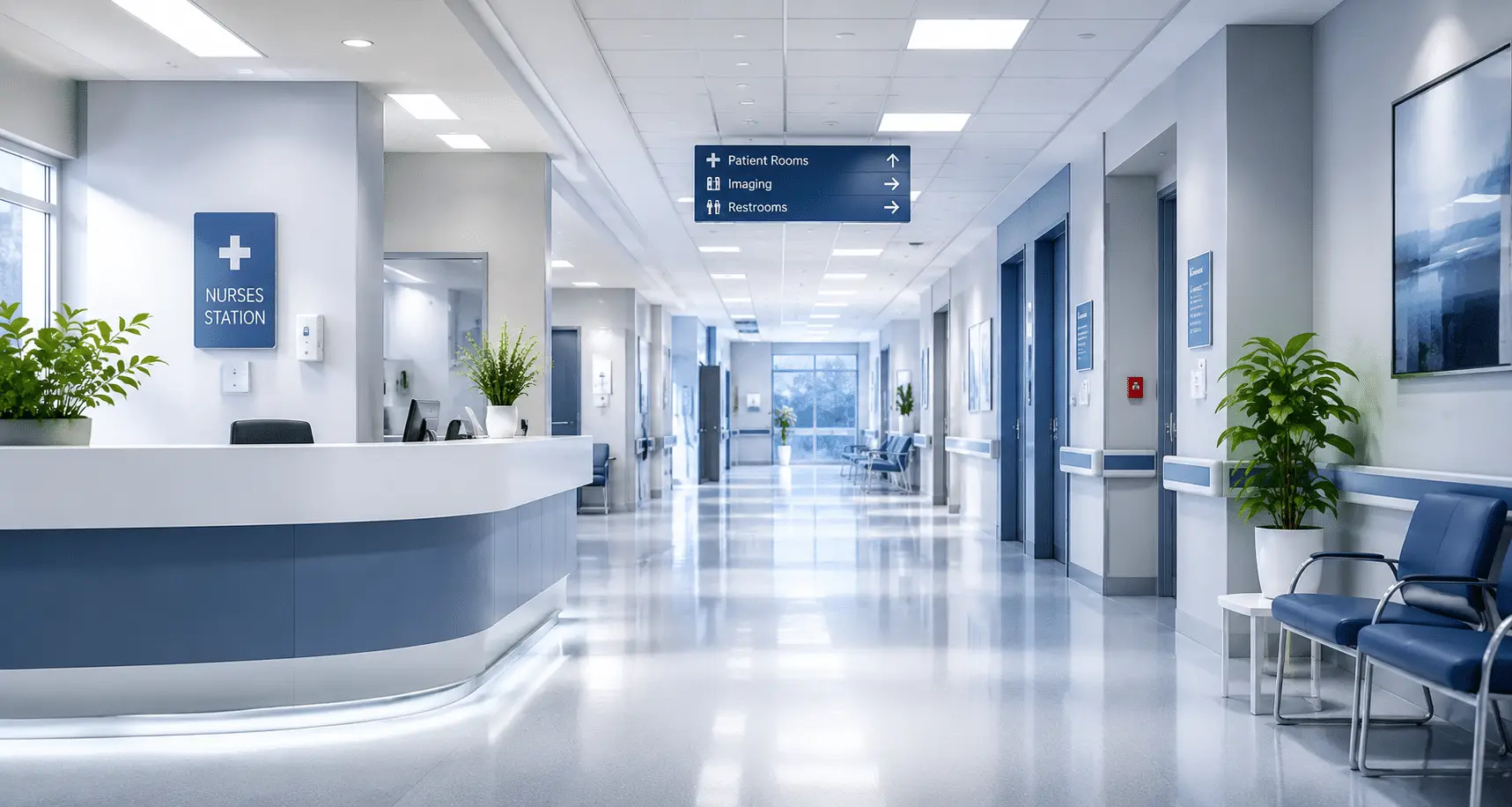
Healthcare Facilities
Certified pest management solutions designed for hospitals, nursing homes, and healthcare environments.
Pest Control for Healthcare Facilities
Pests are naturally drawn to environments that provide access to food, moisture, and shelter, making healthcare facilities particularly vulnerable without effective preventative measures in place. In these sensitive environments, pest activity can create risks that extend well beyond property damage, including hygiene concerns, contamination, and potential impacts on patient well-being.
Healthcare patients are often more vulnerable to secondary infections due to compromised immune systems. As a result, maintaining strict pest management standards is essential to help reduce contamination risks and support a safe, hygienic healthcare environment.
Protech Pest Control has protected Melbourne premises since 2001, backed by more than 40 years of combined industry experience and accreditation with HACCP, NPMA and AEPMA. We service hospitals, day facilities, medical centres, consulting suites, dental and allied health practices, community health services and residential care, and the programs we run for aged care and retirement living are built on the same standards.
To arrange a program for your facility, call us on 03 9449 4244.
How Can We Help?
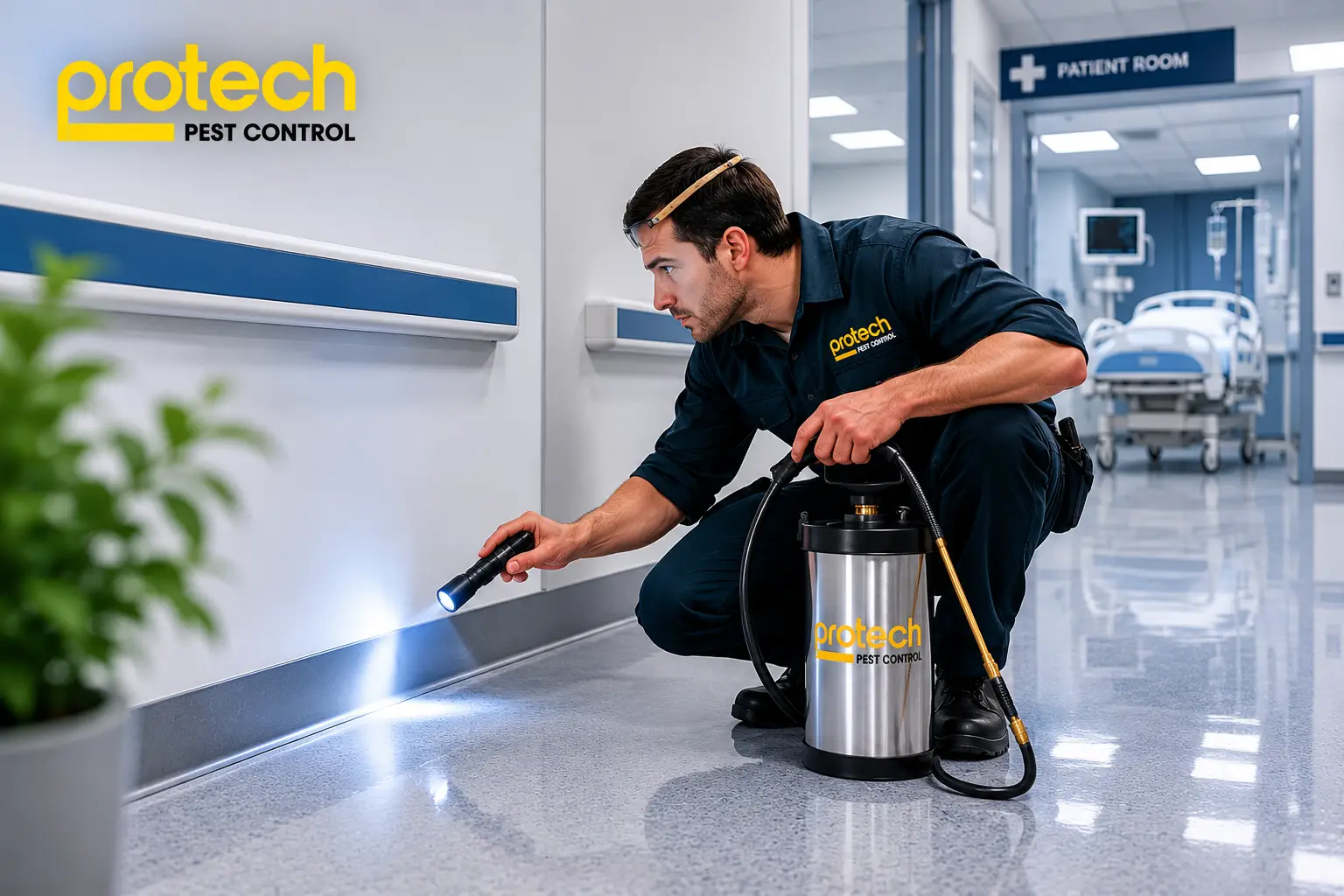
We have extensive experience working with healthcare facilities and understand the critical importance of maintaining the highest standards of hygiene, protection, and care in these sensitive environments. While we operate with a high level of professionalism and precision, we also recognise the unique requirements of hospital and healthcare settings and the need to minimise disruption at all times.
As such, we deliver healthcare pest control solutions that are carefully aligned with healthcare protocols, ensuring both effectiveness and compliance. We strongly advocate for a preventative approach to pest management, as proactive protection is always more effective than reactive treatment.
Where the Pest Risk Sits in a Healthcare Building
A hospital, day facility or large medical centre is several buildings in one. Clinical areas run to infection-control standards, a commercial kitchen produces meals all day, laundries and waste docks operate on their own cycle, and plant rooms and roof spaces sit above all of it. Each zone carries a different pest risk, and a program that treats the site as a single space will miss most of them.
Clinical and sterile areas
Theatres, procedure rooms, sterile stores and treatment rooms are the areas where pest activity carries the greatest consequence and the least tolerance. A single insect found in a sterile store can put stock out of use and trigger an incident report. These areas are inspected for entry points, gaps around service penetrations, door seals and ceiling access, and treatments are planned into downtime windows agreed with your staff.
Wards, patient rooms and consulting suites
Occupied clinical space is warm, quiet overnight and full of soft furnishings, cabinetry and equipment that create harbourage. Bedside lockers, bed frames, wall cavities, skirting gaps and the voids behind built-in furniture are the places activity establishes before anyone sees it. We inspect these areas section by section so beds and bays stay in use while the work is done.
Catering, kitchens and food storage
A healthcare kitchen is a commercial kitchen with a food-safety obligation, and it draws the same pests as any hospitality site. Cooking lines, dishwash areas, dry stores, cool rooms, servery trolleys and ward pantries are all inspected and monitored, using the food-safe methods and HACCP-ready records we apply across Melbourne’s hospitality kitchens, with products and placements that cannot contact food, surfaces or equipment.
Waste handling, dirty utility and linen
Clinical waste rooms, general bin rooms, dirty utility areas and linen chutes concentrate exactly what pests are looking for: organic material, moisture and warmth, in rooms that are opened and closed all day. Bin room hygiene, chute condition, drainage and door seals are assessed on every visit, because these areas feed activity into the rest of the building through service risers and corridors.
Plant rooms, risers and roof spaces
Plant rooms, service risers, ceiling voids and roof decks give rodents and birds a route through the whole footprint without ever crossing a public corridor. Warm plant, condensate, insulation and cable trays support activity year-round. Roof decks and plant platforms also attract nesting birds, which foul walkways and equipment and create a hazard for the maintenance staff who work up there.
Grounds, entries and loading docks
Most activity begins outside. Landscaping against the building line, mulched garden beds, external bin compounds, drainage pits, loading docks and the doors that stand open for deliveries are the entry points that supply everything inside. Perimeter monitoring and proofing at these points is the cheapest protection a healthcare site can buy.
Pests We Manage in Healthcare Facilities
A handful of pests account for nearly every healthcare callout we attend, and each one threatens something different:
- Cockroaches — the highest-consequence pest in a healthcare building. German cockroaches breed quickly in warm, humid areas such as kitchens, dishwash rooms, ward pantries and sluice rooms, travel between rooms through service voids, and carry contamination from waste and drainage onto surfaces and stock.
- Rats and mice — they gnaw cabling, insulation and packaging, contaminate dry stores and consumables, and leave droppings and urine trails that are a direct finding at audit. A rodent moving through ceiling voids and risers can affect several departments from a single harbourage.
- Flies — the fastest route from a waste or drainage source to a clinical or food-handling surface. Small drain flies signal a hygiene or plumbing fault, while house and blow flies around bin rooms, docks and servery areas are a contamination risk that needs both treatment and source control.
- Ants — persistent trails into ward pantries, tea rooms, dressing stores and anywhere sugar or protein is left out. Ants also enter through wall cavities and around service penetrations, so the trail seen inside is rarely where the nest sits.
- Birds — pigeons and gulls nesting on rooftops, plant decks, ledges, canopies and solar arrays foul walkways and equipment, block drainage, and bring mites and other secondary pests into ceiling voids beneath. We use humane proofing, netting and deterrents on these areas.
We also manage spiders, wasps, silverfish, stored-product pests and the occasional termite issue as part of an integrated program, so the whole site sits under one agreement.
Treatments Planned Around Patients and Clinical Areas
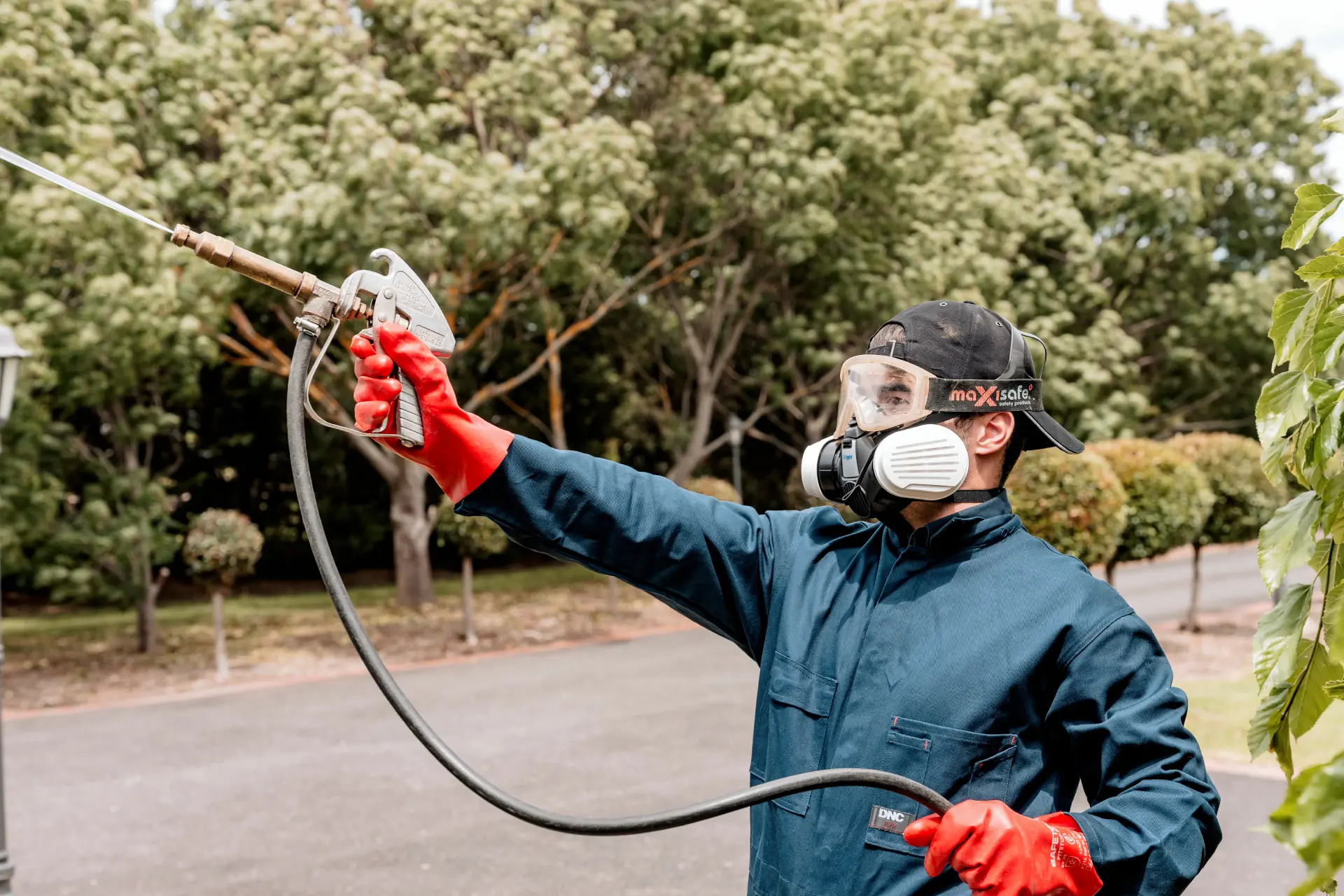
In healthcare, how the work is done carries as much weight as the result. Our programs lead with monitoring, physical proofing and hygiene-based prevention, so in many areas the pest risk is controlled before any product is used at all. Where a product is required, we use APVMA-registered products applied strictly to label, in secured placements out of patient and visitor reach and away from clinical surfaces, sterile stock and food-handling areas.
Out-of-hours and staged servicing
Very little of a healthcare site can be closed, so we work around it. Theatres, sterile stores and procedure rooms are attended during planned downtime or scheduled shutdown periods. Wards are serviced in stages, section by section, so beds and bays stay in use. Kitchens are attended after the last meal service or before the first one. Waste docks, plant rooms and external areas are usually done outside peak hours, and we run 24/7 attendance where a situation cannot wait for the next scheduled visit.
Coordination with infection control and facilities staff
Every visit is agreed with a nominated contact before it happens. Your facilities or infection-control staff confirm which areas are accessible, which need supervised access, and which require notice to the clinical unit. We work to your site’s access, induction and contractor requirements, sign in and out, and confirm at the end of each visit which areas were entered, what was applied and what was left in place. Where an infection-control committee wants advance notice of any product use in a clinical zone, the schedule is built to give it.
Prevention before treatment
The most valuable work on a healthcare site is the work that stops activity establishing: sealing service penetrations, correcting door seals and thresholds, proofing riser and ceiling access, addressing drainage and condensate, adjusting bin room and dock hygiene practice, and cutting back landscaping against the building line. Each of these is recorded as a corrective action recommendation in your report, so your maintenance team can close it out and the record shows it was closed.
Treatments across the wider site follow the same approach we take on every commercial pest control program, and commercial pest management carries the guarantee terms set out in your service agreement, matched to the service frequency.
Trusted by Melbourne Facilities
We are proud to have delivered pest management solutions to a range of healthcare organisations across Melbourne.



Documentation for Accreditation and Infection Control
Healthcare providers have to show that the physical environment is safe, clean and maintained, and pest management sits squarely inside that obligation. The evidence has to exist before the assessor asks for it, so we build the documentation into the service as a core part of the program.
Every visit produces:
- A service report covering areas inspected, activity found, treatments applied and site observations
- Treatment records naming the product, the placement and the quantity used
- Safety data sheets for every product held on site
- A site plan showing each monitoring point and bait-station location by number
- A pest-activity trend log built up visit by visit across the whole footprint
- Corrective action recommendations for your maintenance and cleaning teams to close out
Because the trend log runs across every service, it answers the question an assessor or an infection-control committee usually asks first: has activity in this area been increasing, and what was done about it. A department showing repeat activity is visible in the record long before it becomes an incident, and the closed-out corrective actions sit beside it.
Records are held digitally and can be pulled for an accreditation assessment, an infection-control committee paper, an internal audit or the food-safety audit of your kitchen. Full detail of what arrives after each visit is on our pest control reporting page, and the same pack supports the kitchen’s HACCP obligations without a second contractor or a second set of paperwork.
Why Call Protech Pest Control?
We know how strenuous life is for a healthcare professional. And we are committed to taking your mind off all the pest-related worries, so that you are free to cater to the needs of your patients!
- We are certified and licensed to cater to all healthcare facilities.
- Same-day service is available across Melbourne, including urgent attendance.
- We select lower-toxicity products wherever the pest and the setting allow.
- Root Cause Solutions: We target how pests are entering and surviving.
- Full Pest Coverage: Termites, rodents, birds, insects, and commercial programs.
- Proven Experience: 40+ years of combined industry knowledge.
- Commercial work carries the guarantee terms set out in your service agreement, matched to the service frequency.
- Fully Licensed: Our technicians are fully licensed, insured and trained to deliver safe pest management solutions in accordance with industry standards, and Protech holds CM3 contractor prequalification.
- Ongoing Protection: Focus on prevention and long-term control, Integrated Pest Management (IPM) Programs, Digital reporting & compliance documentation.
- Local Melbourne Expertise: As a Melbourne-based company, we understand local pest activity, environmental conditions and the unique challenges Victorian properties face.
When Activity Is Found in a Clinical Area
Pest activity in a ward, theatre suite, sterile store or catering area is treated as an urgent job, and the response follows the same sequence every time so the record is consistent and your staff know what to expect.
- Call it in. Reactive callouts between scheduled services are part of a commercial agreement, and we run 24/7 emergency attendance for anything that cannot wait for the next visit. Same-day service is normally available.
- Identify the species and the source. The treatment for a German cockroach in a ward pantry has nothing in common with the treatment for an ant trail from an external garden bed. Our technician identifies what was found and traces where it came from before anything is applied.
- Agree access with your staff. The nominated facilities or infection-control contact confirms whether the area can be cleared, supervised or scheduled into a downtime window, and any clinical unit affected is given notice.
- Treat with methods suited to occupied clinical space. Targeted, secured placements and physical control come first. Where a product is applied, it is APVMA-registered, applied to label and kept clear of clinical surfaces, sterile stock and food-handling areas.
- Document the callout. The visit is written up like any other service, with the activity, the treatment, the products used and the corrective actions recorded and added to the trend log for that area.
- Verify and adjust. We return to confirm the result, and where the callout points to a recurring risk we change the program, add monitoring points or bring the service frequency forward for that part of the site.
Call Protech on 03 9449 4244 or request a free quote. Commercial programs are quoted per site, and residential prices for the services your staff and residents also buy are published on our pest control cost page.
Healthcare Pest Control FAQs
Can you work around clinical areas and patient wards?
Yes. Your facilities or infection-control contact tells us which areas are accessible and when, and we build the schedule around that. Theatres, sterile stores, procedure rooms and treatment areas are attended during planned downtime or scheduled shutdowns, wards are serviced section by section so beds and bays stay clear, and back-of-house areas such as plant rooms, waste docks and kitchens are usually done outside peak hours. Nothing happens on site without your staff knowing where our technician is working and what is being applied.
Are your treatments safe around vulnerable patients?
Our healthcare programs lead with monitoring, physical proofing and hygiene-based prevention, so in many areas the risk is controlled before any product is used. Where a product is required we use APVMA-registered products applied strictly to label, in secured placements out of patient and visitor reach, and we keep them away from clinical surfaces, sterile stock and food-handling areas. Every technician is licensed and insured, and Protech holds Cm3 contractor prequalification.
What documentation do we get for accreditation and audits?
Every visit generates a digital report covering pest activity, treatments applied, products used with their safety data sheets, site observations and corrective action recommendations, backed by a site plan showing every monitoring point and bait-station location and a pest-activity trend log built up over time. The pack is structured to serve as evidence for accreditation assessment, infection-control committee papers, internal audit and the food-safety audit of your kitchen.
How often should a healthcare facility be serviced?
It depends on the buildings, the clinical risk profile and what your accreditation requires. Consulting suites and small clinics are often quarterly, larger medical centres and day facilities monthly, and hospitals and high-risk sites with commercial catering commonly need fortnightly or weekly attendance across the whole footprint. We assess the site, recommend a frequency that satisfies your obligations, and lock it into a scheduled program so nothing is missed.
What happens if pests are found in a clinical area between visits?
Call us and we attend. Reactive callouts between scheduled services are part of a commercial agreement, and we run 24/7 emergency attendance for situations that cannot wait, including activity found in a ward, theatre suite, sterile store or catering area. Our technician identifies the species, treats the area with methods suited to occupied clinical space, records the callout in your reporting pack, and returns to verify the result and adjust the program where a recurring risk is identified.
What does a healthcare pest control program cost?
Commercial pest management is quoted per site, because the price depends on the size of the buildings, the number of monitoring points, the service frequency and the documentation you need. There is no fixed commercial price list. Call our Campbellfield office on 03 9449 4244 for a free, no-obligation quote, and we will walk the site and put a program and a price in front of you.
Client Testimonials
I highly recommend Protech Pest Control to others. I experienced a professional service from start to finish, also very friendly & helpful customer service, answering all of my questions I had. I will definitely recommend Protech!
– V BeautystudioLearn More About Pest Solutions
Same-day service, eco-friendly treatments and a pest-free guarantee. Domestic & commercial — all Melbourne suburbs.