

Silverfish in Melbourne
How to identify the wingless, scale-covered silverfish, where it hides in Melbourne homes, what it damages, and how our licensed team clears it.
Written by Muzi Tsolakis, Founder and Competency Assessor, Pest Management Victoria. Last reviewed 11 August 2026.
Silverfish are among the oldest insects on earth, and Melbourne homes give them almost everything they need: humid bathrooms, damp subfloors, dark bookshelves and starchy foodstores. Most people discover them by chance — a quick movement near a bathroom sink late at night, or irregular surface damage to a book spine or a patch of wallpaper. Because the insect is nocturnal and hides in tight crevices during daylight hours, a population can grow steadily for months before the signs become obvious. This guide covers how to make a confident identification, where silverfish establish in Melbourne properties, what they damage and why, how to reduce the conditions that attract them, and what professional treatment looks like when a population is already established.
How to identify a silverfish
Small, fast, moisture-loving insects in a bathroom or laundry are often mistaken for silverfish. If they jump when disturbed, they are springtails, which point to a damp problem rather than a silverfish one.
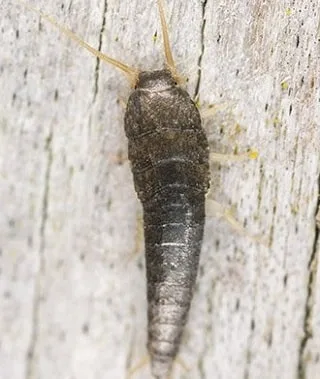
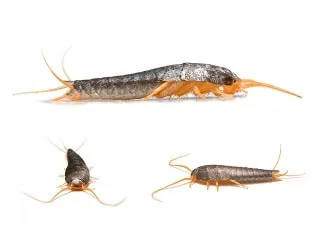
A silverfish is a wingless, flattened insect with a body that tapers from a broad head and thorax down to a pointed abdomen, giving the whole animal a teardrop or fish-like outline when seen from above. Its surface is covered in tiny, tightly packed scales that catch the light and produce the metallic silvery or grey sheen the insect is named for. According to the Museums Victoria species record for Zygentoma (Silverfish), the body reaches up to 2 centimetres in length and is typically grey or brown in colour, with scales that are shed very easily, making the insect hard to grip.
Three slender appendages extend from the tip of the abdomen — one central tail filament (a modified cercus) flanked by two lateral cerci — and two long antennae project from the head. These five projections are the most reliable field indicator: no other common household insect has both the three-tailed rear end and the slender, scaled, wingless body. The legs are short and carry the animal low to a surface, and its movement is characteristically fast and sinuous, a darting glide that disappears into a crack before most people can focus on it.
Silverfish are nocturnal. They stay pressed into very tight crevices during the day — the gap behind a skirting board, the fold of a cardboard box, the binding of a book on the back of a shelf — and come out after dark to forage. That hiding habit is why spotting a live specimen during daylight usually means the population is already substantial and the insect has been displaced from its usual harbourage.
Why silverfish thrive in Melbourne homes
Silverfish belong to the ancient insect order Zygentoma, a lineage that has been on earth for roughly 400 million years, and they have been household associates long enough to be genuinely well-adapted to the indoor environment. The two conditions they need above all others are high humidity and darkness, and many Melbourne homes supply both in abundance: the unventilated subfloors common under older weatherboard and brick houses in the inner suburbs, the tiled bathrooms that trap steam, the kitchen pantries built against an outside wall — all of these are prime territory.
The Australian Museum research blog on silverfish notes their remarkable capacity to absorb moisture from a humid atmosphere, which allows populations to persist in areas that seem merely damp rather than visibly wet. They are also largely vegetarian, eating cellulose-based material — the paper in books, the paste behind wallpaper, the starch in fabric sizing — along with protein from dead insects and organic debris. That diet means most rooms in a home contain something that will sustain them. Once a population establishes in a subfloor or wall void, individuals spread outward at night along the underside of floors and inside wall cavities, colonising bathrooms, laundries, pantries and bookshelves room by room.
Egg-laying is opportunistic. Females deposit eggs in crevices, under loose skirting boards, and in the folds of stored paper, and the eggs are small enough that even a thorough visual inspection misses most of them. A silverfish can live for several years given adequate humidity, which means an undetected population compounds continuously. Melbourne properties with unventilated subfloors are particularly vulnerable, because the trapped moisture under the floor creates a large, stable breeding zone that feeds occupants up into the living areas — one of several reasons subfloor ventilation is a meaningful investment in both pest management and building health.
What silverfish damage — and the allergen question
The damage silverfish leave is distinctive and, once you know what to look for, unmistakable. They feed by rasping or etching surfaces rather than biting clean holes, so the result on paper is an irregular, scraped depression rather than a punched-out gap. On book pages and wallpaper this shows as surface etching with yellowish staining; on fabric it appears as thinning or surface damage to natural fibres such as cotton, linen and wool, including the starch sizing in garments stored long-term. Wallpaper paste, bookbinding glue, and the adhesive on envelope flaps are direct food sources, which is why a book left undisturbed on a shelf for years can emerge significantly damaged.
Stored dry goods are also at risk. Silverfish chew through cardboard packaging and can contaminate the contents — cereals, flour, dried pasta, pet food — with droppings and shed scales. In a commercial food-storage setting this creates both a hygiene issue and a compliance concern under food safety legislation.
The allergen angle is real but worth stating accurately. Silverfish shed their scales continuously as they move, and those scales accumulate as a fine dust in harbourage zones. For people with existing sensitivities to insect-derived proteins, this debris can irritate the airways and trigger or worsen allergic symptoms. The claim needs Muzi review before publish — no specific Australian health authority page currently names silverfish scales as an asthma trigger on a public patient information sheet, so this should be confirmed with reference to clinical sources before asserting it categorically. The practical takeaway is the same either way: a large silverfish population produces organic debris in the same spaces people sleep, eat and breathe, and clearing it removes that material from the indoor environment.
Signs of a silverfish infestation
The most common first sign is the damage itself rather than the insect. Surface etching on book pages or wallpaper, irregular thinning on stored fabric, and yellowish staining on paper or cardboard are all characteristic. Look also for the shed scales — a fine, silvery dust or a scattering of tiny iridescent flakes along the back edge of a shelf, in the corner of a drawer, or around the spine of books that have not been moved recently.
Droppings are small and pepper-like, similar in appearance to fine black specks, and they accumulate in the same areas as the scales: bookshelves, the inside of cardboard boxes, kitchen cabinet corners and around the base of the water heater. A silverfish can survive for weeks without food but needs moisture to function, so any area where droppings and scale accumulate is almost certainly near a moisture source — a leaking pipe, a cold wall with condensation, or a poorly ventilated subfloor below the room.
Live sightings during daylight — particularly around bathroom sinks, bathtubs and kitchen drains — indicate the harbourage areas are full enough that animals are being displaced. At that point the population has grown well past a handful of individuals and treatment is the practical next step.
Reducing the conditions that attract silverfish
Silverfish are fundamentally a humidity problem with a food problem layered on top. Addressing both reduces the conditions that allow a population to sustain itself between treatments and makes the property genuinely less hospitable to re-infestation.
Humidity is the priority. Fix plumbing leaks promptly; ensure bathroom exhaust fans actually vent to outside air rather than into the ceiling cavity; and consider a dehumidifier in enclosed storage areas or laundries that stay persistently damp. In properties with older subfloors, improving subfloor ventilation is the single highest-impact structural change — a well-ventilated subfloor dries out the soil and timber moisture that sustains the breeding population in the zone below the living areas. Our subfloor ventilation service addresses this directly and pairs naturally with a silverfish treatment on properties where the subfloor is the source.
On the food side, store dry goods — cereals, flour, pet food, dried pulses — in sealed containers rather than their original cardboard packaging. Keep bookshelves dusted and avoid leaving stacks of paper, cardboard boxes or old magazines pressed against external or bathroom walls. Clothes and fabric that will be stored long-term are better kept in sealed bags or boxes than open shelves, particularly woollen and linen items. Sealing gaps around skirting boards, where pipes pass through walls, and around the base of built-in cabinetry removes the tight crevices silverfish use as daytime harbourage, making the population easier to reach during treatment and harder to re-establish afterward. These steps are worth carrying out as part of the broader prevention routine in our pest library.
Why DIY treatment rarely clears an established population
Supermarket silverfish baits and surface sprays work on individual foraging insects but rarely reach the harbourage zones where the population actually lives and breeds — the subfloor void, wall cavities, the space behind built-in shelving. A spray applied along a skirting board kills any insect that crosses that line but does nothing for the animals resting in the crevices two centimetres behind the board, and eggs in those same crevices are unaffected entirely.
The nocturnal, crevice-dwelling habit means most of the population is out of reach during any inspection or treatment a homeowner can carry out themselves. Without treating the harbourage zone directly — using a residual spray at the right dilution and an insecticidal dust in the enclosed voids where a liquid formulation cannot penetrate — the surface population simply regenerates from the breeding core within weeks. On properties where the subfloor is involved, the accessible living areas may show reduced activity for a short period after DIY treatment while the subfloor population remains undisturbed and continues to supply new individuals upward.
How Protech treats silverfish
Our silverfish treatment begins with an inspection to identify where the population is living and what is sustaining it — not just where the damage is visible, but where the humidity source and the harbourage zones are. In a typical Melbourne home that means checking the subfloor, the roof space, bathroom and laundry walls, built-in cabinetry and any storage areas with cardboard or paper. That mapping step determines where the treatment materials go, which is the part that makes the difference between a surface result and a lasting one.
The core of the treatment is a combination of residual spray applied to the surfaces silverfish travel across and insecticidal dust injected into the wall voids, subfloor and other enclosed spaces where a liquid formulation would not penetrate. The dust is particularly effective in harbourage zones because it adheres to the insect's surface and enters the harbourage areas on the insects themselves, reaching the parts of the population that never cross a treated surface. The technician works to AEPMA best-practice standards for the choice and placement of materials, and the products used are registered for indoor residential use and safe around children and pets once dry.
Where the inspection identifies a damp subfloor as the breeding source, we will discuss subfloor ventilation as a structural measure alongside the treatment, because treating the living areas in isolation while the subfloor moisture source persists produces a slower and less durable result. The technician explains what was found, what was treated and what structural or housekeeping changes will help, so you leave the visit with a clear picture of why the infestation developed and what to watch for. Our silverfish treatment is part of the broader silverfish control service we carry out for homes and commercial premises across Melbourne, including properties in Campbellfield, Epping, the inner suburbs and the south-east. You can read about other common Melbourne insects in our pest library.
Every general pest treatment is backed by our pest-free guarantee: if silverfish return within the guarantee period, so do we, at no extra charge. If you are seeing the signs of an active population — the etching on paper, shed scales in drawers, or the insect itself after dark — call our Melbourne team on 03 9449 4244 or request a free quote and we will arrange an inspection, most often the same day.
Silverfish in Melbourne FAQs
Are silverfish dangerous to people?
Silverfish do not bite and carry no venom. They are not considered a direct health threat in the way that some biting insects are. However, they shed scales and produce droppings continuously as they move through harbourage zones, and for people with existing sensitivities, this organic debris can irritate the airways or skin. The more practical concern for most households is the damage they cause to paper, books, fabric and stored food — an established population can cause significant material damage over time, particularly in homes with stored books, archival documents or natural-fibre clothing.
Why do I keep seeing silverfish in my bathroom?
Bathrooms combine the two things silverfish need most: high humidity and darkness. Steam from showers keeps the air moist, cold tiles create condensation, and the gap behind the vanity or under the bath provides a sheltered harbourage close to that moisture. Silverfish seen near the sink or drain at night have typically been displaced from their usual hiding spot — either the harbourage is crowded or the humidity in a preferred location has dropped. A persistent bathroom presence usually means the underlying population is substantial.
Can silverfish damage books and clothing?
Yes. Silverfish feed on the cellulose in paper and cardboard, the starch used to size fabric and stiffen garment collars, and natural fibres including cotton, linen and wool. The damage to books appears as irregular surface etching and yellowish staining rather than clean holes; on fabric it shows as surface thinning or irregular damage to stored garments. Wallpaper paste, bookbinding glue and the adhesive on envelopes are direct food sources. In a home with a large library or stored natural-fibre textiles, an undetected silverfish population can cause significant damage over months.
Do silverfish come up from the subfloor?
In many Melbourne homes, yes. An unventilated subfloor provides a large, stable, humid environment well-suited to breeding, and silverfish travel upward at night through gaps around pipes, along wall cavities and through cracks in flooring. Properties that see persistent silverfish activity in ground-floor rooms — particularly kitchens, laundries and hallways — often have the primary breeding zone below the floor. Addressing the subfloor humidity through improved ventilation is one of the most effective structural measures for these properties, and we carry out subfloor ventilation work as part of a coordinated approach.
How much does silverfish treatment cost in Melbourne?
The cost depends on the size of the property, which areas are affected and whether the subfloor or roof space needs treatment alongside the living areas. We provide a free, fixed-price quote before any work begins, so there are no surprises. Call us on 03 9449 4244 or submit an enquiry online and we will arrange a visit, most often the same day.
Is the treatment safe around children and pets?
Yes. The materials Protech uses for silverfish treatment are registered for indoor residential use in Australia and are safe around children and pets once they have dried, which typically takes a short time after application. The technician will advise you of any specific precautions for your property before starting work.
Do you guarantee the silverfish treatment?
Yes. Our silverfish treatment is backed by our pest-free guarantee: if silverfish return within the guarantee period, we come back and re-treat at no extra charge. The length of the guarantee period will be confirmed in writing with your quote.
Protecting Melbourne homes and businesses since 2001 — HACCP, AEPMA and NPMA accredited, rated 4.8★ from 411 Google reviews.



Learn More About Pest Solutions
Same-day service, eco-friendly treatments and a pest-free guarantee. Domestic & commercial — all Melbourne suburbs.