
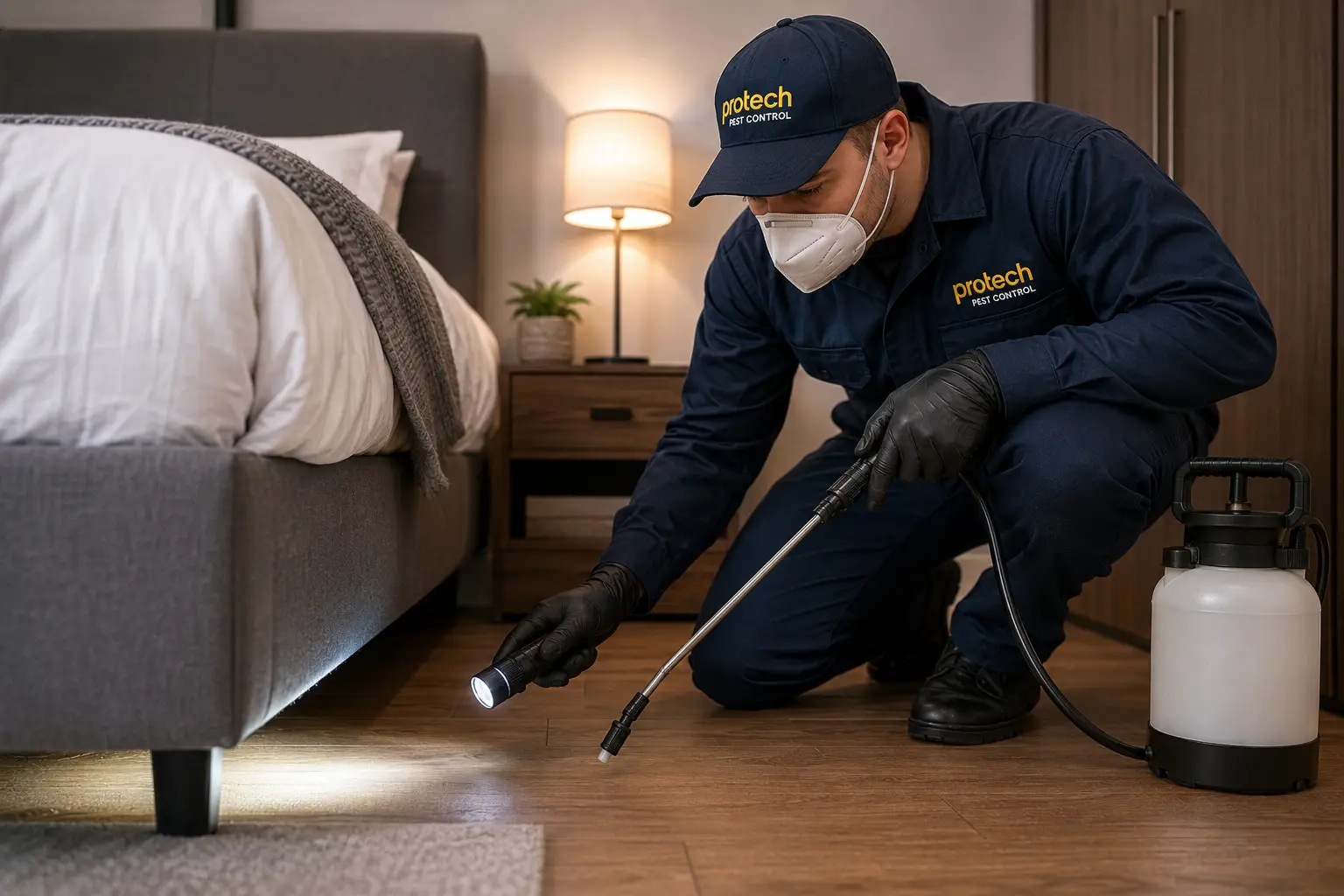
Bed Bug Control Melbourne
Professional bed bug treatment across Melbourne — full inspection and targeted control of every harbourage, with a pest-free guarantee.
Bed Bug Control & Treatment in Melbourne
Bed bugs are one of the harder pests to clear from a Melbourne home, and the calls we take usually come after someone has returned from travel, brought in a second-hand bed or sofa, or moved into a rental where a previous tenant left the problem unresolved. The bites are uncomfortable, the sight of blood spots on the sheets is unsettling, and the anxiety of knowing your bed is infested wears on people quickly.
Protech Pest Control has been treating bed bug infestations across Melbourne since 2001. Our licensed technicians inspect the full room, map every harbourage, and treat each one with a targeted residual application that keeps working on those surfaces as any surviving eggs hatch. That is what reaches the bugs a surface spray on its own will always miss. Every job is backed by our pest-free guarantee.
If you have found bites, blood spots or live bugs, call our Melbourne team on 03 9449 4244 and we will arrange an inspection, most often the same day. For the biology and identification detail, our bed bug guide in the Pest Library covers how to tell a bed bug from other small biting insects.
The Facts on Bed Bugs
Two species affect Australian homes: the common bed bug (Cimex lectularius), which is widespread in temperate southern states including Victoria, and the tropical bed bug (Cimex hemipterus), which is more common in the warmer northern regions. Both are covered in the Australian Museum's bed bug reference.
An adult bed bug is flat, oval and wingless, roughly 4–5 mm long — about the size of an apple seed. Its body is a light reddish-brown that darkens to a deep blood-red and swells noticeably once it has fed. That flat profile is what lets it wedge into a mattress seam, a skirting-board crack or a power-point surround and disappear from view during the day.
Bed bugs develop through five nymphal stages before reaching adulthood, and each moult requires a blood meal. A female lays around two to three eggs a day and several hundred over her lifetime; the whitish, roughly 1 mm eggs hatch in about five to ten days, and development from egg to adult takes around five to eight weeks depending on temperature and feeding, as documented by the Victorian Government's bed bug pest control guidance. Adults commonly live up to about six months and can survive many months without a blood meal, which is one of the reasons an untreated infestation is so persistent.
How Bed Bug Infestations Spread
Bed bugs do not fly or jump. They spread by hitching a ride, which is why the Better Health Channel describes them as hitchhikers. They travel on luggage, clothing, bedding, second-hand furniture and personal belongings, moving from one property to the next without anyone noticing until the population has grown.
Travel is the single most common introduction route we hear about in Melbourne. A couple of bugs or a clutch of eggs tucked into a suitcase lining can establish a new infestation within weeks of a trip home. Hotels, motels, hostels, short-term rentals and student accommodation are recognised transfer points because a high turnover of guests gives the bugs plenty of chances to move between rooms.
Second-hand furniture is the other major source. A bed frame, sofa or armchair from a marketplace listing can carry an existing infestation in its seams and joints. In apartments and shared housing, bed bugs also move between adjoining units through wall cavities, cracks and service conduits, so a problem one floor up can seed a new one below over several weeks.
One point worth stating plainly, because it stops people delaying the call out of embarrassment: a bed bug infestation is not a sign of a dirty home. Health authorities are clear that bed bugs turn up in spotless and untidy places alike, including five-star hotels. Anyone can pick them up.
Signs of a Bed Bug Infestation
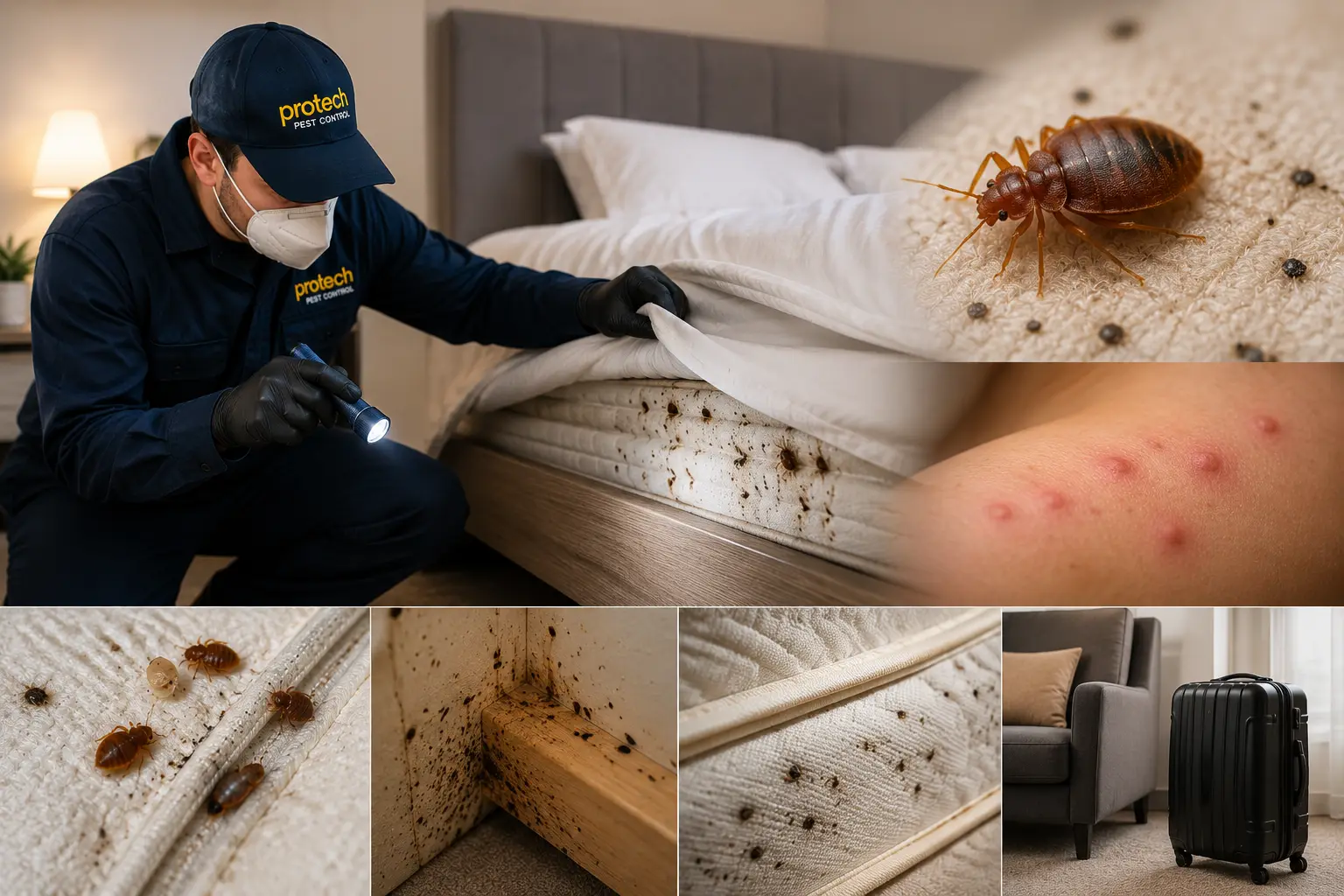
Bed bugs are nocturnal and very good at staying hidden, so most people discover an infestation through the evidence it leaves rather than by finding the insects themselves. Look for the following signs, listed by the Better Health Channel and the Victorian Government:
- Blood spots on bedding: small rust or reddish-brown stains on pillowcases, sheets and the mattress, left when a fed bug is crushed as you roll over or when a bite site seeps slightly.
- Dark faecal spotting: tiny black or dark-brown specks, about the size of a felt-tip dot, along the mattress seams, on the bed frame and on the wall near the headboard.
- Shed skins: translucent cast exoskeletons left behind each time a nymph moults through its five development stages, often found in seams, in wardrobes and behind skirting boards.
- Eggs and eggshells: whitish, roughly 1 mm eggs cemented into crevices in small batches, usually in the deepest seams and joints.
- A sweet, musty odour: a distinctive smell that builds up in a heavily infested room.
- Bites on your skin: itchy welts on exposed skin, though bites alone are not proof — some people show no reaction, and other insects leave similar marks, so treat this as one sign among several.
The most productive places to inspect are the mattress seams and piping, the bed base and slats, the headboard where it meets the wall, bedside drawers, behind picture frames, along skirting boards, and in electrical fittings near the bed. In a heavier infestation the evidence spreads into upholstered furniture, behind loose wallpaper and into curtain folds. A thorough inspection with a torch is the only way to be sure of the full extent, which is where a professional visit begins.
Bed Bug Bites and Health Effects
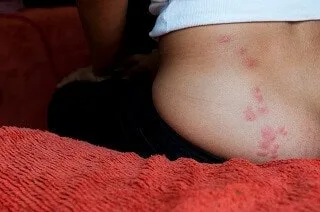
A bed bug feeds by piercing the skin and injecting saliva that contains a mild anaesthetic, which is why most people feel nothing at the time. Bites usually appear on skin exposed while sleeping — arms, shoulders, neck and legs — and often present in a loose line or small cluster along a feeding run. The reaction varies widely from person to person, and according to the Better Health Channel it can take several days, sometimes up to nine, to develop, which makes it harder to connect the bite to its cause.
Some people develop red, itchy welts that fade over a few days; others show no visible response at all. Their bite marks look similar to a mosquito bite or flea bite, so the bite by itself is not a reliable diagnosis.
The clear agreement across Australian health authorities is that bed bugs are not known to transmit disease to people. The practical concerns with a large infestation are the secondary effects: skin infections that can follow from scratching, disrupted sleep, and, in rare cases, a severe allergic reaction in a sensitive person. The anxiety, stress and insomnia that come with an infested bedroom are recognised harms in their own right, which is a good reason to deal with a problem early rather than wait.
Our Professional Bed Bug Treatment Process
Every treatment starts with a thorough inspection of the affected bedroom and any adjoining rooms, mapping all active harbourages across the mattress, bed base, frame, furniture and room perimeter. Treatment placed without a full picture of the infestation misses the pockets that restart the problem, so this step drives everything that follows.
Targeted Chemical Treatment
Once the harbourages are mapped, we apply a targeted residual treatment to each of them — the mattress and base seams, the bed frame joints, surrounding furniture, cracks, crevices and the room perimeter. The residual keeps working on those surfaces after the visit, which matters because bed bug eggs resist many insecticides and continue hatching over the following days. Every product we use is registered with the APVMA and applied by a licensed technician, in line with the Victorian Government's pest control requirements.
Where a Follow-Up Treatment Is Needed
Most jobs are resolved in the one treatment. Where the inspection finds a heavy infestation, your technician may recommend a follow-up treatment, because a large population laying eggs before the first visit can put more nymphs through than a single application accounts for. Your technician will tell you at the time whether your job warrants one, and the recommendation is based on what the inspection actually found rather than applied to every job as a matter of course.
Vacuuming and Encasements
Depending on the job we also use thorough vacuuming to physically remove bugs and eggs from seams and crevices. We recommend bed-bug-rated mattress and base encasements as well, which trap anything remaining and make future inspections far easier, though these are something you buy and fit yourself rather than part of the treatment we supply.
Bed Bug Pest Control Across Melbourne
Protech provides bed bug pest control across the whole of metropolitan Melbourne, covering homes, hotels, student accommodation and rental properties. If you are searching for pest control for bed bugs near you, the practical question is how soon a licensed technician can inspect, and we run same-day inspections across the city. The technician who inspects is the one who treats, so the picture built during the inspection carries straight through to the work.
How to Prepare for a Bed Bug Treatment
Good preparation makes a real difference to how well the treatment penetrates and how quickly the infestation clears. We give you a checklist specific to your treatment type when you book, and in general it covers the following:
- Strip the bed and wash all bedding, linen and affected clothing at 60°C or hotter, then hot-tumble-dry it — heat above 60°C kills bed bugs and their eggs.
- Seal the laundered items in plastic bags and keep them out of the room until treatment is finished.
- Declutter the room so the technician can reach every harbourage, and bag loose items rather than piling them.
- Vacuum the mattress, bed base, frame and skirting boards, then seal the vacuum contents in a bag and dispose of it outside.
- Move the bed a short distance away from walls and other furniture so bugs cannot bridge across during treatment.
- Do not carry items from the infested room into other rooms, since this is exactly how the problem spreads through a home.
- Arrange for children and pets to be out of the treated area during the visit and for any short period your technician specifies afterwards.
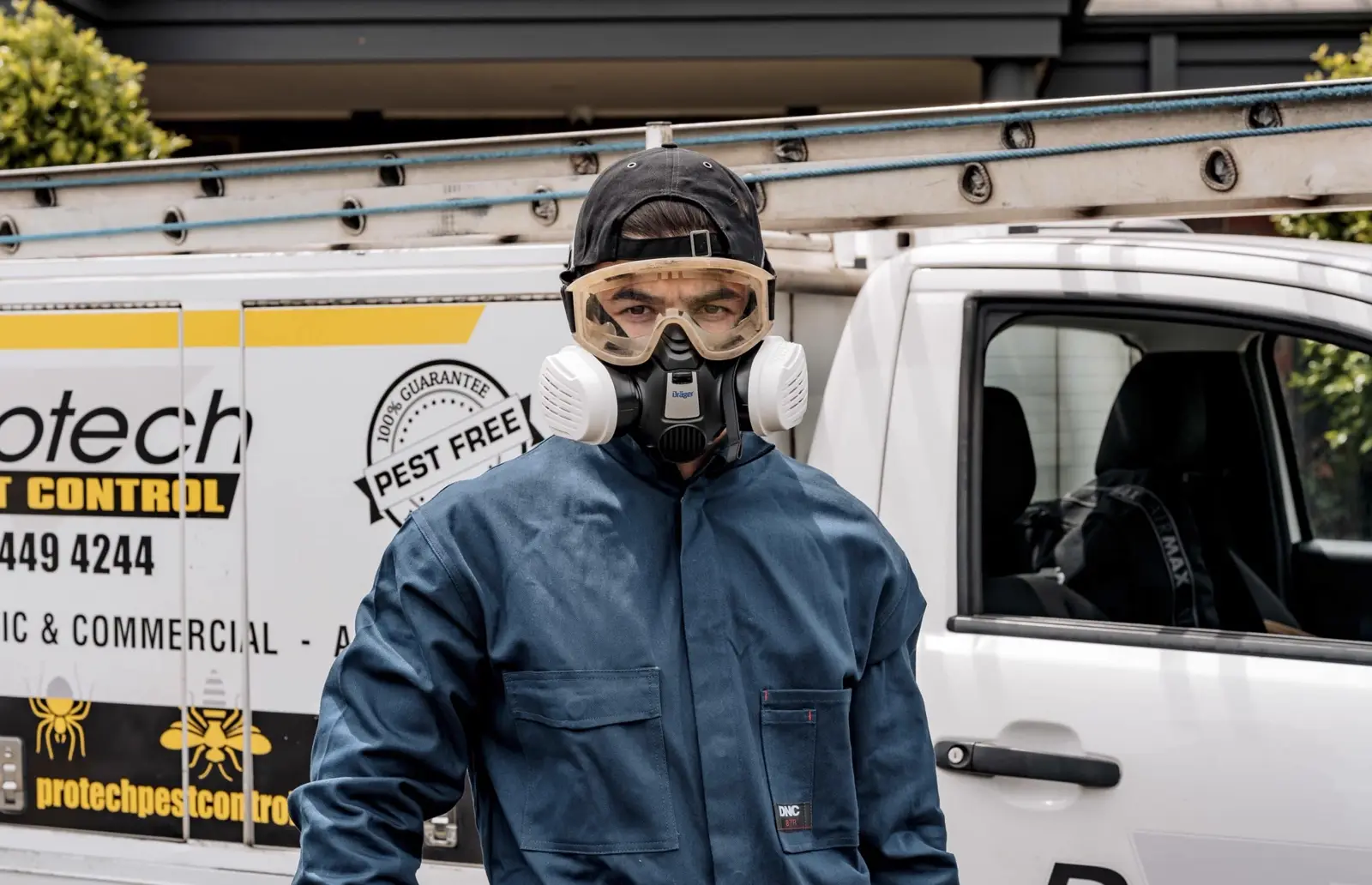
Why Choose Protech for Bed Bug Control in Melbourne?
Protech Pest Control has been serving Melbourne homes and businesses since 2001, with a team carrying more than 40 years of combined experience. We treat bed bugs properly — a full inspection that maps the true extent, then a targeted treatment of every harbourage it finds — for homes and commercial premises alike, including hotels, student accommodation and rental properties.
- Licensed, insured and accredited technicians (HACCP, NPMA, AEPMA)
- Targeted residual treatment of every mapped harbourage, still working as surviving eggs hatch
- Same-day inspection available across Melbourne
- APVMA-registered products, safe for use around children and pets to label
- Free, no-obligation quote with a fixed price before work starts
- Pest-free guarantee with free re-treatment inside the guarantee period
- 4.8★ from 411 Google reviews
How to Prevent Bed Bugs Coming Back
Bed bugs are almost impossible to shut out entirely, because the main introduction routes are everyday activities like travelling and buying furniture. A few consistent habits, most of them recommended by the Better Health Channel, make a real difference:
- When you travel, inspect the mattress seams, headboard and bed frame before unpacking, and keep your suitcase on a luggage rack rather than on the floor or bed.
- When you get home, unpack directly into the laundry and run clothes through a hot dryer cycle before putting them away.
- Inspect any second-hand mattress, bed frame or upholstered piece in good light before bringing it inside, checking seams, joints and undersides.
- Encase mattresses and bed bases in bed-bug-rated zippered covers, which remove the main harbourage and make any live bugs easy to spot on a plain surface.
- Reduce clutter around and under the bed so a small number of bugs cannot go unnoticed, and vacuum bedrooms regularly.
- In units and apartments, seal cracks and gaps around skirting boards, pipes and power points to slow movement between adjoining rooms.
If you would rather have the room inspected before it becomes a problem — after a move, a trip or a second-hand purchase — we can help. A building and pest inspection can pick up an early infestation, and our end of lease pest control covers tenants and property managers who need a treated, documented result before a handover.
What Bed Bug Treatment Costs in Melbourne
Bed bug treatments with Protech start from $297. The final figure depends on how many rooms are affected, how established the infestation is, and how much preparation the property needs. A single infested bedroom and a whole-house spread are very different jobs. We give you a fixed price after the inspection and before any work starts, so the number you agree to is the number you pay. Our full price list is published on our pest control prices in Melbourne page, alongside every other treatment we offer.
How the guarantee works on bed bugs
Bed bugs are one of the few treatments we do not put a fixed re-treatment window on, and the reason is worth explaining. Clearing them depends on the level of activity and on how thoroughly the property has been prepared. We quote bed bug work as a programme of visits matched to what the inspection finds, with the expected number of visits explained before you book. Most jobs are resolved without a routine follow-up. Where activity is heavy, a follow-up treatment forms part of that programme and is quoted with it, so nothing arrives as a surprise charge later. The full schedule of guarantee terms across every treatment we offer is published on our guarantee page.
Frequently Asked Questions
What is the most effective bed bug treatment in Melbourne?
The most reliable approach is a thorough inspection followed by a targeted residual treatment of every harbourage the technician maps. Bed bug eggs resist many insecticides, so the program is built around the hatch cycle: the residual application keeps working on the seams, cracks and joints as any remaining eggs hatch over the following days. Most jobs are resolved in the one treatment, and where the inspection finds a heavy infestation your technician may recommend a follow-up treatment. A single method on its own — a spray, a fogger, or discarding the mattress — rarely clears an established infestation, because the bugs hide well beyond the mattress in the bed frame, skirting boards and surrounding furniture. Our technician inspects and maps the full extent first, which is what lets one program succeed rather than the problem returning weeks later.
How much does bed bug control cost in Melbourne?
We give you a fixed price after the inspection, before any work begins. The cost depends on the size of the infestation, how many rooms are affected, and which treatment methods suit the job — a single lightly affected bedroom is a very different piece of work from a heavy multi-room infestation. Call us on 03 9449 4244 or request a free quote and we will arrange an inspection, most often the same day, and quote you a firm figure with no obligation.
Are bed bugs dangerous to my health?
Bed bugs are not known to transmit disease to people, a point confirmed by both healthdirect and the Better Health Channel. The genuine concerns are the secondary effects of an infestation: disrupted sleep, the skin infections that can follow from scratching bites, and, in rare cases, a severe allergic reaction in a sensitive person. The Better Health Channel also recognises the anxiety, stress and insomnia that a bed bug problem causes, which is a real harm worth taking seriously and a good reason to deal with an infestation early.
How do I know if I have bed bugs and not another insect?
Look for the combination of evidence rather than any single sign. Small rust-coloured blood spots on your sheets or pillowcase, dark faecal specks along the mattress seams and on the bed frame, translucent shed skins near the bed, and a faint sweet-musty odour in a heavily affected room point to bed bugs. If you find a live insect, a bed bug is flat and oval, roughly the size of an apple seed, brown turning rust-red after feeding, and wingless. Finding it in a mattress seam or bed joint rather than in the kitchen helps confirm it. If you are unsure, our inspection will identify exactly what you are dealing with.
Can I get rid of bed bugs myself?
Consumer sprays and dusts can knock numbers down but rarely clear an established infestation, because they cannot reach every harbourage and because bed bugs have developed resistance to some of the insecticides sold over the counter. Eggs cemented into a mattress seam or a crack in a timber bed frame survive contact-only treatments and restart the population within a few weeks. Throwing out the mattress on its own almost never works either, because the infestation is usually spread through the bed frame, furniture and room perimeter. A professional program — a full inspection that maps the true extent, then a targeted residual treatment of every harbourage that keeps working as surviving eggs hatch — is what clears them properly.
How should I prepare for a bed bug treatment?
Preparation directly affects how well the treatment penetrates. In general we ask you to strip the bed and wash all bedding and affected clothing at 60°C or hotter, then hot-tumble-dry it and seal it in bags until the job is done; declutter the room so the technician can reach every harbourage; vacuum the mattress, bed base and skirting and seal the vacuum contents in a bag; and avoid moving items into other rooms, which only spreads the problem. We give you a checklist specific to your treatment type when you book, and your technician will confirm the details.
Is it safe to stay in the home after treatment?
Yes. Once the treatment has dried and any brief re-entry period noted by your technician has passed, the treated rooms are safe to use as normal. We only use products registered with the APVMA and applied to label, and your technician will explain any short access restrictions during and immediately after the visit, including arrangements for children and pets.
Do you guarantee your bed bug treatments?
Yes. Our bed bug work is backed by a pest-free guarantee — if the infestation returns within the guarantee period, we come back and re-treat at no additional charge. We confirm the guarantee period in writing with your quote, so you know exactly what is covered before the work starts.
Client Testimonials
Great experience from beginning to end. The ladies on the phone were polite and efficient and Dwane did an amazing job. We have a baby at home and we were initially concerned about the chemicals. He was very knowledgeable and thorough in explaining the process and reassuring us. Excellent service all round at a very fair price.
– Richard KLearn More About Pest Solutions
Same-day service, eco-friendly treatments and a pest-free guarantee. Domestic & commercial — all Melbourne suburbs.