

Spiders in Melbourne
Identify Melbourne's most common species, understand which pose a genuine risk, and learn how professional treatment keeps them out.
Written by Muzi Tsolakis, Founder and Competency Assessor, Pest Management Victoria. Last reviewed 5 September 2026.
Melbourne sits in one of the most spider-diverse regions in Australia, and our technicians encounter a wide range of species on call-outs across the city — from redbacks under the letterbox to large huntsmen flat against the bedroom wall and black house spiders filling fence-rail gaps with thick, funnel-mouthed webs. Most of those encounters end quietly; the spider poses no meaningful risk, and the real issue is harbouring conditions that let numbers build to the point where webbing is visible everywhere and funnel traps start catching other invertebrates. This guide covers the species Protech most commonly treats in Melbourne homes: how to identify them, which ones carry genuine medical risk (and one that has been dramatically overstated), what the signs of a developing infestation look like, and how a professional treatment clears the problem and keeps it clear.
Melbourne's most common spiders — how to identify them
Redback spider (Latrodectus hasselti) — the one Melbourne residents are right to treat carefully. The female is the hazardous sex: shiny black body, roughly 10 millimetres long, with the distinctive red or orange stripe running down the upper abdomen. Males are much smaller and far less dangerous. Redbacks favour dry, sheltered spots close to human activity — behind the letterbox, under outdoor furniture, inside rarely moved pot plant saucers, in the corner of the garden shed. The Australian Museum's redback factsheet notes that the species has spread readily across the continent because disturbed suburban environments suit it well.
White-tailed spider (Lampona cylindrata and L. murina) — a slim, dark grey to black hunting spider, 12 to 20 millimetres long, recognisable by the clear white spot at the tip of the abdomen. White-tails are ground and foliage hunters rather than web-builders; they enter houses at night and are often found inside bedding, clothing left on the floor and between stacked items. They are frequently blamed for serious skin wounds, but a large monitored study of over 100 confirmed white-tail bites found no cases of ulceration, leading healthdirect to conclude that "current evidence suggests that white tail spider bites do not cause skin ulcers (necrotising arachnidism)." Bites cause local burning pain and swelling — unpleasant, but not the flesh-eating emergency that older accounts described.
Black house spider (Badumna insignis) — charcoal grey to black, with a velvety appearance, body length around 15 to 18 millimetres in the female. Builds the thick, irregular, funnel-mouthed webs that collect in the corners of window frames, around door architraves and along fences and retaining walls. The web's appearance — dark, messy, with a tubular retreat — is the clearest field mark. Bites are uncommon because the spider retreats when disturbed, and symptoms are generally mild.
Huntsman spider (family Sparassidae) — large, flat-bodied and long-legged, with a legspan that can reach 15 centimetres on some species, according to the Australian Museum. Grey to brown, often with a banded leg pattern; they do not build a capture web but hunt actively across bark, walls and ceilings. They enter houses readily and are the spider most likely to be found on a bedroom wall or behind a sun visor. Bites are rare and produce only minor local effects — the main concern is the startle response from finding one in a car.
Wolf spider (family Lycosidae) — the fast, hairy ground hunter of Melbourne lawns and garden beds, from one to eight centimetres across in camouflage patterns of brown, grey, yellow and black. Wolf spiders build no web at all: they hunt across open ground, often in daylight, and the female carries first her ball-shaped egg sac and then the hatched spiderlings on her back — the surest identifier in the family. The Australian Museum puts bite symptoms at the minor end, usually local pain or itchiness, with swelling, dizziness and nausea occurring less commonly. At night their eyes catch a torch beam, which is why a torch swept across a summer lawn picks out dozens of small bright points.
Mouse spider (genus Missulena) — a stocky, ground-dwelling spider with a characteristically high, rounded head and large jaws; body 10 to 35 millimetres. The Australian Museum notes that mouse spider venom is comparably toxic to funnel-web venom, and funnel-web antivenom has proven effective for serious mouse spider envenomation — which means the same first-aid protocol applies: pressure immobilisation and immediate medical assessment. Serious bites are rare, but this is one species where a cautious response is warranted.
Funnel-web spider (Hadronyche spp.) — the name most people associate with Sydney, though Victoria has its own species, the Victorian funnel-web (Hadronyche modesta). It lives in the moister forested country to Melbourne's east, through the Dandenong Ranges and the outer hills, sheltering in silk-lined burrows in damp soil and under logs rather than in typical suburban gardens, so most Melbourne households never come across one. It is a glossy dark brown to black spider with a stocky build and prominent downward-pointing fangs. Encounters and bites are uncommon, but the genus is medically significant and the Australian Museum advises treating any funnel-web bite as a potential emergency: apply a pressure immobilisation bandage and get the person to hospital straight away. Funnel-web antivenom is effective, and no deaths have been recorded from any funnel-web species since it became available in 1981.
Trapdoor spider — a stout brown to dark grey burrowing spider, and the one most often mistaken for a funnel-web around Melbourne, which is the usual reason we are called to identify one. Better Health Channel classes trapdoor spiders as not dangerous to humans, while noting that their fang size means a bite can be deep and painful with local swelling. Many Victorian species, including the Melbourne trapdoor spider (Stanwellia grisea), build an open silk-collared burrow with no lid at all, whatever the common name suggests. Females stay near the burrow for a life that can run 5 to 20 years, while males roam in autumn and early winter and are the ones that turn up indoors and in swimming pools.
Daddy-long-legs (Pholcus phalangioides) — the pale, almost translucent spider with extremely long thin legs that occupies ceiling corners throughout Melbourne homes. A popular myth claims it carries extraordinarily potent venom held in check only by fangs too small to pierce human skin; the Australian Museum addresses this directly: "there is no scientific evidence to back this up." It is harmless. Its habit of co-existing peacefully with humans and preying on other small invertebrates (including redbacks) has given it an unearned sinister reputation.
Common garden / orb-weaver (Eriophora spp.) — the large spiders that construct the dramatic wheel-shaped webs across garden openings each evening. Females reach 2 to 3 centimetres; the Australian Museum notes they are reluctant to bite, and that symptoms are usually negligible or mild local pain, numbness and swelling, with nausea and dizziness occurring only occasionally. They dismantle the web by dawn and rest in foliage during the day, so the overnight appearance of a large web is often alarming but the spider itself is rarely visible at daylight inspection.
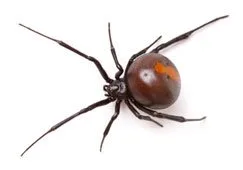
Melbourne spider identification at a glance
The table below condenses the species accounts above into the checks that settle most identifications: where the spider was, whether there was a web, and what it looked like. It reads best alongside the detail, because size overlaps between species and behaviour separates them more reliably than colour.
| Spider | Size | Where you meet it | Web | Bite |
|---|---|---|---|---|
| Redback | female ~10 mm | dry sheltered spots — letterbox, shed, outdoor furniture | messy tangle near the ground | medically significant — seek medical advice |
| White-tailed | 12–20 mm | indoors at night; bedding, clothes on the floor | none — hunter | burning pain and swelling; no ulcer evidence |
| Black house | 15–18 mm | window frames, architraves, fences | thick, funnel-mouthed, untidy | uncommon, generally mild |
| Huntsman | legspan to 15 cm | walls, ceilings, cars, under bark | none — hunter | rare, minor |
| Wolf spider | 1–8 cm | lawns, leaf litter, ground level; day or night | none — ground hunter | usually minor — local pain or itchiness |
| Mouse spider | 10–35 mm | burrows near waterways; males wander by day | burrow with trapdoors | treat as serious — pressure bandage, call 000 |
| Victorian funnel-web | stocky, glossy, dark | moist forested country east of Melbourne | silk-lined burrow | treat as an emergency — pressure bandage, call 000 |
| Trapdoor | stout, to ~35 mm | garden burrows; males roam autumn–winter | burrow, often with no lid | deep and painful but classed not dangerous |
| Daddy-long-legs | small body, very long legs | ceiling corners indoors | loose tangle | harmless |
| Garden orb-weaver | 2–3 cm | foliage by day; web spans garden gaps at night | large wheel web, rebuilt nightly | reluctant to bite; usually mild |
Two habits of thought keep the table honest in use. A spider that cannot be confidently identified, especially a stout dark one found at ground level, earns the cautious response — the pressure-bandage protocol and medical assessment — because the cost of over-caution is a wasted bandage and the cost of the reverse is much higher. And a web without a spider still identifies its builder: the wheel belongs to an orb-weaver, the untidy funnel-mouthed sheet in a window corner to a black house spider, the sticky tangle near the ground with debris in it to a redback.
Why spider numbers build up around Melbourne homes
Spiders do not seek out homes for warmth the way cockroaches or rodents do. They follow prey. A house or garden with an abundant supply of flies, moths, mosquitoes and other small insects is an attractive hunting ground, and once a few spiders establish webs and burrows in good positions, the concentration of prey draws more. Gardens with dense ground cover, timber retaining walls, stored materials along fences and exterior lighting that runs all night are the most common harbouring conditions we find on Melbourne properties.
Melbourne's climate plays a role too. Autumn is the peak period for spiders entering structures: maturing males of several species roam at ground level in search of females from late summer through autumn, which coincides with cooler nights pushing invertebrate activity toward sheltered spots close to buildings. The result is that spring cleaning often reveals an established spider population that built up quietly through the cooler months. Egg sacs compound the issue; a single female redback can produce multiple sacs in a season, each containing up to 250 eggs, which means a population in a sheltered corner of a shed can grow considerably before it is noticed.
Health risks: what the evidence actually says
The genuine medical risk from Melbourne spiders comes from a short list of species. Redback envenomation is the most common serious spider bite in Australia: the venom causes intense and progressive local pain, sweating localised to the bite site, nausea and, in significant cases, systemic effects. Antivenom is available, and according to the Australian Museum, no deaths have been recorded since antivenom was introduced. Healthdirect advises washing the bite with soap and water, applying a cold pack for 15 minutes, and seeking medical attention if symptoms are significant or worsening — ice alone is not sufficient if pain escalates.
The white-tailed spider myth deserves a clear statement because it still circulates widely. White-tail bites do not cause the flesh-eating wounds or necrotising skin lesions that were widely reported in the 1980s and 1990s. A monitored study of over 100 confirmed white-tail bites found not a single case of ulceration, and healthdirect now states plainly that "current evidence suggests that white tail spider bites do not cause skin ulcers." The genuine symptoms are a burning pain, swelling and occasional blistering — unpleasant, worth treating, but not a medical emergency in a healthy adult.
Mouse spiders warrant attention because their venom is potent. Although serious envenomation is uncommon, the first-aid protocol is the same as for funnel-web spiders: pressure immobilisation bandaging applied immediately and assessment at a hospital emergency department, because funnel-web antivenom covers mouse spider bites. Huntsmen, black house spiders, daddy-long-legs and garden orb-weavers pose little or no medical risk; bites from these species, if they occur at all, produce only localised minor symptoms.
Signs that spiders have established around your property
The most visible sign is webbing — but the type of web narrows down what you have. Thick, irregularly shaped, funnel-mouthed webs packed into corners, gaps in brickwork and around window frames are characteristic of the black house spider. Fine, tangled cobweb structures in dry, dark, sheltered spots near ground level — under garden furniture, in meter boxes, behind downpipes — point toward redbacks, and a close look will often reveal the glossy female in the retreat at the centre. Large circular orb webs appearing overnight across garden openings are the work of orb-weavers, while the absence of a web but frequent sightings of large spiders on walls and ceilings indicates huntsmen.
Beyond webbing, look for egg sacs: redback egg sacs are white, papery and round, clustered in the web retreat; black house spider sacs are small and pale and tucked into the funnel; orb-weavers produce soft, greenish sacs in sheltered spots among leaves. Finding multiple egg sacs is a reliable sign that a population is already established rather than a single wandering spider. Increased daytime sightings of nocturnal species — white-tails, redbacks — suggest numbers have grown to the point where the available hiding spots are crowded.
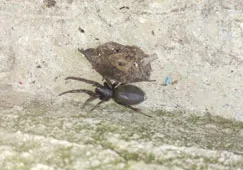
Reducing spider harbouring conditions around the home
Because spiders follow prey rather than seeking out human structures deliberately, reducing the insect population around the building is the most durable long-term measure. Yellow or warm-toned outdoor lighting draws significantly fewer flying insects than cool white LED globes, cutting the food supply available to web-building spiders along the eaves and around door frames overnight. Reducing standing water removes mosquito breeding sites and, in turn, one of the main prey items keeping populations fed.
Physical harbouring reduction complements the insect work. Clear stored items — timber piles, stacked plant pots, garden equipment, boxes in the garage — away from the external walls of the building, since these create the dry, sheltered microhabitats that redbacks and black house spiders favour. Trim vegetation back from the building so that ground-level foliage does not touch the wall and provide a bridging route indoors. Seal gaps around weep holes, cracks in renders and the points where pipes and cables pass through external walls, because these are the entry points that allow ground-hunting species like white-tails and mouse spiders inside at night. Inside, shake out clothing and shoes that have been on the floor, and check bedding before use during autumn when male spiders are actively roaming — this is the simplest way to avoid the accidental contact bites that most white-tail and redback injuries involve.
These measures are worth applying consistently, but they are not a substitute for treatment once webbing and egg sacs have already established across a property. You will find related prevention advice in our guides for other pest species in the pest library.
Why DIY sprays have limits with established spider populations
Consumer surface sprays have a genuine role against individual spiders on contact, but they perform less reliably against an established population spread across a property's eaves, sub-floor edges and garden perimeter. The core difficulty is that spiders pick up insecticide primarily through direct contact with their body, not through the tarsal pads on their leg tips the way crawling insects do — so a spray applied to a web or a nearby surface reaches the spider only if it walks through the treated area deliberately. Web-building species that stay in the retreat at the centre of the web can avoid the spray entirely.
Egg sacs are unaffected by surface sprays. A treatment that eliminates visible adults but leaves sacs in place will be followed by a new generation within weeks. Without professional web removal, the dead webbing also stays in place and continues to trap insects, providing food for new arrivals. The perimeter banding treatment a professional applies uses a longer-residual product at label rates and covers the eaves, subfloor vents, window reveals and garden perimeter zones that harbour populations beyond the reach of a consumer spray can — the combination of product choice, concentration and placement is what makes the difference between a short-term reduction and a durable result.
How Protech treats spiders
A standard spider treatment begins with a walk of the property — eaves, window frames, fence lines, garden edges, subfloor vents, garage interior and any stored material against external walls — to map where populations are established and identify the species involved. This step determines which areas need treatment, whether any harbourage conditions need addressing before the chemical work, and whether anything like a redback population in a subfloor or a shed justifies particular care.
The core of the treatment is a residual perimeter band applied to the external eaves, under-eave joints, weep holes, window and door reveals, the fence line and the garden perimeter to the depth that harbourage conditions warrant. Web removal accompanies the spray: removing existing webbing eliminates the prey-catching infrastructure and forces any surviving spiders to rebuild in the treated zone, which increases uptake of the residual chemical. Internal harbourage spots — garage racking, stored boxes, ceiling corners — are treated where necessary. Redback populations in subfloors or dense garden harbourage may require a more thorough internal treatment of those specific zones.
Our spider treatments are backed by a pest-free guarantee: if spiders return within the guarantee period we come back and re-treat at no extra charge. The guarantee period is confirmed in writing with your quote. Our team covers spider control across Melbourne for homes and commercial premises alike — if you are seeing redback webs, thick black house spider webbing across the eaves or multiple egg sacs in the garden, call our Melbourne team on 03 9449 4244 or request a free quote and we will arrange a visit, most often the same day.
Spiders in Melbourne FAQs
What are the most common spiders in Melbourne?
The spiders Melbourne households meet most are the black house spider in window frames and fences, the daddy-long-legs in ceiling corners, huntsman spiders on walls and in cars, wolf spiders across lawns and garden beds, white-tailed spiders hunting indoors at night, redbacks in dry sheltered spots like sheds and letterboxes, and the garden orb-weavers whose wheel webs appear across paths each evening. Ground burrowers — trapdoor spiders, and less commonly mouse spiders — turn up as wandering males in season. Of that list, the redback is the one with real medical significance, and any unidentified stout, dark, ground-dwelling spider deserves the cautious response.
Are white-tailed spiders really dangerous — do they cause flesh-eating wounds?
No. This is a well-documented myth that continues to circulate despite being thoroughly investigated. A monitored study of more than 100 confirmed white-tailed spider bites found not a single case of skin ulceration, and healthdirect now states plainly that current evidence does not support a link between white-tail bites and necrotising skin lesions. A white-tail bite causes local burning pain, swelling and occasionally blistering — unpleasant, and worth monitoring — but it is not a medical emergency in a healthy adult. If symptoms are severe or worsening, see a doctor.
Which Melbourne spiders are actually dangerous?
The two species that warrant genuine caution in Melbourne are the redback and the mouse spider. Redback bites cause progressive local pain, localised sweating, nausea and potentially systemic effects; antivenom is available and effective, and no fatalities have been recorded since its introduction. Mouse spider venom is comparably potent to funnel-web venom, and the same first-aid response applies: pressure immobilisation bandaging and immediate hospital assessment. Huntsmen, black house spiders, daddy-long-legs and garden orb-weavers pose little or no medical risk.
What should I do if I'm bitten by a redback?
Wash the bite area thoroughly with soap and water, apply a cold pack for 15 minutes to ease the pain, and see a doctor if symptoms are significant. Cold compresses alone are not sufficient if the pain escalates or spreads, or if you develop sweating, nausea or other systemic symptoms — these are signs that antivenom may be needed and you should attend an emergency department. Do not apply pressure immobilisation bandaging to a redback bite; that technique is correct for funnel-web and mouse spider bites, where it slows venom spread, but it can worsen pain in redback cases.
Are daddy-long-legs spiders actually venomous?
The popular claim that daddy-long-legs carry extraordinary venom held in check only by fangs too small to penetrate skin has no scientific basis, and the term people reach for — whether poisonous or venomous — does not change the answer. The Australian Museum states directly that there is no evidence to support it. Daddy-long-legs are harmless to humans and actually perform a minor service by preying on other small invertebrates, including redbacks, in ceiling corners.
Are there funnel-web spiders in Melbourne?
Yes, though not the Sydney funnel-web. Victoria has its own species, the Victorian funnel-web (Hadronyche modesta), which lives in the moister forested areas to Melbourne's east — through the Dandenong Ranges and the outer hills — rather than in suburban backyards, so most residents never encounter one. Bites are rare. The genus is still medically significant, so any funnel-web bite should be treated as an emergency: apply a pressure immobilisation bandage and get to hospital immediately. Funnel-web antivenom is effective, and there have been no deaths from a funnel-web bite anywhere in Australia since it became available in 1981.
How much does professional spider treatment cost in Melbourne?
We give a fixed price after the inspection, before any work begins, so there are no surprises after the job is done. The cost depends on the size of the property, the species involved, and how extensively the harbourage areas need to be treated — a standard treatment for a redback-free home with eaves webbing is a different scope from a property with established redback populations in the subfloor and garden. Call us on 03 9449 4244 or request a free quote and we will arrange a visit, most often the same day, to assess the situation and give you an accurate price.
Does a professional spider treatment include web removal?
Yes. Web removal is part of a professional treatment, not an add-on. Removing existing webbing eliminates the prey-catching structure that sustains the population and ensures that any surviving spiders must rebuild in zones treated with the residual product. Leaving webbing in place significantly reduces how well the treatment works, which is why it is included as standard.
Do you guarantee spider treatments?
Yes. Our spider treatments are backed by a pest-free guarantee. If the spiders return within the guarantee period, we come back and re-treat at no extra charge. The length of the guarantee period is confirmed in writing with your quote, so you know exactly what you are covered for before we begin.
Protecting Melbourne homes and businesses since 2001 — HACCP, AEPMA and NPMA accredited, rated 4.8★ from 411 Google reviews.



Sources and further reading
- Australian Museum — Redback Spider (Latrodectus hasselti)
- Australian Museum — White-tailed Spider
- Australian Museum — Huntsman Spiders
- Australian Museum — Mouse Spiders
- Australian Museum — Daddy-long-legs Spider
- Australian Museum — Funnel-web Spiders
- Australian Museum — Garden Orb-weaving Spiders
- healthdirect — Spider bites
- Australian Environmental Pest Managers Association (AEPMA)
Learn More About Pest Solutions
Same-day service, eco-friendly treatments and a pest-free guarantee. Domestic & commercial — all Melbourne suburbs.