

Huntsman Spiders in Melbourne
How to recognise them, why they appear on walls and behind sun visors, and why this large, fast spider is harmless to people.
Written by Muzi Tsolakis, Founder and Competency Assessor, Pest Management Victoria. Last reviewed 7 July 2026.
Of all the spiders we are called about in Melbourne, the huntsman generates the most alarm for the least genuine risk. It is large, it is fast, and it has a habit of appearing flat against a bedroom wall or darting out from behind a sun visor, which is enough to unsettle anyone. The reality is that this is a harmless spider doing useful work, and understanding it takes most of the fear out of the encounter. This guide covers how to identify a huntsman, how it lives and why it comes indoors, and the honest position on when a treatment is actually worth it. Our wider spiders guide sets the huntsman in context with the species that do carry a medical risk.
How to identify a huntsman spider
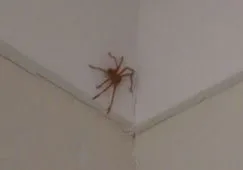
The huntsman is unmistakable once you have seen one: a large, flat-bodied spider with long legs held out to the sides in a low, crab-like posture that lets it move sideways across a surface at speed. The colouring is grey to brown, often mottled, with a banded pattern on the legs that helps it blend against bark. The Australian Museum gives a body length of around two centimetres for a female and a little less for a male, with a legspan reaching up to fifteen centimetres on the larger species.
That flattened shape is the key to the whole animal. It lets a body only two centimetres long slide into a gap the width of a coin, under loose bark, behind a picture frame or into the cavity behind wall linings. Huntsmen build no capture web, so you will never find one sitting in a snare; instead you meet it out in the open on a wall, a ceiling or a fence, which is exactly why an encounter feels so sudden.
How huntsman spiders live and hunt
Huntsmen are ambush and pursuit hunters that spend their lives on flat, vertical surfaces: the bark of eucalypts, timber fences, brick walls and the underside of eaves. Through the day the spider wedges itself into a crevice out of sight, and at night it comes out to hunt across those surfaces, catching insects with speed and strong front legs. Several Melbourne species live this way, and one, the social or flat huntsman, is unusual in sheltering communally under a single sheet of bark in loose family groups.
A female huntsman lays her eggs in a flat silk sac, which she often guards closely and, in some species, carries with her. A guarding female is the one situation where a huntsman may stand its ground rather than flee, so a spider that seems reluctant to move is usually protecting a sac nearby. Left alone, the whole life cycle plays out on the bark and walls around a property with very little overlap with the people living there.
Are huntsman spiders dangerous?
The plain answer is no. The huntsman is not considered dangerous to people, and its size and speed account for almost all of its reputation. It has no reason to bite a human and every reason to avoid one, so bites are genuinely uncommon and usually happen only when a spider is trapped against skin, most often a guarding female that has been cornered. The Australian Museum advises that a cold pack will relieve the local pain of a bite and that medical attention is only needed if symptoms persist, which is a measure of how minor the effect is.
Set against that small risk is a real benefit. Huntsmen are effective predators of cockroaches, moths and other insects, so a huntsman living around the outside of a house is steadily reducing the pests people are far more likely to want gone. We think it is worth being straight about that, because the fear a huntsman provokes is out of all proportion to what it actually does, and a single spider outdoors is better left to earn its keep.
Why huntsmen turn up indoors and in cars
A huntsman comes inside for the same two reasons it does anything: it is following insects, and it is looking for a tight, dark place to shelter during the day. Homes offer both, especially where outdoor lighting draws moths and other insects to the walls at night. Once inside, the spider settles behind a curtain, a wardrobe or a picture frame and is often only discovered when it moves. Sealing gaps around windows, doors and eaves, and using warm-toned outdoor globes that attract fewer insects, both reduce how often this happens.
The car is the classic case. A huntsman sheltering in the cabin, behind the sun visor, the door trim or the rear-view mirror, has usually been there unnoticed for some time before it chooses the worst possible moment to appear. It poses no danger to a driver beyond the startle, and the safe response is to pull over calmly and let it settle or guide it out, since swerving to a spider on the dashboard is the genuine hazard in that situation.
When a huntsman is worth treating, and when it is not
Our honest position is that a lone huntsman outdoors does not warrant a treatment. It is harmless, it is helping with the insects around your property, and removing it changes nothing for the better. The straightforward way to deal with a single spider indoors is to place a container over it, slide a card underneath and carry it outside, which avoids both a bite and the mess of a squashed spider the size of a hand.
A treatment becomes worthwhile in a few situations: when huntsmen are appearing indoors repeatedly, when there are enough of them that they have become a genuine source of stress in the home, or when their presence is a sign of a broader insect and spider population that is worth reducing anyway. In each of those cases the aim is to address the conditions drawing them in, and the spiders follow the food. That is where a professional treatment earns its place.
How Protech manages huntsman spiders
Where huntsmen are a persistent problem, our treatment concentrates on the insects and harbourage drawing them to the building rather than on chasing individual spiders. The technician walks the property to identify where they are sheltering and what is feeding them, then applies a residual band to the eaves, walls, window and door reveals, fence lines and the garden perimeter, and treats the crevices and stored materials that give the spiders daytime cover. Reducing the insect prey around the lights and walls removes the reason the huntsmen keep returning.
We will always tell you honestly if we think the spiders are better left alone, and we cover the wider spider control picture for homes and commercial premises across Melbourne, with every treatment backed by our pest-free guarantee. If huntsmen are coming indoors often enough to be a problem, an inspection will show what is drawing them and what will actually help. Call our Melbourne team on 03 9449 4244 or request a free quote, and we will arrange a visit, most often the same day.
Huntsman spider FAQs
Are huntsman spiders dangerous?
No. The huntsman is large and fast enough to give anyone a fright, but it is not dangerous to people. It has no capture web and no interest in humans, and bites are rare because the spider would far rather run than stand its ground. On the uncommon occasion one does bite, the Australian Museum notes only minor local pain that a cold pack will ease. There is no antivenom because none is needed.
How big do huntsman spiders get?
The body is modest at around two centimetres for a female and a little less for a male, but the legs are long and held out to the sides, so the legspan can reach up to fifteen centimetres on the larger species. That wide, flat profile lets the spider slip into narrow gaps under bark and behind wall linings, and it is also what makes a huntsman on the wall look far bigger than its body alone.
Why do huntsman spiders come inside and into cars?
Huntsmen are active hunters that live on flat surfaces such as tree bark, fences and walls, and they wander onto and into buildings while looking for insects and for a tight crevice to shelter in during the day. The same flat-bodied habit takes them behind sun visors, door trims and rear-view mirrors in cars, where they have usually been sheltering unseen before appearing at an inconvenient moment. The spider is not seeking people out; it is following prey and looking for a place to hide.
Are huntsman spiders good to have around?
In the garden and around the outside of the house, yes. Huntsmen are effective predators of cockroaches, moths and other insects, so a resident huntsman is quietly reducing the very pests people call us about. For that reason we take an honest view: a single huntsman outdoors is doing useful work and does not need treating. It is only when numbers build, or when they are repeatedly coming indoors, that a treatment is worth considering.
How do I get a huntsman out of the house safely?
The simplest and safest method is to place a container over the spider, slide a piece of card underneath to trap it, and carry it outside to release it near a tree or fence. Huntsmen move quickly but they are not aggressive, and this avoids both a bite and the mess of squashing a large spider. If huntsmen are appearing indoors regularly, that usually points to an insect population drawing them in, which a professional treatment can address.
Do you guarantee spider treatments?
Yes. Our spider treatments are backed by our pest-free guarantee. If spiders return within the guarantee period we come back and re-treat at no additional charge, and the length of that cover is confirmed in writing with your quote.
Protecting Melbourne homes and businesses since 2001 — HACCP, AEPMA and NPMA accredited, rated 4.8★ from 411 Google reviews.



Learn More About Pest Solutions
Same-day service, eco-friendly treatments and a pest-free guarantee. Domestic & commercial — all Melbourne suburbs.