

Possums in Melbourne Roofs
How to identify the brushtail and ringtail possum, why they enter roof voids, what Victorian law requires, and how our licensed team manages them humanely.
Written by Muzi Tsolakis, Founder and Competency Assessor, Pest Management Victoria. Last reviewed 18 June 2026.
The heavy thumping across a Melbourne ceiling after dark, the scratching at dusk or first light, the damp-fur odour drifting down from the roof space — for many householders these are the first signs that a possum has taken up residence overhead. Our team at Protech is called out to possum jobs across the city regularly, and the work is unlike any other pest call-out: possums are protected native wildlife under Victoria's Wildlife Act 1975, which means the lawful response is exclusion and proofing, not extermination or relocation to another site. This guide covers how to tell a brushtail possum apart from a ringtail, how to read the signs that one is living in your roof, the damage and health nuisance they can cause, and the correct, legal path to managing them — so you know exactly what to expect before picking up the phone.
How to identify Melbourne's two common possums
Two possum species account for the vast majority of roof-void calls in Melbourne: the common brushtail possum and the common ringtail possum. Telling them apart matters because they behave differently, produce different sounds and require slightly different exclusion approaches.
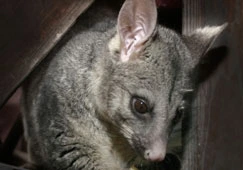
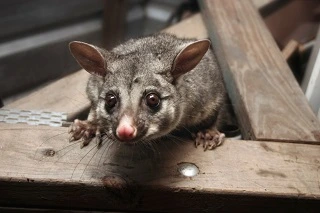
The common brushtail possum (Trichosurus vulpecula) is the larger of the two — body up to 55 cm long with a tail of up to 40 cm, as recorded in the Museums Victoria species record. It carries a thick, bushy tail with a black, prehensile tip, large pointed ears and silvery-grey to brown fur above with paler underparts. Its call is a distinctive deep guttural cough or hiss, sometimes a series of clicks. If you hear a noise overhead that sounds almost too large to be a cat, and it follows a slow, heavy, irregular path along the ceiling rather than the rapid-fire scurry of a rat, a brushtail possum is the most likely culprit.
The common ringtail possum (Pseudocheirus peregrinus) is noticeably smaller — body and tail each up to 38 cm, according to the Museums Victoria ringtail species record. It is grey-brown above with a creamy white belly, a distinctive white patch behind each eye, and a coiled tail with a prominent white tip occupying roughly the last quarter of its length. Its call is a soft, bird-like chirping, which often causes householders to search for a trapped bird rather than a possum. In Melbourne gardens, ringtails also build dreys — dome-shaped leaf nests in shrubs and dense foliage — but they will move into roof voids or wall cavities when hollow-branch habitat is scarce.
The Australian Museum notes that brushtail possums are the species most commonly found inside houses, largely because they are highly adaptable to urban environments and readily substitute a roof void for a tree hollow. Ringtails are encountered less often inside buildings but do appear, particularly in older homes with accessible eaves.
Why possums enter roof voids
Possums are natively hollow-dwellers. In bushland they occupy the hollows of old eucalypts, but Melbourne's urban landscape offers far fewer of these cavities than the animals need. A roof void is a ready substitute: it is warm, sheltered from rain, free from most predators and, for a brushtail, comfortably sized. A single animal or a mother with a joey can establish a regular occupancy within days of finding an entry point, returning to the same warm spot each morning after foraging through the night.
Entry is typically through a gap in the eaves, a lifted or cracked roof tile, a broken fascia board, an unscreened vent or the point where a downpipe or cable passes through the soffit. A brushtail possum needs an opening of roughly the diameter of a tennis ball to squeeze through; the smaller ringtail can fit through less. Overhanging tree branches and climbing plants give them aerial access to the roofline from the garden, so a branch touching a gutter is often the first link in the chain that ends with thumping overhead.
Brushtail possums are broadly solitary and territorial, so a roof void typically holds one adult or a mother and joey rather than a colony. Ringtails, unusually among Australian marsupials, are social animals often found in small family groups, meaning a single entry point can admit several animals over time.
The signs of a possum in the roof
The most reliable diagnostic sign is the sound profile. Possums are crepuscular and nocturnal — most active in the hour around dusk and dawn, and through the night — so the noise follows a predictable daily pattern. A brushtail produces a heavy, deliberate thump that moves along ceiling runs slowly, nothing like the quick light scratching of a rat. A ringtail is lighter-footed and faster, but still heavier and more deliberate than a rodent, with the chirping call as a giveaway.
Secondary signs include droppings in the roof cavity or at the base of the entry point — possum droppings are cylindrical, roughly 1–2 cm long and dark brown, larger than rat droppings and with a more fibrous plant-material texture. You may also notice urine staining on ceiling plaster (a yellowish-brown patch with a sharp ammonia-musk odour), scratch marks on the fascia or soffit near entry points, and worn fur-grease marks on the timber immediately inside the gap they are using. Dead give-away: the heavy pungent smell distinctive to a possum's scent-marking territory, quite unlike the musky odour of rodents.
Damage and health nuisance
Possums do not gnaw structural timbers or cabling the way rodents do, but their presence in a roof is far from harmless. The main practical concerns are urine and droppings accumulating over months of regular occupation. Possum urine soaks into roof insulation and ceiling plaster, producing persistent staining and an odour that can permeate the rooms below; in a heavily used roof void, the damage to insulation can be significant. Droppings and pooled urine also create conditions that attract blowflies and other insects.
From a health perspective, possum droppings can carry bacteria including Salmonella. The Victorian Government's Better Health Channel notes that salmonellosis is spread through contact with animal faeces, and good hygiene practice after any contact with animal droppings — including washing hands thoroughly and avoiding touching the face — applies here as it does with other animals. The practical risk in a sealed roof void is low as long as the space is not entered without care, but it rises if an animal dies inside and is not located promptly. A possum carcass in a ceiling void produces a strong, persistent odour that can last several weeks; locating and removing it promptly limits both the smell and the fly activity.
Possums are also territorial and will defend themselves if cornered — they carry sharp claws and teeth. An animal that feels trapped, such as one that has entered a living space through a ceiling access hatch, should never be handled without the right protective equipment. Call us and we will retrieve it safely.
What the law requires — the critical point
This is the section that matters most, and it is worth reading carefully before taking any action. Both the common brushtail possum and the common ringtail possum are protected wildlife under Victoria's Wildlife Act 1975. It is an offence to harm, kill or relocate a possum away from the property where it was captured. The law is unambiguous and the penalties are real.
The Victorian Government's official guidance on brushtail possum wildlife management methods sets out what is and is not permitted. For common brushtail possums living in buildings, a Governor in Council Order permits residents or licensed operators to use a cage trap — but only for the purpose of releasing the animal on the same property, within 50 metres of the capture site, after sunset on the day of capture. Transporting a possum to another street, suburb or bushland reserve is not relocation — it is an offence, and research has confirmed that possums released in unfamiliar territory are often attacked by resident animals and frequently do not survive.
For ringtail possums, the position is stricter: trapping without a specific permit is not permitted under the same GiC Order that covers brushtails. An Authority to Control Wildlife (ATCW) from DEECA is required, and approval is only granted after all practical non-lethal exclusion options have been exhausted.
The lawful, evidence-based approach for both species is therefore: proof the building to exclude the animal before or after it leaves to forage, and where a trap is used to capture a brushtail that cannot otherwise be excluded, release it on the same property with a nest box provided as an alternative to the roof void. This is exactly what our licensed team does. We do not offer, suggest or carry out any form of removal that conflicts with the Wildlife Act — and any operator who does is exposing themselves and their client to prosecution.
Keeping possums out — exclusion and proofing
Because relocation is not a solution, proofing the building against re-entry is the centrepiece of any effective and legal possum management program. The goal is to identify every entry point in use, seal all but one, and fit that remaining opening with a one-way exit device that allows the possum to leave for its nightly foraging but prevents it from returning. Once the animal has vacated, the final exit is sealed. This approach is non-lethal, does not require handling the possum, and complies fully with the Wildlife Act.
Practical proofing measures that property owners can take before or alongside a professional visit include trimming back any tree branches or climbing plants that contact the roofline — this removes the aerial access route and is often the single most effective deterrent. Replacing lifted or cracked tiles, repairing broken fascia and sealing service penetrations all eliminate the entry points possums are using. Wrap smooth metal sheeting or purpose-made possum guards around the lower trunk of garden trees you want to protect.
A nest box installed in a tree on the property gives the displaced possum an alternative hollow to occupy once it has been excluded from the roof. The Victorian Government recommends providing a nest box as part of the exclusion process, and we include this advice with every possum job. A possum with a suitable hollow nearby is far less likely to attempt to re-enter the building. You can find these and the other species guides in our pest library.
How Protech manages possums
Every possum call-out begins with a thorough inspection of the roof void, eaves, fascia and perimeter to map every entry point and establish which species is present. Knowing whether you have a brushtail or a ringtail determines the correct course of action under the Wildlife Act, and the inspection is what makes the rest of the job accurate rather than approximate.
For most jobs, the solution is a proofing program: we seal all entry points except one, fit a one-way exit device, and confirm the possum has vacated before closing the final opening. Where a brushtail possum is trapped to facilitate exclusion — for example where the roof configuration makes a one-way device impractical — we follow the statutory requirements precisely: the animal is released on the same property, within 50 metres of the capture point, after sunset on the day of capture. We provide advice on nest box placement to give it an alternative hollow, reducing the chance of it attempting to re-enter.
We also carry out dead possum retrieval where an animal has died inside a roof void — whether from natural causes, dog or cat attack, or secondary rodenticide exposure (possums can be killed by consuming poisoned rodents, which is another reason baiting programs near possum habitat need to be run carefully by a licensed operator). Retrieval, sanitisation of the affected area and a deodorising treatment are part of the service.
Our possum work is part of a broader suite of residential and commercial services across Melbourne. If you are unsure whether you have a possum, a rat or another animal in the roof, an inspection settles it — the treatment is completely different and getting it right at the start is the fastest path to a quiet ceiling. Call our Melbourne team on 03 9449 4244 or learn more about our possum removal service, and we will arrange a visit, most often the same day.
Possums in Melbourne Roofs FAQs
Are possums protected in Victoria?
Yes. Both the common brushtail possum and the common ringtail possum are protected under Victoria's Wildlife Act 1975. It is an offence to harm, kill or relocate a possum away from the property on which it was captured. The only lawful management path is humane exclusion — proofing the building against re-entry — and, where a brushtail is trapped, releasing it on the same property within 50 metres of the capture site after sunset on the day of capture. The Victorian Government's official guidance on brushtail possum management makes this clear, and Protech operates strictly within these requirements.
Can possums be relocated to another suburb or bushland?
No. Relocating a possum to an unfamiliar site is unlawful under the Wildlife Act 1975 and is also harmful to the animal. Research has shown that possums released in unfamiliar territory are frequently attacked by resident animals and often do not survive. The legal requirement for brushtail possums trapped in buildings is release on the same property, within 50 metres of the capture point, after sunset on the same day. For ringtail possums, a specific permit is required even for trapping; exclusion and proofing is the standard approach for that species.
How do I know if it is a possum in my roof and not rats?
The sound profile is the main clue. A possum produces a heavy, slow, deliberate thump that moves along ceiling runs in a way no rat does — rats make light, rapid scratching that darts quickly back and forth. A brushtail also makes a guttural cough or hiss; a ringtail makes a soft bird-like chirp. Possum activity peaks around dusk and dawn and through the night, following the same broad paths rather than the erratic movement of a rodent. Droppings also differ: possum droppings are larger (1–2 cm), cylindrical and fibrous from a plant diet; rat droppings are spindle-shaped and smaller. If you are unsure, an inspection confirms which animal is present and determines the correct response.
Can I trap a possum myself?
For common brushtail possums, a GiC Order under the Wildlife Act permits residents to use a cage trap, but only to release the animal on the same property within 50 metres and after sunset on the day of capture. Ringtail possums cannot be trapped without a specific permit. In practice, a licensed operator is the sensible choice: they carry the right equipment, know which species requires which authority, can safely handle the animal, and will seal the entry points to prevent re-entry — the part that determines whether the problem is actually solved.
Will a possum damage my home?
Possums do not gnaw wiring or structural timber the way rodents do, but months of regular occupation cause real damage. Urine soaks into insulation and ceiling plaster, producing staining and persistent odour. Droppings accumulate and attract insects. Entry points are often widened over time as the animal forces gaps. A possum carcass inside the roof produces a strong odour for several weeks. Addressing the entry points early — before the occupancy extends over a full season — limits the remediation needed.
How much does possum exclusion and proofing cost in Melbourne?
The cost depends on the size of the property, the number of entry points that need sealing, roof access conditions and whether retrieval or sanitisation is required. We give you a fixed price after the inspection, before any work begins, so there are no surprises. Call us on 03 9449 4244 or request a free quote and we will arrange a visit, most often the same day, to give you an accurate assessment.
Do you guarantee your possum proofing work?
Yes. Our possum exclusion and proofing work is backed by a pest-free guarantee. If possums re-enter the proofed areas within the guarantee period, we will return and rectify the issue at no extra charge. We will confirm the guarantee period in writing with your quote.
Protecting Melbourne homes and businesses since 2001 — HACCP, AEPMA and NPMA accredited, rated 4.8★ from 411 Google reviews.



Sources and further reading
- Victorian Government — Brushtail possum wildlife management methods
- Museums Victoria — Common Brushtail Possum (Trichosurus vulpecula)
- Museums Victoria — Common Ringtail Possum (Pseudocheirus peregrinus)
- The Australian Museum — Common Brushtail Possum
- Better Health Channel (Victoria) — Gastroenteritis: salmonellosis
Learn More About Pest Solutions
Same-day service, eco-friendly treatments and a pest-free guarantee. Domestic & commercial — all Melbourne suburbs.