

Moths in Melbourne
How to tell clothes moths from pantry moths, understand why larvae cause all the damage, and get the right treatment for your Melbourne home or business.
Written by Muzi Tsolakis, Founder and Competency Assessor, Pest Management Victoria. Last reviewed 18 June 2026.
The two moth problems we are called out to most in Melbourne are completely different animals — clothes moths in wardrobes and pantry moths in kitchens — and they need different treatment approaches. What they share is the one feature that surprises most people: it is the larvae, not the flying adults you see at night, that do every bit of the damage. A clothes moth adult lives only a few weeks and never feeds at all; a pantry moth adult cannot chew through packaging. Both species lay their eggs precisely where the larvae will have something to eat the moment they hatch, and an established population can run for months in a dark wardrobe or undisturbed pantry shelf before anyone notices. This guide covers how to identify each type, the signs they leave, what puts your home at risk, and how Protech's licensed team approaches treatment.
How to identify clothes moths
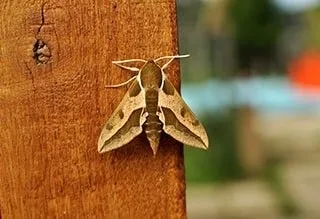
The two clothes moth species Protech encounters most in Melbourne are the case-making clothes moth (Tinea pellionella) and the webbing clothes moth (Tineola bisselliella). Both are small, pale golden insects — around 6 to 8 millimetres long as adults — and both are strongly photophobic, meaning they run for a dark fold of fabric the moment a light comes on rather than taking flight. The Australian Museum notes that adult clothes moths actively avoid light and prefer the darkness of a wardrobe or drawer, which is exactly why many infestations go undetected until the damage is already done.
The two species are easiest to tell apart by what the larva leaves behind. The case-making clothes moth larva carries an open-ended silk case as it feeds, dragging it from place to place and enlarging it as it grows. The webbing clothes moth larva, by contrast, does not carry a case but spins silken webbing directly across the fabric surface it is eating — a thin, sticky sheet that traps frass (droppings) and shed skins and is often the first visible sign of an infestation. In practice, the treatment approach for both is the same, so precise species-level ID matters less than confirming they are present.
Adults of both species are sometimes mistaken for grain moths or small flies, but the golden buff colour, the habit of running rather than flying, and the strong preference for dark undisturbed locations give them away. The brown house moth is a larger, darker species (bronze-brown with darker flecks) that also turns up in Melbourne properties; its larvae eat both textile fibres and stored food, making it something of a bridge between clothes moths and pantry moths.
How to identify pantry moths
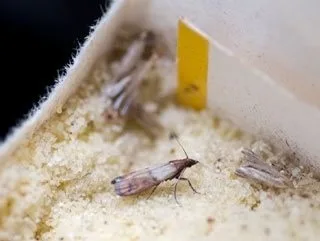
The pantry moth found in Melbourne kitchens is almost always the Indian meal moth (Plodia interpunctella), catalogued in the Atlas of Living Australia among Australia's established stored-product pests. Unlike clothes moths, the adult Indian meal moth is a recognisable insect once you know what to look for: its forewings are distinctively two-tone, pale grey or cream at the base and copper-brown or reddish-brown toward the tip. Adults are around 8 to 10 millimetres long, and unlike clothes moths they do fly at night — you will often spot them fluttering near kitchen lights or across the ceiling above the pantry.
The larva is the stage that matters. Indian meal moth larvae are creamy white with a darker head capsule, and they feed on a wide range of dry goods: flour, cereal, rice, oats, nuts, dried fruit, chocolate, birdseed, and pet food. As they feed they spin a characteristic fine silken webbing through the food, binding the contents of a packet together and making the infestation obvious once you break open a container. The larvae also migrate freely across shelving once a packet is breached, moving from one container to another and pupating in cracks around shelf edges, in the folds of packaging or in the corners of pantry walls. A single contaminated packet of flour brought home from a supermarket can introduce a breeding population in as little as a few weeks.
Pantry moth pupae are also found well away from the food itself — tucked into ceiling corners, behind kickboards and along the top edges of cupboard doors. Spotting pupae in those locations confirms the infestation has already progressed beyond a single food source and spread through the pantry.
Why larvae do all the damage
Understanding the lifecycle explains why clothes moth and pantry moth adults are almost irrelevant to the damage, and why killing the adult moths you can see does little to solve the problem. Adult moths of both groups have either vestigial or absent mouthparts as adults — they exist only to find a mate and lay eggs in the right location. A female webbing clothes moth lays between 40 and 50 eggs over two to three weeks, attaching them individually to fabric fibres with a sticky secretion. A female Indian meal moth can lay over 200 eggs directly onto food material.
Once the eggs hatch — within four to ten days in Melbourne's warmer months, or up to a month in cooler conditions — the larvae begin feeding immediately. The clothes moth larva feeds on keratin, the structural protein in natural fibres: wool, silk, cashmere, mohair, fur, feathers and leather. Synthetic fibres are largely untouched, though a larva will chew through a synthetic-blend fabric to reach the natural-fibre component underneath. The pantry moth larva has chewing mouthparts capable of cutting through thin plastic film and cardboard packaging, not just loose food.
The larval stage is also the longest part of the lifecycle. Depending on temperature and food quality, larvae can remain feeding for two to six months before pupating, and in a Melbourne wardrobe or pantry that is rarely disturbed they can complete multiple generations in a single year. This is why an infestation caught early — before the second generation is underway — is far quicker and cheaper to resolve than one that has been running unseen through an entire winter.
Signs of a moth infestation
For clothes moths, the first sign is usually irregular holes in natural-fibre garments — jagged and uneven, not the clean cuts of physical damage. These are most often found on the reverse of a garment or in areas that have been undisturbed: trouser legs folded at the back of a drawer, the underside of a jumper, beneath the seat cushion of an upholstered chair, or along the carpet edges where skirting boards meet the floor. Alongside the holes, look for silken webbing or larval cases on fabric surfaces, small sand-like frass deposits in shelf corners, and papery empty pupal cases in folds of clothing or carpet pile. Adult moths darting from a wardrobe when it is opened, or running across a wall near stored clothing, confirm breeding adults are present.
For pantry moths, the webbing spun through dry goods is usually the first visible indicator — a sticky, clumping texture inside a packet of flour, rice or cereal, sometimes with tiny cream larvae visible if the packet is inspected closely. Pupae cases in the corners of the pantry ceiling, behind the pantry door or along the top edge of shelving are a reliable indicator that the infestation has already spread beyond a single source. Seeing Indian meal moth adults flying at night near kitchen lights or across the ceiling above the pantry means a breeding population is established and eggs are being laid in the food stores. Adult moths seen during the day, particularly clinging to walls near the pantry, usually indicate numbers are already substantial.
In both cases, the damage and signs accumulate well before most householders investigate, because both species are at their most active in the dark and in the undisturbed parts of a room. A periodic inspection of stored clothing and dry goods — particularly after a long period without opening a wardrobe or a deep pantry shelf — catches problems early and limits the cost of treatment.
Health and property risks
Moths do not bite, and the adult stage of either species poses no direct health risk. The risks come from larval activity. For pantry moths, contaminated food — food containing larvae, eggs, frass or shed skins — is unfit to eat, and consuming it can cause gastrointestinal discomfort. The webbing woven through food also makes it impossible to pick out affected material and retain the rest; any food that shows webbing throughout should be discarded. In a commercial food business, a pantry moth infestation can trigger a compliance issue and mean the disposal of significant stock.
For clothes moths, the primary risk is property damage. Larvae feeding on wool carpets can leave bare patches that are costly to repair or replace; damage to high-value natural-fibre clothing — cashmere, vintage wool, silk, handwoven textiles — can be financially significant and irreversible on items that cannot be replaced. Feather pillows, down quilts and upholstered furniture stuffed with natural materials are also at risk.
The Better Health Channel (Victorian Government) notes that common indoor allergens include insect-related particles; fine shed larval skins and frass from an active infestation can contribute to the allergen load in an enclosed space and are worth considering for household members with sensitive airways. As with any active pest infestation, early treatment limits cumulative exposure and the extent of property damage.
The Australian Environmental Pest Managers Association (AEPMA) recommends that persistent or large-scale moth infestations be handled by a licensed technician, both to ensure the correct product is selected and to reduce the risk of re-infestation from untreated harbourage points.
How to keep moths out
Prevention for clothes moths and pantry moths draws on the same principle: remove the conditions that allow larvae to feed undisturbed. For clothes moths, the most effective single step is ensuring that all natural-fibre garments are washed or dry-cleaned before storage, because larvae are attracted to body oils, perspiration and food residues on fabric. Store cleaned garments in sealed airtight bags or cedar-lined boxes; cedar oil has a mild deterrent effect on adult moths looking for a laying site, though it will not eliminate an established infestation and loses effectiveness as the wood dries. Vacuum wool carpets and rugs regularly, paying particular attention to the edges along skirting boards and under furniture where larvae prefer to feed undisturbed. After vacuuming, remove and seal the vacuum bag, since moth eggs and larvae can survive inside it.
For pantry moths, transferring dry goods into hard-sided sealed containers — glass jars or rigid plastic canisters — on the day of purchase is the most reliable prevention step. Indian meal moth larvae can chew through thin plastic film, cardboard and foil-lined packaging and also enter through manufacturing seams; a sealed rigid container denies them access. Check older stock at the back of the pantry periodically, since a packet that has sat undisturbed for several months is a common source of a first infestation. When buying in bulk, inspect the packaging for any sign of webbing before bringing it inside.
Inspect any second-hand or donated textiles — rugs, upholstered items, vintage clothing — before bringing them into the home, since this is a common entry route for clothes moths. Freezing a garment or textile at or below -18°C for at least 72 hours kills both eggs and larvae and is a practical option for items that cannot be washed or dry-cleaned. For ongoing protection in older Melbourne homes with wool carpets and large fabric stores, an annual professional inspection is worth arranging — a trained technician can identify early-stage larval activity before a breeding population establishes.
You will find related prevention advice across our Melbourne Pest Library.
Why DIY control rarely solves an established infestation
Pheromone sticky traps — the product most often sold in supermarkets for clothes moths — are a monitoring tool, not a treatment. They attract and catch male moths only, which can help confirm whether a species is present, but they leave females and larvae entirely unaffected and do nothing about the eggs already laid in fabric. Seeing a full trap does not mean the infestation is worsening; it means males are still active. Seeing an empty trap does not mean the infestation has cleared; it may mean the males are already gone and the larvae are well into their feeding cycle.
Thorough treatment for an established infestation requires treating the surfaces larvae contact — not just the visible adults. For clothes moths that means treating inside wardrobes, the back and base of drawers, carpet edges, under furniture and along skirting boards with APVMA-registered products at the correct dilution. For pantry moths it means removing all affected food, treating shelf surfaces including cracks and joins, and deploying pheromone traps to monitor residual activity after treatment. Both require a level of inspection and product application that supermarket sprays — often applied to the wrong surfaces at an incorrect concentration — cannot reliably deliver.
A licensed technician working under AEPMA guidelines will also identify the harbourage points and sources a DIY approach misses: the untouched packet at the back of the pantry, the undisturbed rug in the spare room, the folded winter coat that has not been moved in two seasons. Without clearing those sources, a re-infestation from the same population is common within weeks of an incomplete treatment.
How Protech treats moth infestations
Every treatment starts with an inspection to confirm which species are present and where they are breeding — clothes moths and pantry moths require different product selection and application zones, so correct identification is the foundation of an effective program. The technician will examine wardrobes, drawers and carpet edges for clothes moth activity, and pantry shelving, food storage areas and ceiling corners for pantry moth signs, building a complete picture of where the infestation is established before any product is selected.
For clothes moths, we apply APVMA-registered residual sprays to the surfaces larvae contact: the inside of wardrobes and drawers (on the hard surfaces, not on clothing), carpet edges and skirting boards, and under the bases of beds and furniture. We will advise you on any preparation needed before the visit — for example, emptying shelving so surfaces can be treated fully — and give you a clear indication of the ventilation period before the areas are re-entered. For pantry moths, treatment involves removing all contaminated food, thoroughly treating shelf surfaces, joins and cracks, and placing pheromone monitoring traps to identify any residual adult activity in the weeks after treatment, which tells us whether a follow-up is needed.
Our moth treatments are backed by Protech's pest-free guarantee: if signs of activity return within the guarantee period, we come back to inspect and retreat at no extra charge. Most household moth infestations clear with a single treatment when the harbourage is correctly identified and treated; a follow-up visit may be recommended for larger or longer-established infestations. For the full range of services, visit our moth pest control page, or read about related pests in the Pest Library. To get a free, fixed-price quote, call our Melbourne team on 03 9449 4244 or request a quote online.
Moths in Melbourne FAQs
How do I know if I have clothes moths or pantry moths?
The location and type of damage tell you quickly. If you are finding holes in wool, silk, cashmere or natural-fibre carpet — particularly in undisturbed dark areas — and seeing small pale golden moths running from light in wardrobes, those are clothes moths. If you are finding silken webbing through dry goods in the pantry, larvae in flour or cereal, or pupae in pantry ceiling corners, and seeing two-tone brown-and-grey moths flying at night near kitchen lights, those are pantry moths (Indian meal moths). The two species occasionally overlap in older properties, but they are almost always confined to their respective areas. An inspection by a licensed technician confirms the species and maps the extent of the infestation.
Can moths damage synthetic fabric or carpets?
Clothes moth larvae feed specifically on keratin, the protein found in natural fibres. Pure synthetic fabrics — polyester, nylon, acrylic — are not a food source and are unlikely to be damaged. However, blended fabrics that contain wool or other natural fibres can be damaged even when the synthetic component is dominant, because larvae will chew through the blend to reach the natural-fibre portion. Wool-blend carpets, cotton-backed wool rugs and upholstery stuffed with natural materials are all at risk. Fully synthetic carpets are generally not damaged.
Is moth-infested food safe to eat?
Food that contains visible larvae, eggs, webbing or frass should be discarded. The food itself is not toxic, but consuming larvae or their waste carries a contamination risk and most people find it unacceptable. Even food that appears intact next to visibly infested packets should be transferred to sealed rigid containers while you arrange treatment, since Indian meal moth larvae migrate freely between packets on the same shelf.
Do pheromone moth traps work?
Pheromone sticky traps catch male moths only and function as a monitoring tool, not a treatment. They are useful for confirming whether a species is present and for tracking adult moth activity after a professional treatment. They will not reduce larval populations, eliminate eggs already laid in fabric or food, or stop females from continuing to breed. A full trap means males are present; it does not mean the infestation is larger or smaller than it was before the trap was placed.
How much does professional moth treatment cost in Melbourne?
The cost depends on the species, the extent of the infestation and the areas to be treated — a small pantry moth job in a single kitchen and a clothes moth infestation across multiple wardrobes and wool carpets are priced differently. We provide a free, fixed-price quote before any work begins. Call 03 9449 4244 or request a quote online to arrange a visit, usually available the same day.
Is the treatment safe around children and pets?
Yes. Protech uses APVMA-registered products that are formulated and applied to be safe in residential and commercial settings. We apply treatments to the surfaces larvae contact — cupboard interiors, carpet edges, skirting boards — and advise you on the short ventilation period before the treated areas are re-entered. The technician will discuss any specific precautions relevant to your household, including pets and young children, at the time of the visit.
Do you guarantee moth treatments?
Yes. Our moth treatments are backed by a pest-free guarantee. If signs of moth activity return within the guarantee period, we return to inspect and retreat at no extra charge. We confirm the length of the guarantee period in writing with the quote, so you know exactly what is covered before we begin.
Protecting Melbourne homes and businesses since 2001 — HACCP, AEPMA and NPMA accredited, rated 4.8★ from 411 Google reviews.


Sources and further reading
- The Australian Museum — Case-bearing Clothes Moth (Tinea pellionella)
- Atlas of Living Australia — Tineola bisselliella (Webbing Clothes Moth)
- Atlas of Living Australia — Plodia interpunctella (Indian Meal Moth)
- Better Health Channel (Victorian Government) — Asthma and Allergens
- Australian Environmental Pest Managers Association (AEPMA)
Learn More About Pest Solutions
Same-day service, eco-friendly treatments and a pest-free guarantee. Domestic & commercial — all Melbourne suburbs.