

Black House Spiders in Melbourne
How to recognise them, why their web is confused with a funnel-web's, and how our licensed team clears them from window frames and eaves.
Written by Muzi Tsolakis, Founder and Competency Assessor, Pest Management Victoria. Last reviewed 7 July 2026.
The black house spider is the one behind most of the messy, lacy webbing that gathers in the corners of window frames and along fences across Melbourne. It is a common, settled resident of suburban homes, and its funnel-shaped retreat is the single most frequent reason people ring us worried they have a funnel-web. The two are unrelated, and telling them apart is straightforward once you know what to look for. This guide covers how to identify the black house spider, its distinctive web, the truth about its bite, and how our technicians clear an established population. Our wider spiders guide sets it alongside the other species you are likely to meet.
How to identify a black house spider
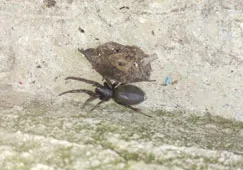
The black house spider, Badumna insignis, is a dark, robust spider. The Australian Museum describes grey hairs usually visible on the carapace, dark brown to black legs, and a charcoal grey abdomen marked with a pattern of paler spots on the upper surface, though that pattern can be faint. Females are noticeably larger than males, with a body length around fifteen to eighteen millimetres, and there is a fair range of sizes among adults.
You will most often see the spider sitting at the entrance of its funnel-shaped retreat, waiting for prey to touch the web, and it will disappear into the tube instantly if disturbed. A closely related species, the grey house spider, lives the same way and looks similar. Both are velvety and dark, and both are far more often identified by the web they build than by a clear look at the spider itself, since it spends most of its time hidden in the retreat.
The web, and why it is confused with a funnel-web
The black house spider builds a lacy, tangled web with one or more funnel-shaped entrances leading back to the retreat where the spider shelters. That funnel is exactly what causes the confusion, because people understandably assume a funnel-shaped web belongs to a funnel-web spider. The Australian Museum notes that this web is frequently mistaken for a funnel-web's, and the two spiders are not related at all.
The distinction is easy to hold once you know it. The black house spider spins its exposed, untidy web across the sunny surfaces of a building, on window frames, brickwork, fences and eaves, out in the open air. A funnel-web spider lives in a silk-lined burrow in damp ground, in moist forested country to the city's east, and would never be found spun across a window. If the web is out in the open on the wall of your house, it belongs to a black house spider, and it carries none of the risk a funnel-web would.
Where you find them around Melbourne homes
Black house spiders favour dry, sheltered surfaces with cracks and gaps to anchor a retreat, and the modern home offers those in abundance. The corners of window frames are the classic location, and their fondness for them earned the alternative name of window spider. Beyond that we find them in brickwork and weep holes, along fence rails and retaining walls, under eaves and gutters, and on rough-barked trees, which is their natural habitat away from buildings.
A large part of what draws them to a house is the lighting. Outdoor lights and lit windows pull in moths, beetles and other flying insects after dark, and the black house spider positions its web to intercept them, feeding on the very insects the lights attract. This is why the webs cluster around porch lights, windows and doorways, and why a property with plenty of night-time insect activity tends to build up a strong black house spider population over time.
Is the bite dangerous?
The black house spider is not considered dangerous to people. It is a timid animal that retreats into its funnel at the slightest disturbance, so bites are genuinely uncommon and usually only occur when a spider is pressed against skin. The Australian Museum notes that a bite can be quite painful and cause local swelling, and that occasional cases bring on symptoms such as nausea, sweating, headache or giddiness, but these pass and the spider poses minimal danger overall.
For first aid, a cold pack eases the local pain, and it is worth keeping the site clean as it heals. Seek medical advice if the symptoms are strong, if they spread, or if you are simply unsure, and the Victorian Poisons Information Centre is available at any hour on 13 11 26. For a healthy adult the bite is a painful nuisance and no more, which puts it a long way from the serious spiders it is sometimes mistaken for.
Why the webs keep coming back
Wiping away a black house spider web feels like dealing with the problem, and for that one spot it does. The reason the webbing returns is twofold. The egg sacs are tucked deep inside the funnel, where a broom or a household surface spray does not reach them, so a fresh generation hatches within weeks and rebuilds in the same favoured corners. And the insects around the outdoor lights keep arriving every night, giving each new spider a reason to set up in exactly the same place.
Reducing that insect supply is the most effective long-term measure. Warm-toned outdoor globes draw far fewer flying insects than cool white LEDs, which cuts the food available along the eaves and around the doors overnight. Clearing webs regularly helps discourage the spiders, and sealing gaps around windows and weep holes limits where they can anchor a retreat. On a property that is already producing egg sacs across the window frames and fences, these steps work best alongside a treatment that reaches the retreats and sacs directly.
How Protech treats black house spiders
Our treatment begins with a walk of the property to map where the black house spiders are established: the window frames, brick weep holes, eaves, fences and any rough surfaces near outdoor lighting. We apply a residual product to those harbourage zones and the surrounding surfaces, and we physically remove the webbing and the funnels so the population cannot simply carry on from where it was. Removing the webs also forces any surviving spiders to rebuild across the treated surfaces, which increases how much of the product they pick up.
Because the lights and their insects are what feed the population, we look at that side too and advise on reducing the prey that keeps drawing the spiders back. Our team covers spider control for homes and commercial premises across Melbourne, and every spider treatment is backed by our pest-free guarantee. If lacy webbing is building up across your window frames and eaves, an inspection will clear it properly and reduce what keeps it coming back. Call our Melbourne team on 03 9449 4244 or request a free quote, and we will arrange a visit, most often the same day.
Black house spider FAQs
Is the black house spider dangerous?
It is not considered dangerous to people. The black house spider is timid and retreats into its web at the first disturbance, so bites are uncommon. When a bite does happen it can be quite painful and cause local swelling, and occasionally symptoms such as nausea, sweating or a headache follow, but these settle and there is no antivenom because none is needed. A cold pack eases the pain, and medical advice is worth seeking only if symptoms are strong or you are concerned.
How do I tell a black house spider web from a funnel-web spider web?
The black house spider builds a lacy, messy web with one or more funnel-shaped entrances leading to its retreat, and that funnel is often mistaken for the burrow of a funnel-web spider. The two are unrelated. Black house spider webbing sits out in the open on window frames, brickwork, fences and eaves, and it looks untidy and tangled. Funnel-web spiders live in silk-lined burrows in the ground in moist forested country, not spun across a sunny window frame, so the location and the exposed lacy web are the giveaways.
What does a black house spider look like?
It is a dark, robust spider with grey hairs usually visible on the carapace, dark brown to black legs, and a charcoal grey abdomen marked with a pattern of paler spots on top. Females are noticeably larger than males, with a body around fifteen to eighteen millimetres. It is often found sitting at the mouth of its funnel-shaped retreat, and it will vanish into the tube the moment the web is touched.
Where do black house spiders live around the home?
They favour dry, sheltered surfaces with gaps to anchor a retreat. The classic spots are the corners of window frames, which is why they are sometimes called window spiders, along with brickwork and weep holes, fence rails, the underside of eaves, gutters and rough tree bark. Around houses they do well near outdoor lights, where they catch the moths, beetles and other insects drawn to the glow at night.
Why do black house spiders keep coming back after I clear the webs?
Clearing the visible web removes the spider's snare, but the egg sacs tucked into the funnel are unaffected by a quick wipe or a household spray, so a new generation hatches within weeks and rebuilds in the same spots. The insects around the outdoor lights keep drawing them back as well. A professional treatment reaches the retreats and sacs together and reduces the insect prey, which is what stops the cycle repeating.
Do you guarantee spider treatments?
Yes. Our spider treatments are backed by our pest-free guarantee. If spiders return within the guarantee period we come back and re-treat at no additional charge, and the length of that cover is confirmed in writing with your quote.
Protecting Melbourne homes and businesses since 2001 — HACCP, AEPMA and NPMA accredited, rated 4.8★ from 411 Google reviews.



Learn More About Pest Solutions
Same-day service, eco-friendly treatments and a pest-free guarantee. Domestic & commercial — all Melbourne suburbs.