
Restaurant & Café Pest Control
Food-safe, discreet, audit-ready pest management for Melbourne restaurants, cafés and food businesses — scheduled around your service and backed by our pest-free guarantee.
Restaurant & Café Pest Control Melbourne
Food-safe pest management that protects your kitchen and your rating
A cockroach on a table, a mouse in the dry store or a fly problem in the kitchen can cost a food business a review, a customer or its food-safety rating in a single night. Protech Pest Control gives Melbourne restaurants, cafés and food businesses the food-safe, discreet pest management they need to protect their produce, their customers and their reputation.
With over 40 years of combined industry experience and a company history going back to 2001, we understand how a commercial kitchen runs and what a food-safety auditor expects. Our tailored commercial pest control programs deliver real protection with minimal disruption to service. Venues that sit inside a broader hospitality group — hotels, pubs, clubs and function centres — are covered by our hospitality and food services pest control work.
To arrange a program for your venue, call Protech on 03 9449 4244.
Why food businesses attract pests
A commercial kitchen offers a pest everything it needs in one place: warmth, water, food debris, grease and dozens of hidden harbourages behind equipment. Deliveries can bring pests in with the stock, and the busy, warm environment lets a small problem build quickly between visits. Without a managed program, the risk is constant.
A single pest incident in a food business can lead to:
- Contamination of food, produce and preparation surfaces
- A failed food-safety audit or council inspection
- Poor reviews and damage to your reputation
- Health risks to customers and staff
- Spoilage and stock loss in dry stores and cool rooms
- Forced closure while a problem is brought under control
A managed program keeps a food business clean, compliant and protected through every service.
Pests We Manage in Restaurants & Cafés
Our technicians regularly manage and prevent cockroaches, rats and mice, flies, ants, stored-product pests, and the occasional bird or wasp issue — the pests that most threaten the hygiene, produce and food-safety rating of Melbourne restaurants, cafés and food businesses. Each one arrives by a different route and each one threatens a different part of the operation, which is why a kitchen program treats them as separate problems.
German cockroaches
The German cockroach is the species that dominates commercial kitchens, and it is the one most likely to cost a venue its rating. It is small enough to live inside equipment, and it favours the warm, humid voids around dishwasher motors, coffee machines, bain-maries, fridge compressors and the cavity behind a cooking line. A German cockroach population arrives in cardboard cartons, egg trays, produce crates and second-hand equipment, so a spotless kitchen can still receive one with a delivery.
The insects seen out on a bench during service are a small share of the population; the rest sits in voids that cleaning never reaches. That is why kitchen cockroach work centres on targeted gel baiting and monitoring in the harbourages themselves, supported by proofing of the gaps between and beneath units. Broad spraying across a food-handling area does very little to a population living inside a motor housing, and it puts product where it has no business being. Our full approach to the species is set out on our cockroach control page.
Rats and mice
Rodents reach a food venue through the back of house: a delivery door propped open through a busy afternoon, a gap under a roller door, a broken drain, a service penetration behind the dishwasher, or the shared wall of a neighbouring tenancy. Once inside they work the dry store and the bin area, gnawing through cardboard, plastic and packaging film to reach product.
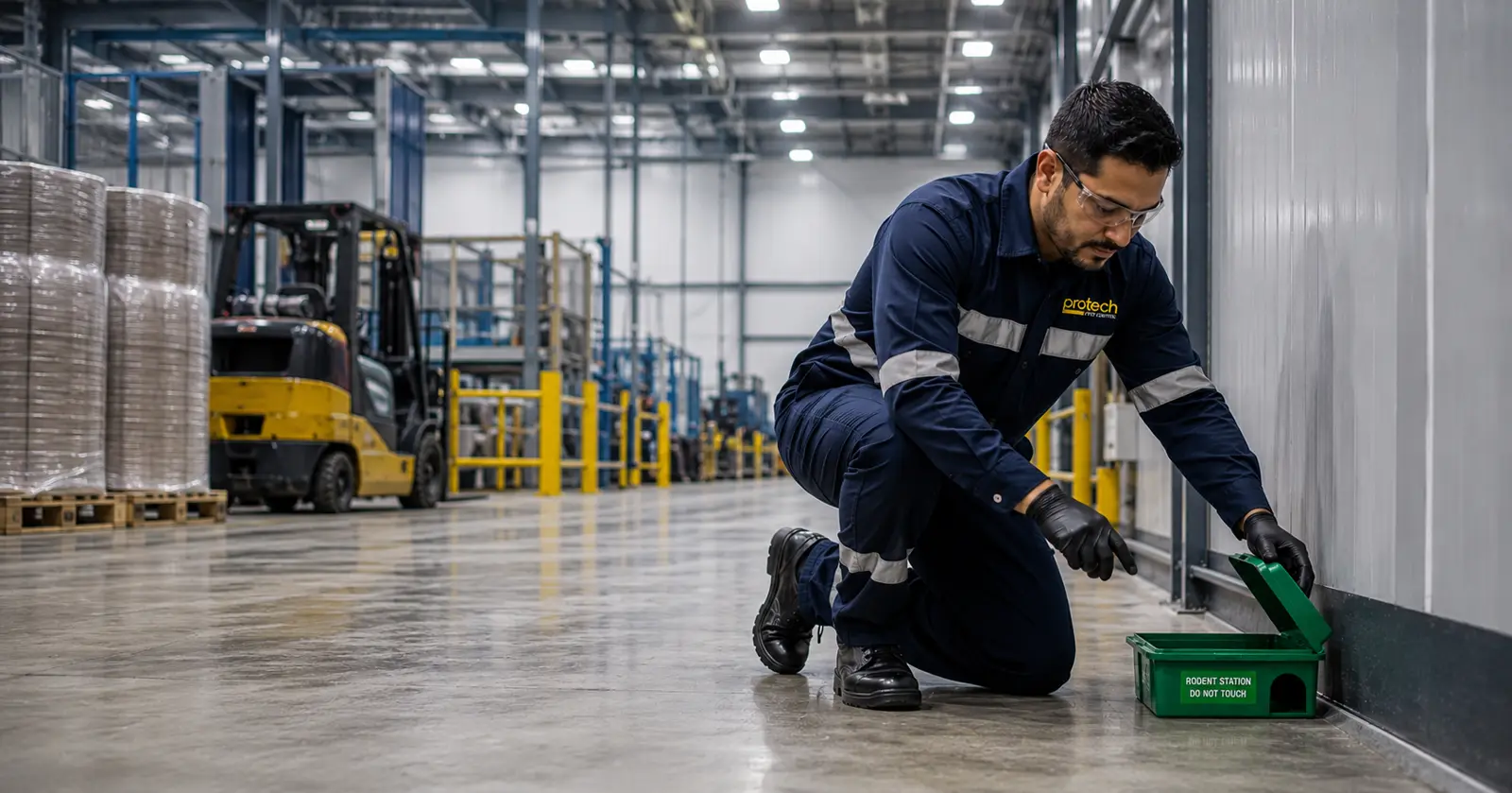
The damage runs past the stock they eat. Rodents contaminate far more than they consume, they gnaw cabling and insulation, and a single run of droppings on a dry-store shelf is enough to fail an inspection and force a stock write-off. Rodent work in a food venue combines secured, tamper-resistant baiting away from food-handling areas, monitoring at the entry points, and physical proofing of the gaps that let them in. See our rat and mouse control page for the detail.
Flies
Flies are the pest customers notice first, and there are two distinct problems behind them. House flies and blowflies come in from outside, drawn to bins, grease and open waste, and they move between the bin area and the prep bench carrying whatever they walked through on the way. Small flies — drain flies, fruit flies and vinegar flies — breed on site, in the organic film that builds inside floor wastes, drains, grease traps, mop sinks and under the beer taps at a bar.
Treating the adults on the wing achieves nothing while the breeding site is intact, so fly work starts by finding where they are developing. That means drain and floor-waste treatment, grease-trap servicing arrangements, waste-handling changes, screening and door management at entries, and fly units placed where they will catch without sitting over an exposed bench. Our fly control page covers the species and the methods.
Ants
Ants find a café faster than almost anywhere else, because a sugar station, a syrup pump, a coffee grinder and a sticky spill under a bench are exactly what a foraging trail is looking for. Colonies usually sit outside in garden beds, paving joints or wall cavities and send workers in along a fixed route, which is why spraying the visible trail clears the bench for a day and changes nothing underneath.
Ant work in a food venue identifies the species first, because the bait that clears one species is ignored by another, then treats the nest through that bait and proofs the entry route. Our ant control page sets out the species we deal with across Melbourne.
Stored-product pests
Weevils, flour beetles, sawtoothed grain beetles and pantry moths live in the dry goods themselves — flour, rice, grains, nuts, dried fruit, spices, pasta and pet-food stock in a venue that also serves animals. They frequently arrive already inside a bag from the supplier, then move into neighbouring product once the packaging is open.
The tell is usually webbing in the corner of a bulk bag, fine dust beneath a shelf, or small beetles walking the seam of a container. Managing them means locating and removing the infested lot, decanting bulk goods into sealed containers, tightening stock rotation so nothing sits at the back of a shelf for a year, and monitoring the dry store on the service schedule. For commercial sites where it can be done safely, fumigation is available for stored-product problems in a warehouse or bulk storage setting.
Birds and wasps
Outdoor dining, courtyards and rooftop terraces bring their own two problems. Birds gather where food is dropped and roost on the ledges and signage above a footpath area, fouling tables, umbrellas and the entry itself. Wasps become active through the warmer months around bins, drinks service and anywhere sweet waste collects, and a nest in a wall cavity or under an eave above a dining area is a genuine safety issue for staff and customers. Both are handled as part of the same program, with proofing and exclusion work for birds and located nest treatment for wasps.
We look where pests actually hide
In a food business, pests establish in the warm, greasy, hard-to-clean spots behind the line long before they are seen in the dining room. Our technicians inspect exactly those areas.
High-risk areas we assess include:
- Behind and beneath cooking lines and equipment
- Cool rooms, freezers and their motor housings
- Dry stores and stock shelving
- Dishwash areas, sinks and floor wastes
- Grease traps and drains
- Bars, serveries and coffee stations
- Bin rooms and external waste areas
- Wall voids, ceiling spaces and service penetrations
- Delivery and back-of-house entry points
Finding the risks early keeps a problem out of the dining room and off your food-safety report.
Why a Commercial Kitchen Is Harder to Protect Than Any Other Site
A kitchen is one of the few commercial environments that supplies every condition a pest population needs, continuously, in the same few square metres. Understanding why makes it clear why a food venue needs a managed program where a low-risk office might get by on a quarterly visit.
Constant heat
Cooking lines, ovens, dishwashers, fridge and freezer compressors and hot-water services keep the voids behind and beneath the equipment warm right through a Melbourne winter. German cockroaches breed continuously at those temperatures, so a population that would slow to nothing in an unheated storeroom keeps producing generations behind the line all year. Winter offers a kitchen no natural break in pest pressure.
Permanent moisture
Cooking vapour, washdown at close, condensation on cool-room panels, dripping taps, mop sinks and standing water in floor wastes all keep the back of house damp. Cockroaches need that water, drain flies breed directly in the film it leaves behind, and rodents will pick a site with reliable water over one without it. A dry kitchen is a much harder kitchen to infest, which is why our reports flag leaks and drainage faults as corrective actions alongside pest findings.
Food available around the clock
Even a venue that cleans down properly leaves food available overnight: debris in the seals of a bench refrigerator, grease in the gap behind a fryer, product residue in a floor waste, an open bulk bag in the dry store, and full bins in the waste area. Pests forage while the kitchen is closed and empty, which is the window the whole population uses.
Equipment that never moves
Most commercial kitchen equipment is heavy, plumbed, cabled or built in, and much of it has stayed in position since the fit-out. The 20 mm gap between two units, the cavity under a bench, the space behind a cool-room panel and the void inside a plinth are cleaned rarely if at all, and that is precisely where a cockroach population sits. Our inspections work those voids with a torch and a mirror, and part of the program is telling you which items should be pulled out at the next deep clean.
Deliveries every day
A food venue takes stock several times a week, and every carton, crate, pallet and egg tray arriving through the back door is a possible carrier. Cardboard in particular travels well with cockroach egg cases in the flutes. A venue can run a clean, well-managed kitchen and still be reinfested by a single delivery, which is why the delivery point is inspected on every visit and why we cover receiving practice with your team.
Short closing windows
A kitchen that closes at midnight and opens at six leaves very little time for anything that needs the space clear. Work in a food venue has to be planned around that window, and our scheduling is built accordingly.
Pest Management Built Around Your Venue
Every food business runs differently. We build each program around your kitchen, your menu, your trading hours and your food-safety obligations.
Our pest management services for restaurants and cafés include:
- Routine inspections and preventative treatments
- Integrated Pest Management (IPM) programs
- Cockroach management for kitchens and equipment voids
- Rodent monitoring, baiting and physical proofing
- Fly management and control at entries and waste areas
- Stored-product pest management in dry stores
- Drain and grease-trap treatment
- Digital reporting and HACCP-ready documentation
- Site-specific risk assessments and corrective action recommendations
For food-handling areas we favour targeted baiting, monitoring and proofing over broad spraying, and we time the more intensive work for after close so service is never affected.
Servicing a Venue That Trades Seven Days
The practical question every operator asks first is when we would actually be on site. For a food venue the answer is worked out with you before the program starts, and it is written into the service agreement so it is booked in advance and never negotiated at the door.
Setting the frequency
Frequency is set by risk. A high-volume kitchen, an older building, a tenancy sharing walls with other food operators or a site with a history of cockroach pressure sits on a shorter cycle than a small café with a limited menu. Most Melbourne restaurants and cafés run monthly or fortnightly, with the interval reviewed once we have a few visits of trend data showing what the site actually does between services. If the monitoring shows a site is quiet, we will tell you the cycle can stretch; if activity keeps appearing at the same point, we will tell you it needs tightening.
Working around service hours
Most of our food-venue work happens before opening, after close or on a quiet trading day. Early-morning attendance suits a dinner-only restaurant, a late visit after close suits a café that opens at six, and a venue with a single closed day usually gives us the cleanest run at the equipment voids. Out-of-hours attendance is planned into the agreement, so it is scheduled and costed up front.
Venues that never fully close
Function centres, seven-day pubs and venues with rolling breakfast-to-late-night service rarely have a genuine closed window. Those sites are serviced in stages: the dry store and bin area on one pass, the cooking line during the changeover lull, the bar after last drinks. Splitting a visit across zones keeps the whole site covered without ever taking a working area out of use during service.
Access, keys and alarms
Out-of-hours servicing works only if access does. We set the arrangements with your manager before the first visit — who lets the technician in, whether keys and alarm codes are held, which door is used and who is notified when the visit is complete. Every technician is licensed, insured and carries identification.
Between scheduled visits
Reactive callouts are part of a commercial agreement. We run 24/7 attendance including emergency callouts, and same-day service is normally available, which is what a venue needs when a customer reports a sighting during service or an inspector raises something on the spot. Every callout is documented in the same reporting system as a scheduled visit, so the record stays complete.
Audit-Ready Documentation, Every Single Visit
Food businesses have to demonstrate compliance with their food-safety obligations, and pest management is a core part of that. We build our programs to support your records as part of the service.
Every service visit generates a detailed digital report covering pest activity, treatment records, site observations and corrective action recommendations, ready for food-safety audits, council inspections and your HACCP file. We keep your full service history on hand so it is there when an auditor asks.
The documentation a venue receives covers:
- A service report for every visit, recording what was inspected, what was found and what was applied
- Treatment records naming the products used, the rates and the areas treated
- Safety data sheets for every product held or applied on site
- A site plan showing the location of every bait station and monitoring device
- A pest-activity trend log, so a rising or falling count can be seen over months
- Corrective action recommendations, with the maintenance and housekeeping items that need your team’s attention
Protech is HACCP, NPMA and AEPMA accredited, and the paperwork is structured so it drops straight into an audit folder. Our HACCP pest control page sets out exactly what an auditor receives, and our digital reporting page shows how the records are delivered and stored.
Front of House, Presentation and Discretion
A pest control visit in a hospitality venue is a customer-facing event whether anyone intends it to be. Diners draw conclusions from a marked vehicle at the front door, a technician in a public area during service, or a bait station visible under a banquette. Our servicing is planned so none of that is part of the experience.
Attendance is timed outside trading wherever the site allows it. Where a visit has to overlap with opening, technicians work back of house first, keeping equipment and paperwork out of public view. Where a visit must go unseen we attend when no customers are present and park in an area agreed with you. Monitoring devices in customer areas are placed discreetly and are tamper-resistant, sited under fixed joinery and along skirting runs where they do the job without being part of the room.
The same thinking applies to how a problem is reported. Findings go to your manager in the digital report, and anything urgent is raised directly with the person you nominate away from the floor. For outdoor dining, courtyard and terrace areas, bird proofing and wasp work are scheduled outside service hours so the seating is back in use before the next sitting.
What Your Team Can Do Between Visits
A scheduled program does the technical work, and the housekeeping between visits decides how much there is to do. These are the practices that make the biggest difference in a Melbourne food venue, and they are the ones our corrective action recommendations return to most often.
Waste handling
Keep bin lids closed and bins away from the building line where the layout allows it. Wash bins and the bin pad down regularly, because the residue on the ground under a bin feeds flies and draws rodents even when the bins themselves are clean. Get waste out of the kitchen at close so full bins are never left overnight, and check that the bin area gutter or drain is clear so wash water is not sitting there in the morning.
Drains, floor wastes and grease traps
Small flies breed in the organic film inside floor wastes, mop sinks and drain lines, so those need brushing out on the cleaning roster and not simply flushing with water. Keep grease traps serviced on the interval your council or trade waste agreement sets, and tell us if a servicing date has slipped, because a trap left too long becomes the single largest fly source on a site.
Checking deliveries
Give cartons, crates and pallets a look before they go into the dry store, especially cardboard and egg trays, and turn a bag over to check the seams and folds. Break down cardboard and remove it from the building the same day, because a stack of it in the bin area or a back corridor becomes harbourage within a week. Where a supplier repeatedly delivers product with activity in it, tell us, because we can note it in the report and it becomes evidence for the conversation with that supplier.
Storage and rotation
Decant bulk dry goods into sealed containers, keep stock off the floor and clear of the wall so shelving can be inspected and cleaned, and rotate properly so nothing sits at the back of a shelf for a year. Stored-product pests are found almost every time in the oldest bag on the site.
Doors, screens and gaps
The delivery door propped open through a warm afternoon is the most common entry route in a Melbourne food venue. Keep external doors closed when they are not in use, keep door seals and brush strips in repair, and report a damaged screen or a gap under a roller door as soon as it appears. A 10 mm gap under a back door is an open invitation to a mouse.
Cleaning where it is difficult
Build the awkward areas into the deep-clean roster: under and behind the cooking line, the plinths beneath benches, the fridge and cool-room seals, the cavity behind the dishwasher and the coffee machine drip area. Those are the harbourages, and cleaning them removes the food and moisture that a treatment cannot.
Reporting what staff see
Ask your team to report a sighting to the manager the day it happens, with where and when. A dated note of a cockroach seen near the dishwasher at close gives our technician a starting point on the next visit and goes into the trend record. Sightings that are never reported become the infestation nobody could explain.
Preparing for a Council Health Inspection
Melbourne food premises are inspected by their local council’s environmental health officers, and pest activity is one of the things an officer looks at closely. An inspection can be unannounced, so the useful preparation is the state the venue is in on an ordinary Tuesday.
Where officers commonly look:
- Dry stores and shelving, for droppings, gnawed packaging and stored-product activity
- Behind and beneath the cooking line and other fixed equipment
- Floor wastes, drains, dishwash areas and the mop sink
- The bin area, the bin pad and the external waste storage
- Door seals, screens, gaps under doors and service penetrations
- Cool rooms and fridge seals
- Fly units, bait stations and monitoring devices, and whether they are serviced and recorded
- Your pest management records themselves
Keep the current service reports somewhere they can be produced without hunting for them, along with the treatment records, the safety data sheets and the site plan. An officer who can see a documented, current program with corrective actions being closed out is looking at a very different premises from one where the answer is that somebody comes occasionally.
Close out the corrective actions in our reports, or tell us why an item has been left, and we will note it. An outstanding recommendation that has sat unaddressed across three service reports is a much harder thing to explain than one raised for the first time last week. If an officer does raise pest activity during a visit, call us on 03 9449 4244. We attend urgently, treat the problem, and issue a report documenting the response for your file and for the council.
Restaurant & Café Pest Control FAQs
Are your treatments safe to use in a commercial kitchen?
Yes. We select products and methods suited to food-handling areas and place them where they cannot contact food, surfaces or equipment, favouring targeted baiting, monitoring and proofing over broad spraying. Every technician is licensed and trained for food premises, and our work is backed by our pest-free guarantee.
Can you work around our service hours?
Yes. We build the program around your trading hours, timing inspections and treatments for early mornings, after close and quiet days so the kitchen and dining areas are clear when you are serving.
Do you provide documentation for food-safety audits?
Every visit generates a detailed digital report covering pest activity, treatments applied, site observations and corrective actions, formatted for food-safety audits, council inspections and your HACCP records. We keep your full service history on file so it is ready when an auditor asks.
What pests do you treat in restaurants and cafés?
We manage cockroaches, rats and mice, flies, ants, stored-product pests, and occasionally birds and wasps across kitchens, cool rooms, dry stores, bars, dining areas, bin stores and drains. We can run a preventative program or respond fast to an active problem.
How often should a restaurant or café be serviced?
Most Melbourne food venues sit on a monthly or fortnightly cycle, and a high-volume kitchen or a site with a history of cockroach pressure is often serviced more frequently again. The right interval depends on your menu, your volume, the age and layout of the premises and what your food-safety program requires. We assess the site, recommend a frequency that satisfies your obligations and lock it into a scheduled program so nothing is missed.
What does pest control cost for a restaurant or café?
Commercial work is quoted per site, because a 30-seat café and a multi-kitchen restaurant group carry very different scope. The quote depends on the size and layout of the premises, the pest pressure we find, the monitoring equipment the site needs and the service frequency your risk profile calls for. You receive a fixed quoted price before any work begins, and the quote itself is free. Our published pest control prices cover the residential and one-off services a hospitality operator also buys, such as a termite inspection.
What happens if we find a pest between scheduled visits?
Call us. Reactive callouts between scheduled services are part of a commercial agreement, and we run 24/7 attendance for the situations that cannot wait, such as a rodent sighting an hour before service or activity flagged during a council inspection. We attend, treat the problem, document the callout and adjust the program if the same risk keeps returning.
Protect Your Kitchen, Your Customers and Your Rating
Talk to Protech Pest Control about a documented, food-safe pest management program for your Melbourne restaurant or café. Call 03 9449 4244 or request a free quote — scheduled servicing around your trading hours, 24/7 attendance between visits, and audit-ready reporting from a HACCP, NPMA and AEPMA accredited team trusted since 2001.
Learn More About Pest Solutions
Same-day service, eco-friendly treatments and a pest-free guarantee. Domestic & commercial — all Melbourne suburbs.