
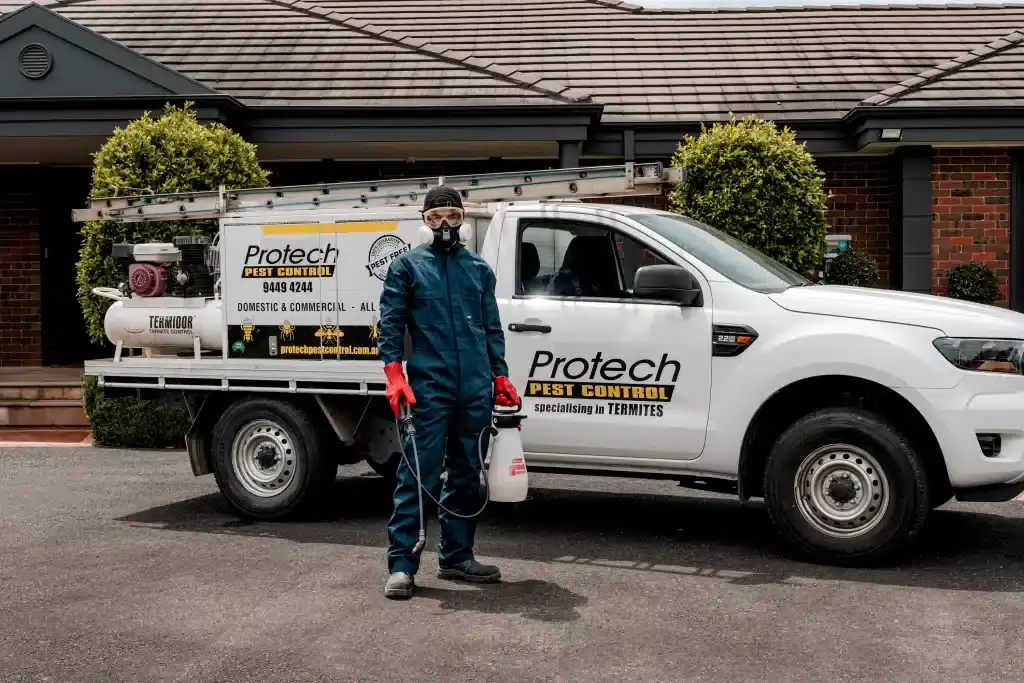
What a Commercial Kitchen Pest Program Involves
What gets serviced, what gets documented, and the structural reason one tenancy sometimes cannot be cleared on its own.
Written by Muzi Tsolakis, Founder and Competency Assessor, Pest Management Victoria. Last reviewed 5 August 2026.
For a food business, pest management is a compliance obligation with a commercial consequence attached. A single sighting during an inspection can mean a notice, a failed audit or a review that costs considerably more than the servicing would have. This is what a proper program covers, what the documentation needs to contain, and the one structural issue that decides whether a cockroach problem in a strip tenancy can be solved at all.
Setting the frequency
Frequency should follow the risk profile of the premises rather than a package. Most cafes and restaurants sit on monthly or fortnightly servicing. Busy kitchens handling fresh produce, meat and seafood often need fortnightly. Food manufacturing and processing sites can need weekly attendance. Low-risk offices and retail are frequently quarterly.
What sets it is what you handle, how much waste you generate, the condition and age of the building, whether you share structure with neighbouring tenancies, and what your certification or supply agreements require. We look at the premises first and then recommend, because a bakery, a seafood retailer and a bar carry genuinely different risks even on the same street.
The other input is your own obligations. Businesses supplying supermarkets or operating under HACCP or a supplier program are frequently required to hold a documented program at a specified frequency, and that requirement sets a floor regardless of what the premises would otherwise need.
What each service visit covers
A visit is an inspection as much as a treatment. We work through the areas where activity establishes and where an auditor will look: the kitchen line and behind and beneath equipment, kickboards and cupboard voids, dry and cool store rooms, dishwash and waste areas, staff amenities, ceiling spaces and service ducts where accessible, the loading area, and the external perimeter including the bin store and any rear laneway.
Rodent stations are checked, recorded and replenished to a documented plan, with each station numbered and mapped. Cockroach work is gel baiting placed into the harbourage behind and beneath equipment rather than a surface spray, because that is where the population lives. Fly control covers the breeding source, drains and waste rather than only the flying insects. Anything found is recorded, whether or not it needed treating on the day.
We attend before opening or after close for food premises, use targeted low-odour products around food-handling areas, and keep the work out of view of customers.
The documentation an audit asks for
This is where programs most often fall short, and it is the cheapest part to get right.
- A service report for every visit — what was inspected, what was found, what was done, and what needs attention from you.
- Treatment records — product used, where, at what rate, and by which licensed technician.
- Chemical safety data sheets for every product used on site, kept current.
- A site plan showing bait station locations and numbering, so any station can be located and checked.
- A pest activity log tracking findings visit by visit so trends over time are visible.
The activity log is the one most often missing, and it is the one that distinguishes a managed program from a series of attendances. It is also what lets us tell you that, for instance, activity at the rear of the building has been climbing for three visits, which is the point at which something structural is usually worth fixing.
The shared-wall problem, stated plainly
In a strip of adjoining tenancies — which describes a great deal of commercial food premises across Dandenong, Springvale, Bentleigh and every suburban shopping strip in Melbourne — the building behaves as one connected structure. Adjoining premises commonly share wall cavities, ceiling spaces, grease lines, plumbing runs and service ducts, and German cockroaches travel through all of them without ever crossing an external surface.
The consequence is that a well-run business can be treated properly, see a genuine improvement, and have the population return from the tenancy next door. That is not a treatment failure, and we will say so directly rather than let an operator conclude their money was wasted. What resolves it is a coordinated treatment across the affected tenancies, which usually means a conversation with the landlord, the centre management or the neighbouring operator.
The same logic applies to shared bin areas and rear laneways, which are the main rodent pressure point on any strip and are frequently used by several businesses, making them nobody's clear responsibility. A coordinated external baiting program across the tenancies is considerably more effective than one business treating alone.
Getting a program in place
We look at the premises, set a frequency against your risk and your compliance obligations, and put the documentation in place from the first visit. Our commercial pest control page covers the full service, with sector programs for hospitality and food venues, restaurants and cafes, factories and industrial sites, offices, healthcare and schools and childcare.
Multi-site operators get a single point of contact and consolidated reporting across every location, which is what makes audit time manageable. Call 03 9449 4244 or request a quote.
Protecting Melbourne homes and businesses since 2001 — HACCP, AEPMA and NPMA accredited, rated 4.8★ from 411 Google reviews.


Learn More About Pest Solutions
Same-day service, eco-friendly treatments and a pest-free guarantee. Domestic & commercial — all Melbourne suburbs.