
How to Get Rid of Termites
How to confirm what you have found, the one thing not to do, and the treatment that genuinely clears a termite colony in a Melbourne home.
Written by Muzi Tsolakis, Founder and Competency Assessor, Pest Management Victoria. Last reviewed 7 July 2026.
Termites deserve special care, because the instinctive reaction to finding them tends to make the problem worse. A colony can contain hundreds of thousands of workers quietly eating the structural timber of a house, and in Melbourne the culprit is almost always a subterranean species that nests in the soil and travels up into the building out of sight. When people find them, the urge is to spray the area or knock down the mud, and that urge causes real harm, because it scatters the colony and buys it time. This guide explains how to confirm what you have found, the one thing not to do, and the treatment that genuinely clears a termite problem.
Confirm it is termites
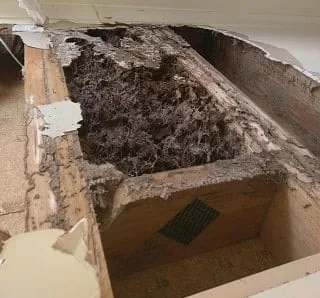
Before anything else, work out whether you are actually looking at termites. The clearest signs are pencil-thin to finger-width mud tubes running up brick, stumps, slab edges or subfloor timbers, timber that sounds hollow when tapped or gives way under light pressure, and, after warm humid evenings in spring and summer, small piles of shed wings near windows and doors where flying termites have swarmed.
Museums Victoria describes how the common subterranean termite travels through wood, under the ground and in the covered mud tunnels it builds above ground, which is why so much of the activity stays hidden. If you are finding small pellets of what looks like coarse sawdust, that points to a different situation covered in our guide to termite droppings and frass.
The one rule: do not disturb them
The single most important thing to do, once you suspect termites, is to leave them completely alone. Do not break open the mud tubes, do not pull apart the damaged timber to see how far it goes, and do not spray the area with insecticide from the shed. Subterranean termites react to disturbance by abandoning the galleries you have exposed and moving to feed elsewhere in the building, often somewhere you will not notice for months, which makes the eventual treatment harder and lets the damage spread.
Keeping the area untouched means a technician can find the active workings, identify the species and treat the colony where it is genuinely feeding.
Why home treatments fall short
Home approaches to termites tend to fail for a structural reason. A can of surface spray kills the handful of workers it contacts and warns the rest to relocate, and it never reaches the nest, which may sit metres away in the soil or inside a tree stump. Retail bait stakes pushed into the garden are a scaled-down version of a professional system and rarely hold enough active product, in the right places, to bring down a colony that is already inside a house. Termite control works at the level of the whole colony, and reaching it takes both the diagnosis and the products that are only available to a licensed operator.
The professional path that actually works
A proper termite job starts with a thorough building and pest inspection to find the extent of the activity and locate where the termites are entering. From there, treatment usually takes one of two forms.
A chemical soil treatment, often described as a termite barrier, places a treated zone in the soil around and under the building that termites carry back to the colony as they pass through it, working to eliminate the colony and protect the structure. A baiting and monitoring system installs stations that termites feed on and share through the colony, gradually collapsing it, with ongoing monitoring to catch new activity.
The right choice depends on the building, the soil and the situation, and our guide comparing barriers and baiting walks through how that decision is made.
What AS 3660 means for you
Termite management in Australia is governed by Australian Standard AS 3660, the national standard for termite management in and around buildings. It sets out how protection systems are to be designed, installed and maintained, and it is candid about their limits: a barrier reduces the risk of concealed entry, though no system stops termites being present on a property, which is why regular inspection is written into the standard as an ongoing requirement. A licensed technician treating your home works to AS 3660, and that is part of what separates professional termite work from a hardware-store attempt.
Prevention and ongoing inspections
Once a termite problem is treated, keeping the house protected is an ongoing job. Reduce the moisture and timber contact that draw termites in: fix leaking taps, downpipes and hot-water overflows, improve subfloor drainage and ventilation, keep garden beds, mulch and stored timber away from the walls, and make sure weep holes and slab edges stay clear and visible so any new mud tubes can be spotted.
Above all, book a professional inspection every twelve months, or more often on a high-risk property, because early detection is what keeps a fresh incursion from becoming major structural damage. If you have found termites, or you are simply due for a check, call our Melbourne team on 03 9449 4244 or request a free quote, and we will arrange an inspection. You can read more about our full termite treatment options at any time.
Termite FAQs
Can I get rid of termites myself?
Realistically, no. Home sprays and retail bait stakes reach only a few workers and warn the colony to relocate, and they never treat the nest, which can sit well away from the timber being eaten. Subterranean termites are managed at the level of the whole colony under Australian Standard AS 3660, and that takes a licensed technician with the diagnosis and the professional products to match. The most useful thing a homeowner can do is leave the termites undisturbed and book an inspection.
Do termites go away on their own?
No. A subterranean colony that has found the timber in a house has found a reliable food source and will keep feeding, often for years, until it is treated. Activity can appear to stop if the termites are disturbed, though that usually means they have moved to another part of the structure. Treating the colony is the only way to end the problem.
How much does termite treatment cost?
It depends on the property, the type and extent of the activity, and whether a chemical barrier or a baiting system suits the situation, so we quote each job after an inspection. We give you a clear, itemised quote for the recommended treatment before any work begins. Call 03 9449 4244 to arrange an inspection and quote.
How often should I have a termite inspection?
At least once every twelve months for most Melbourne homes, and more frequently for properties in high-risk areas or with a history of activity. Annual inspection is written into Australian Standard AS 3660 as part of ongoing termite management, because it is what catches a new incursion early, before it becomes costly structural damage.
What is the difference between a termite barrier and baiting?
A termite barrier is a treated zone placed in the soil around and under a building that termites pass through and carry back to the colony, protecting the structure from concealed entry. A baiting system uses stations of a material termites feed on and share through the colony, gradually collapsing it, with ongoing monitoring. The best fit depends on the building and soil; our barriers-versus-baiting guide explains how we choose.
Protecting Melbourne homes and businesses since 2001 — HACCP, AEPMA and NPMA accredited, rated 4.8★ from 411 Google reviews.



Learn More About Pest Solutions
Same-day service, eco-friendly treatments and a pest-free guarantee. Domestic & commercial — all Melbourne suburbs.